


The Horowitz Andreessen Academy
Yes, it’s real.
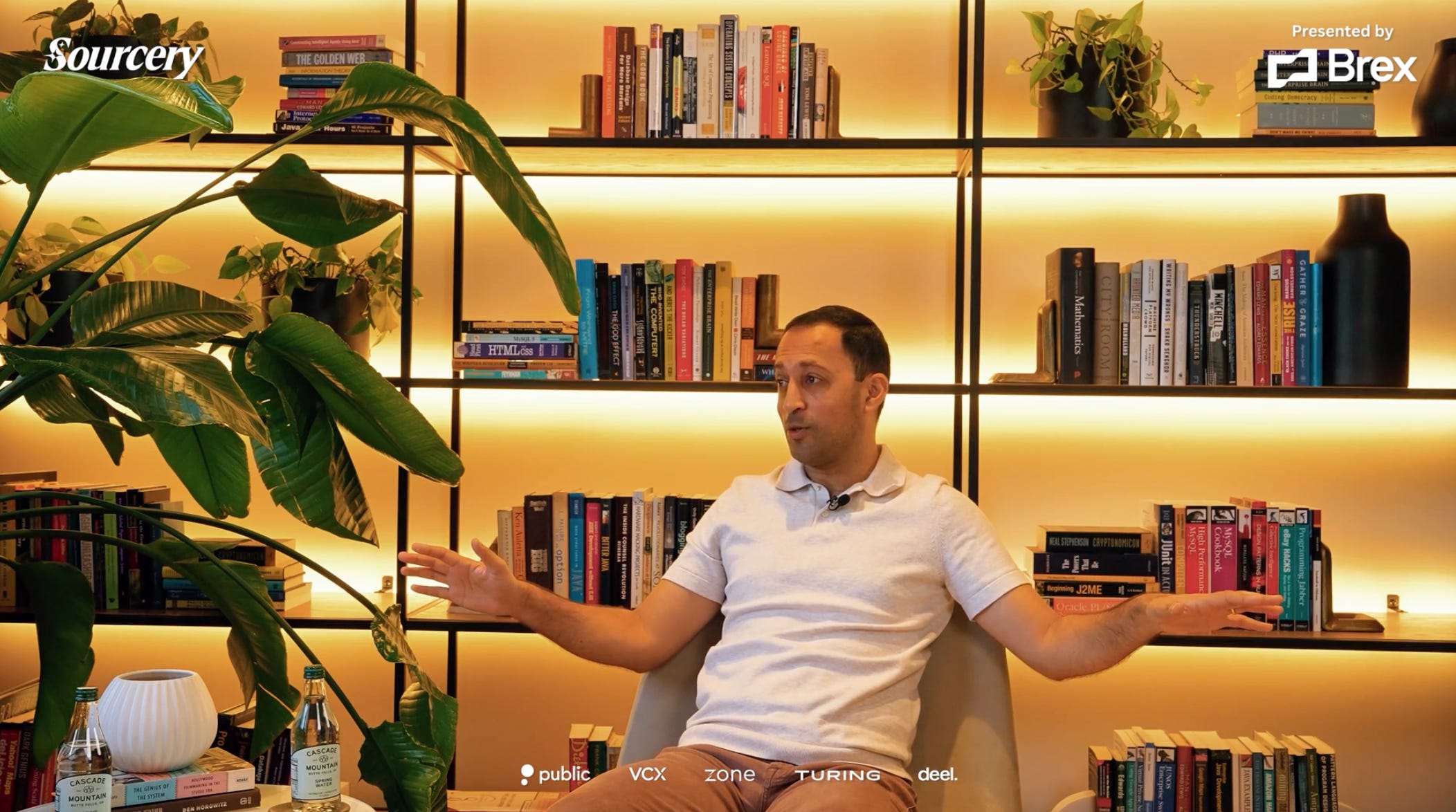
Gagan Biyani, Founder & CEO of Horowitz Andreessen Academy (fmr Co-Founder of Udemy + Maven), joins Sourcery from a16z’s San Francisco office to unveil a new kind of school built for the AI era.
→ Listen on X, Spotify, YouTube, Apple
Backed with $42M from a16z and investors including Adam D’Angelo, Tobi Lütke, Tony Xu, Fidji Simo and Shyam Sankar, Horowitz Andreessen Academy is an AI-native, unaccredited residential program designed for some of the world’s most ambitious young builders.
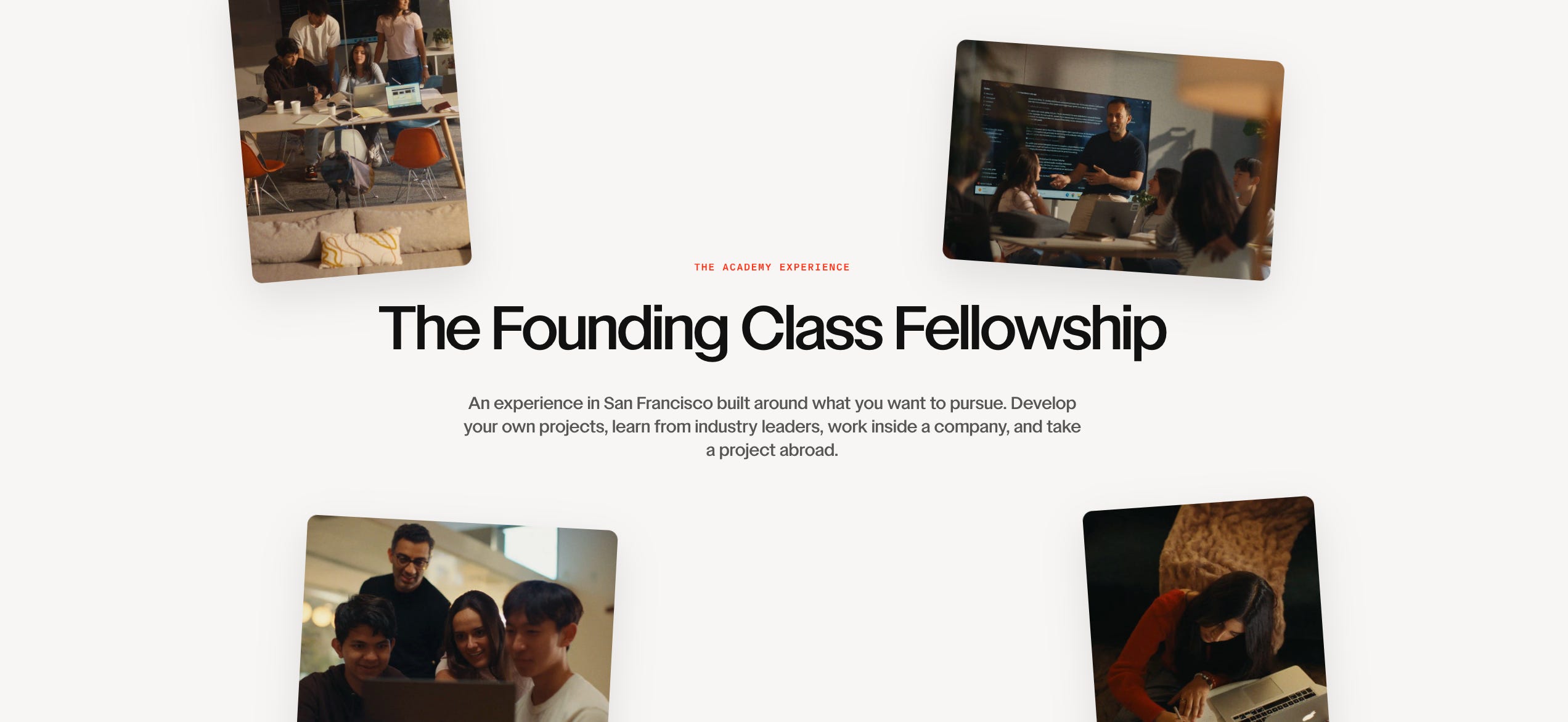
Its Founding Class will bring roughly 50 students to San Francisco in Fall 2027 for a one-year, tuition-free fellowship. Instead of optimizing for grades, tests and credits, the Academy plans to optimize for proof of work, high agency and building real projects.
Students will learn alongside a network that includes founding partners Anthropic, Anduril, Coinbase, Meta, NVIDIA, OpenAI, Palantir, Replit and Stripe, with 75–80% of their time intended for projects and building.
Gagan and I discuss why AI is forcing education to change, why he believes traditional college still makes sense for most students, the rise of the “super IC,” why young founders shouldn’t rush to raise venture capital, what it means to become an AI-native builder, the importance of failure, and why Silicon Valley itself is central to the Academy’s model.
𝐓𝐈𝐌𝐄𝐒𝐓𝐀𝐌𝐏𝐒
(00:00) Gagan Biyani, Founder & CEO of Horowitz Andreessen Academy
(01:01) Why this Academy is different from college
(04:44) Started his first company at age 13
(08:30) Building a school for Silicon Valley
(11:55) Raising $40M for a School
(14:06) "You Did What?" - Proof of work over grades
(19:08) Should young builders really start companies?
(22:37) Why this is different from YC and fellowships
(27:35) The Academy is for young builders
(31:33) Why schools need to embrace AI
(37:18) How AI is changing education
(44:17) What an AI-native curriculum looks like
(48:51) Why high-agency students struggle in college
(53:12) Why the best builders zigzag
(1:02:19) Why you should apply even if you don't get in
(1:04:36) Building a supportive environment for young builders
(1:08:54) What the Academy program looks like
(1:10:44) Why the Academy is in San Francisco
(1:11:19) The people who shaped Gagan
(1:14:41) Favorite book!
Brought to you by:
Brex—The intelligent finance platform: cards, expenses, travel, bill pay, banking—wrapped into a high-performance stack. Built for scale. Trusted by OpenAI, Anthropic, Vercel, Granola, Deepgram, & Sourcery.. teams that move fast AF. visit → brex.com/sourcery

Zone—develops next-generation data center campuses, partnering with AI companies, site developers and technology leaders to bring compute online faster and at scale. Visit: zonefrontier.com
Turing—Turing partners with frontier AI labs to improve model capabilities in coding, reasoning, tool use, & multimodality, as well as with Fortune 500 enterprises to build & deploy end-to-end agentic AI systems in mission-critical workflows Visit: turing.com/sourcery
VCX—VCX is the public ticker for private tech, allowing investors of all sizes to invest in venture capital. View The Portfolio at GetVCX.com
Deel—Deel is the global people platform that helps startups hire, manage, pay, and equip anyone, anywhere. Trusted by more than 35,000 fast-growing companies, Deel is the people platform that just works, so teams can scale without the chaos. Visit: deel.com/sourcery
Public-–Investing platform Public just launched Generated Assets, which lets you turn any idea into an investable index with AI. With Generated Assets, you can build, backtest, refine, and invest in any thesis with AI. Gone are the days of one-size-fits-all ETFs. Try it today: public.com/sourcery
The Horowitz Andreessen Academy, a16z’s $42M School for Builders
a16z Incubated the Academy & Backed with $42M
The Horowitz Andreessen Academy launched today in San Francisco. The Academy is a private, residential program in San Francisco for the world’s most ambitious young builders coming out of high school, 100% focused on the startup, tech, and leadership skills that students need to start their own venture or immediately join a fast-growing tech company. It’s the first elite institution built from the ground up for young builders, by the people who built Silicon Valley.

The Academy has raised $42 million from a16z and a group of individual investors, including Adam D’Angelo, Tobi Lütke, Tony Xu, Fidji Simo, Garry Tan, Joe Liemandt and Shyam Sankar. The raise covers several years of runway, with the goal of building one of the strongest, most enduring education companies for technology founders and operators.
“Instead of raising for 18 months, we raised for a few years. This was very intentional because there’s a big difference between starting a school and starting an AI app. And one of the biggest differences is you need longevity.”
The Founding Class Fellowship Is 50 Students, One Year and Tuition-Free
Applications for the Founding Class Fellowship opened today for the inaugural class, starting Fall 2027. The cohort will be roughly 50 students, the program runs one year, and will be tuition-free. The Academy will be built in San Francisco, the epicenter of innovation.
“Today we’re announcing the Founding Class Fellowship. It’s a one-year program, and it does not have tuition.”
A two-year program is targeted for 2028, pending regulatory approval, at tuition levels comparable to elite private universities. The Academy is a new kind of institution built specifically for the AI era, and accreditation works differently for a program like this than it does for a traditional university, and The Academy does not grant a degree. Students leave the Academy with something more valuable than a traditional diploma: a portfolio of real work, a network of operators and investors, and hands-on experience at some of the best companies in technology.
“The goal of this program is to build a high-value institution, not an elite institution, that delivers so much value that the students think it’s absolutely worth that tuition.”
Early cohorts will be small, but longer-term, class sizes are likely to grow.
Who the Academy Is Built For
The Academy is designed primarily for high school graduates who would otherwise attend a four-year university. Students will be chosen entirely on proof of work—what they have built, shipped, or earned—not grades, essays, or legacy. Eligibility is for high school graduates ages 16 to 22, who would otherwise attend a four-year university. Transfers and international applicants are accepted, with priority given to graduating high school seniors. Year one can function as a gap year or a deferral.
“It’s young people who are constantly feeling the itch to go and produce things.”
College remains the right choice for most students, and The Academy is not built to replace it. The Academy is for a specific kind of student: someone who already knows how to build and wants to spend the next year doing it at full speed alongside investors, operators, and the companies building the technology they want to work in.
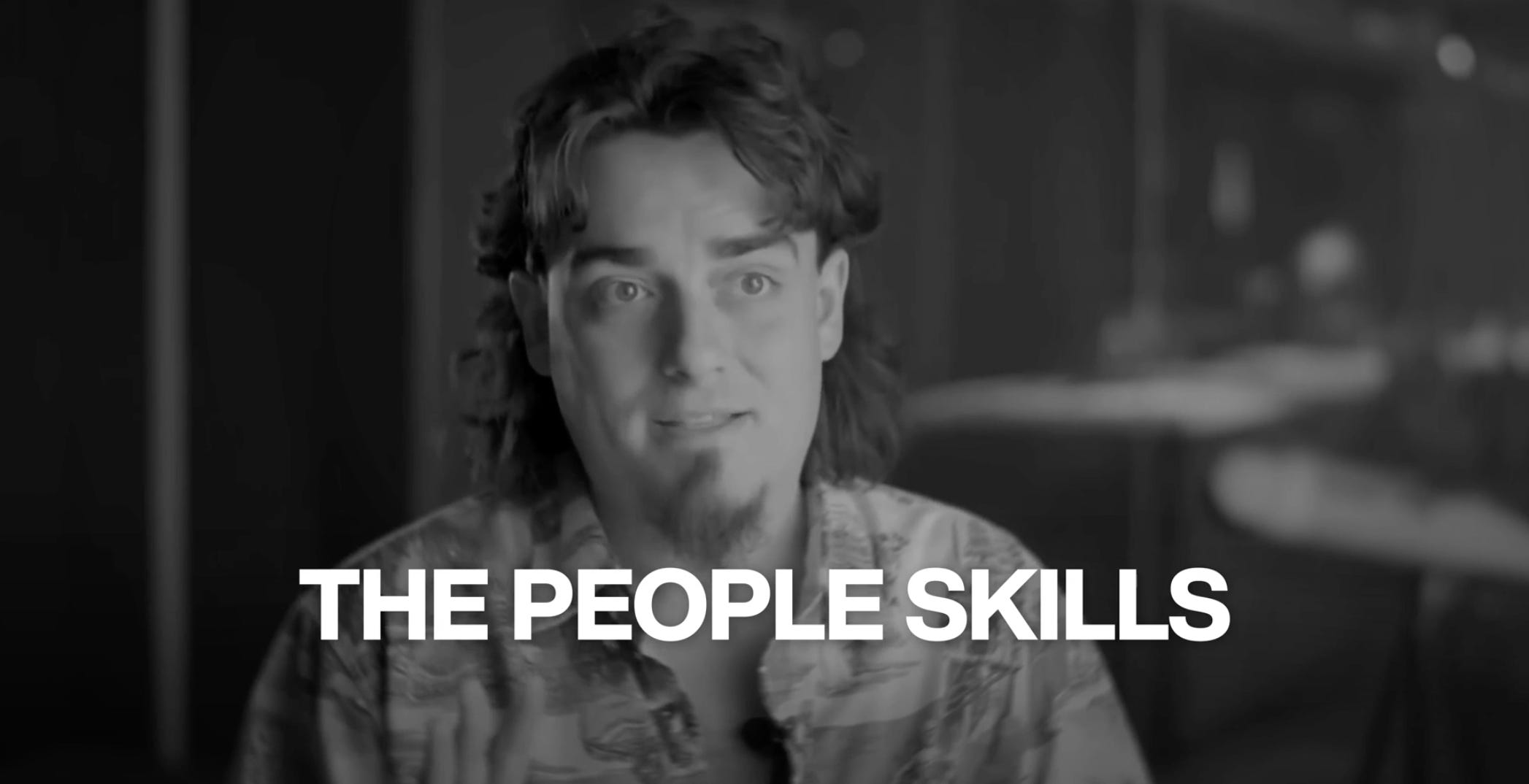
Two young builders from the current applicant pool illustrate the type of young abitious students you’re likely to see at The Academy. One is a 16-year-old in Tennessee who built an LLM for biology, originally for molecule design and since pivoted to proteins. Another built a large TikTok following as a teenager and worked on Alpha School.
“Most students are not gonna be a fit for the academy. We’re only taking 50 students in our founding class fellowship.”

Admissions Run on Portfolios, Proof of Work, and, In-Person Interviews
The first round of the application is a portfolio submission plus basic applicant information where they ask about what the student has built and what they’re passionate about. The second round is some additional testing and an in-person interview.
“The big difference between going to the academy and going to college is we are not gonna prioritize your grades. We’re gonna prioritize proof of work.”
Grades, essays and test scores aren’t weighted like they are in traditional college admissions. Admissions run of proof-of-work and a passion for building.
“Our goal is going to be looking at slope and not experience. So we wanna know that you are constantly learning, that you’re a sponge, that you’re someone who has a penchant for building things and has done builder-like things.”
Applicants who discovered building late are still eligible. A student who spent years in high school on math competitions and started building in senior year is still someone The Academy wants to meet.

Anthropic, OpenAI and NVIDIA Are Co-Writing the Curriculum
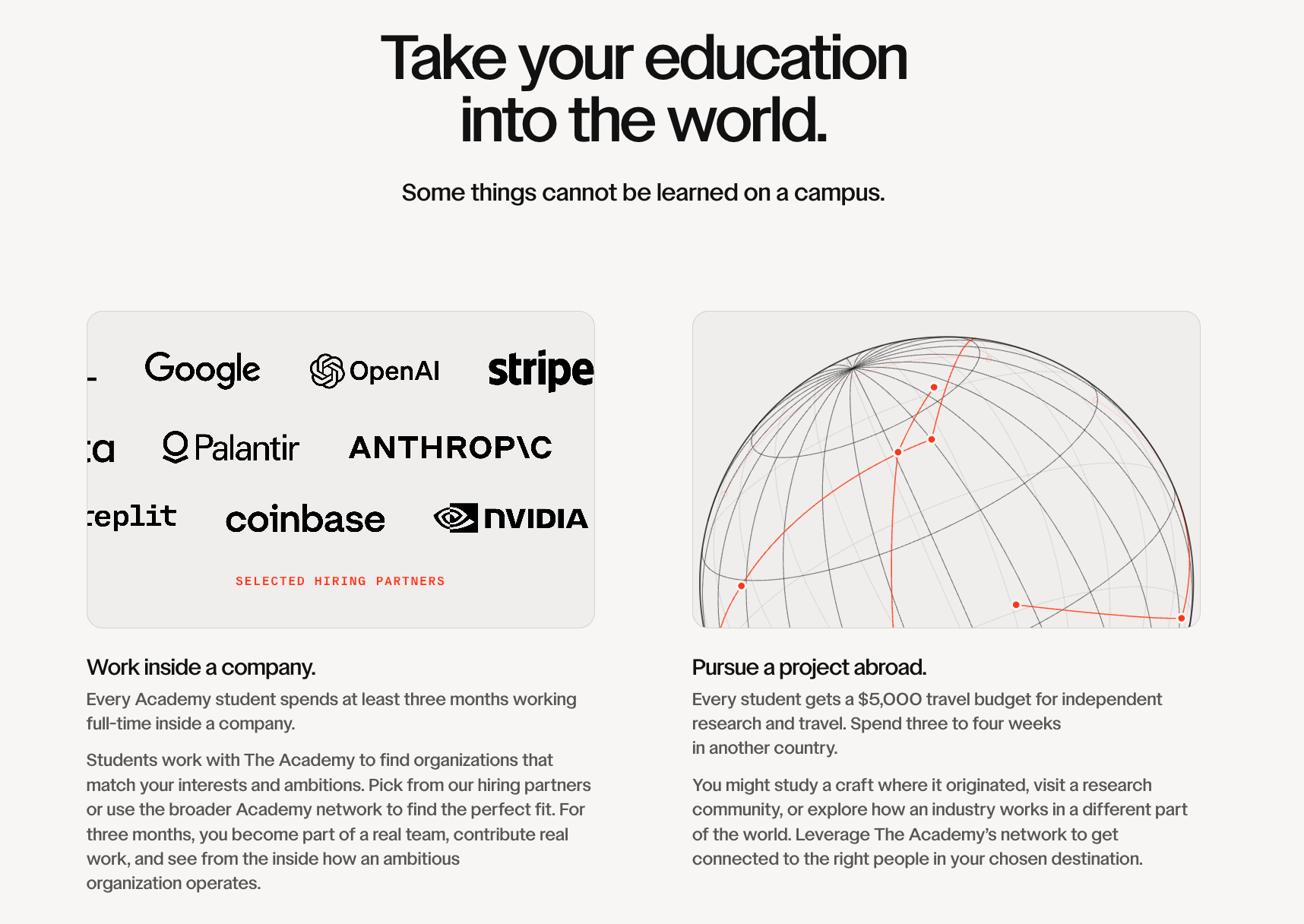
Founding Partners include Anthropic, Anduril, Coinbase, Google, Meta, NVIDIA, OpenAI, Palantir, Replit and Stripe. Partners will give input on curriculum, provide software and compute access, and open their offices to students for in-person work.
“These companies are going to help us by providing curricular support. We have an advisory group with them, so we can frequently get feedback on what types of talent they’re seeing in the market, as well as what they want young people to learn.”
Beyond the Founding Partners, more than 40 hiring partners have signed on, including Applied Intuition, Base Power Company, Cognition, Databricks, Notion, and Shopify, and are excited to recruit The Academy students and graduates for internships and full-time roles.
“The leading researchers in AI are no longer at university campuses.
They are at these companies.”


75-80% of Student Time Goes to Self-Directed Projects
The curriculum reserves 75% to 80% of student time for projects the students choose themselves, across three categories: research, learning, and building or entrepreneurial work. Classes are didactic only, with no problem sets, tests or assigned project parameters attached to them.
“One of the most important things that you wanna preserve, 75 to 80% time for students to do work on projects and build things.”
The program is built around four traits: AI-Native Building, High Agency, Ambition, and Interpersonal Skills. Coursework will be expansive and span practical subjects like Designing, Building, and Evaluating AI Systems, Founder-Led Sales, Go-to-Market for B2B, Storytelling and New Media, Leading High Ownership Cultures, and Startup Mechanics: Formation, Cap Tables, Finance, and Fundraising, taught by practitioners rather than academics.
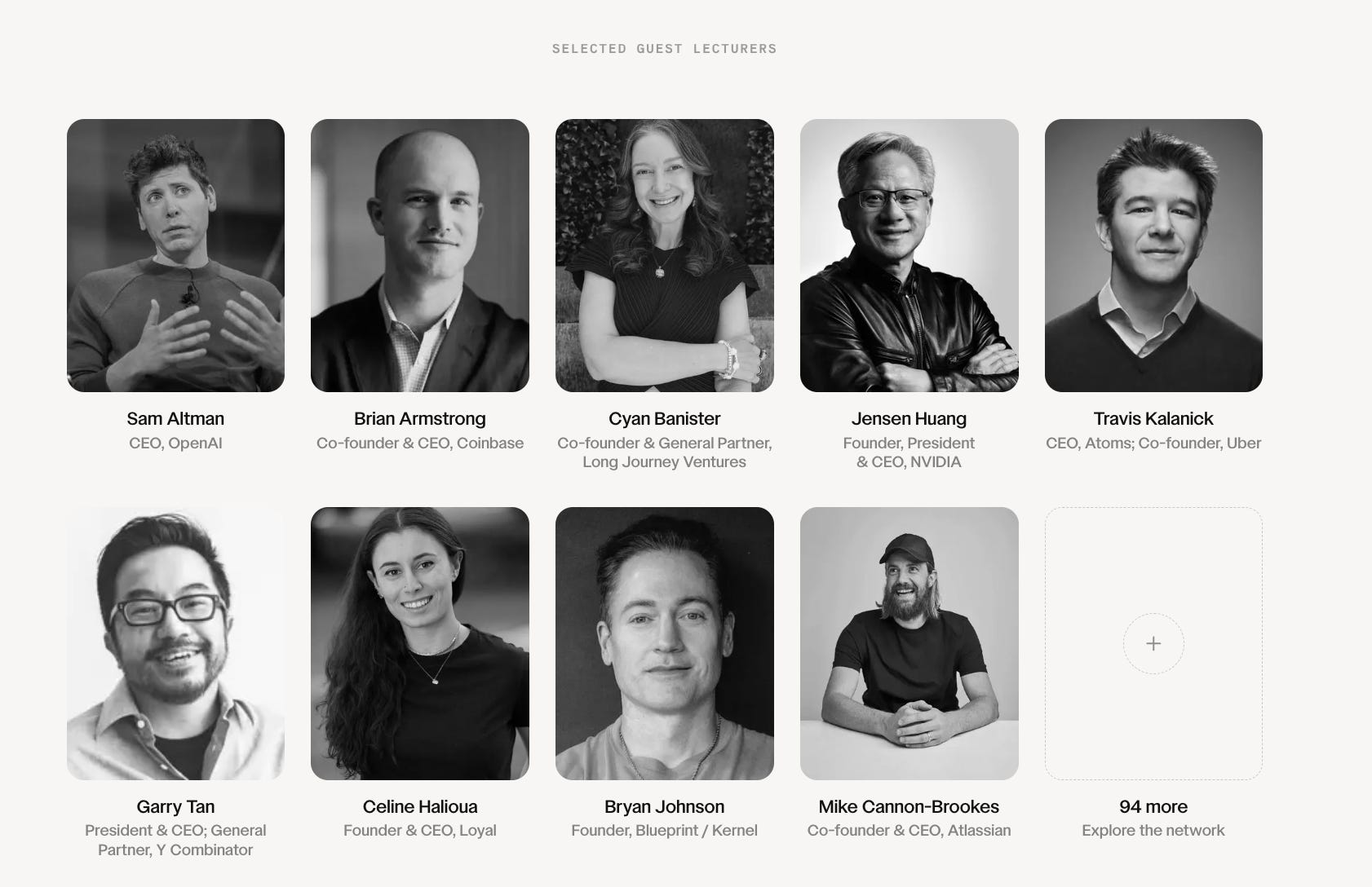
Every student gets $50,000+ in compute credits and technology resources from Academy partners, a $5,000 travel and exploration budget, access to the a16z network and its investors, and time inside some of the country’s fastest-growing startups and most established tech companies.
“You should come in and learn how to orchestrate 30 agents at a time, 50 agents. Orchestrate agents that are orchestrating agents that are orchestrating agents.”

The Academy Will Help the Most Fundable Teenagers Find their Passion and Big Idea
Young builders in this cohort are already the types of young builders that are receiving seed checks and starting companies, but that’s not the goal of The Academy. The Academy’s position is that only a small share of them should start companies right away, that they need time to explore, chase ideas, and learn the fundamentals of startup creation before they take outside capital and dedicate the next decade to something.
“Only a very, very, very small percentage of these builders should be starting companies right away.”
Students who want to leave and raise will be supported, including help finding investors, with no requirement to finish the program. Once admitted, students remain in the network whether they leave in month 2 or complete the full term.
“Raising capital for these kids is gonna be easy. They should come into the academy thinking, ‘I can raise capital whenever I want. If I’m gonna take someone’s money, I better do it for the right reasons.’”
The Academy draws a line between itself, the Thiel Fellowship, Y Combinator & a16z Speedrun: those programs require a company at entry, & the Academy doesn’t. a16z Speedrun is also a partner, and the Academy can route students into it when they’re ready.

The Business of The Academy
Tuition is expected to carry most of the Academy’s revenue once the two-year program launches.
“This is a big spiky point of view, but we believe this school is gonna be so valuable that we’re gonna charge for it.”
The Founding Class operates as a pre-revenue cohort, and mirrors the value exchange of being an early employee at a startup. For the Academy students who join the Founding Class Fellowship, they’ll capture the upside of no tuition.
An AI-Native School Launching Into Campus Backlash
AI has drawn open hostility on university campuses, including booing and walkouts at commencement ceremonies and orientation events. If you’re an AI doomer, The Academy not the place for you. The Academy is all-in on AI.
“We want the AI boomers. We want the folks who are looking for an AI optimistic future, and we wanna show the world that there is an AI optimistic future.”
College has obviously been around a long time. The University model goes back a thousand years, and even all the way through the twentieth century, the growth of post-secondary education has been a force for knowledge advancement and upward mobility everywhere. But it has to evolve.
Vanderbilt, Northeastern and Arizona State are universities already innovating on this, and The Academy’s goal is to innovate and serve as a reference model for those institutions and others on how to best prepare young people for the future.
How you can apply:
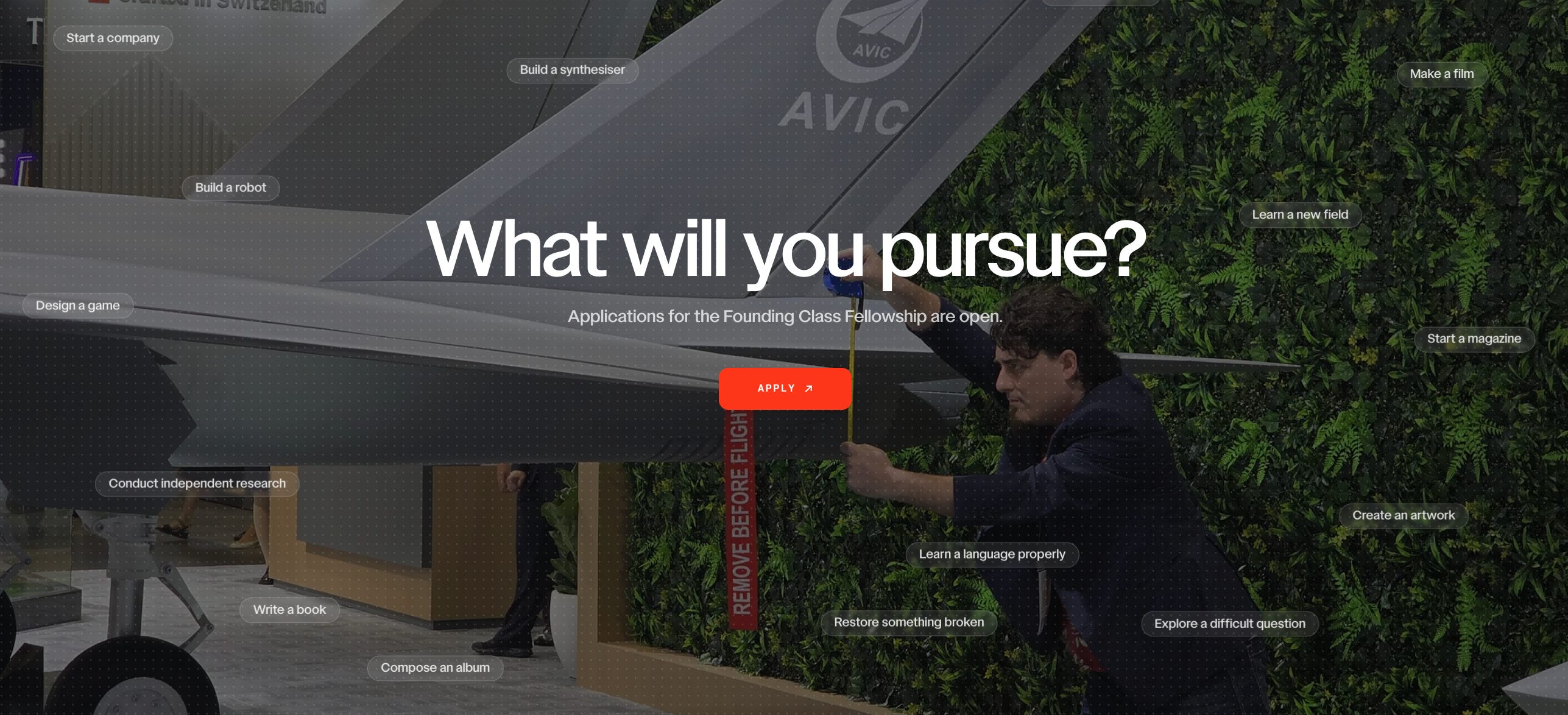
Go to theacademysf.com to apply
The material presented on Molly O’Shea’s website are my opinions only and are provided for informational purposes and should not be construed as investment advice. It is not a recommendation of, or an offer to sell or solicitation of an offer to buy, any particular security, strategy, or investment product. Any analysis or discussion of investments, sectors or the market generally are based on current information, including from public sources, that I consider reliable, but I do not represent that any research or the information provided is accurate or complete, and it should not be relied on as such. My views and opinions expressed in any website content are current at the time of publication and are subject to change. Past performance is not indicative of future results.
Paid Endorsement. Brokerage services by Open to the Public Investing Inc, member FINRA & SIPC. Advisory services by Public Advisors LLC, SEC-registered adviser. Crypto trading provided by Zero Hash LLC, licensed by the NYSDFS. Generated Assets is an interactive analysis tool by Public Advisors. Output is for informational purposes only and is not an investment recommendation or advice. See disclosures at public.com/disclosures/ga. Matched funds must remain in your account for at least 5 years. Match rate and other terms are subject to change at any time.