


HODL? “Adoption is early”
I sat down with Apoorv Agrawal, AI Partner at Altimeter, to break down Anthropic’s financials, the economics of the AI supercycle, & Apoorv introduces his framework for the “Four Seasons of AI”: Anthropic, OpenAI, SpaceX, and Google, with open source as the evergreen fifth season.
→ Listen on X, Spotify, YouTube, Apple
Examining the competitive dynamics between the four AI giants, like OpenAI’s commercial expansion, SpaceX’s emerging AI infrastructure business, Google’s accelerating cloud and TPU business. He also explains why companies like Baseten, Fireworks, and Modal are positioned to capture value as the AI economy expands.
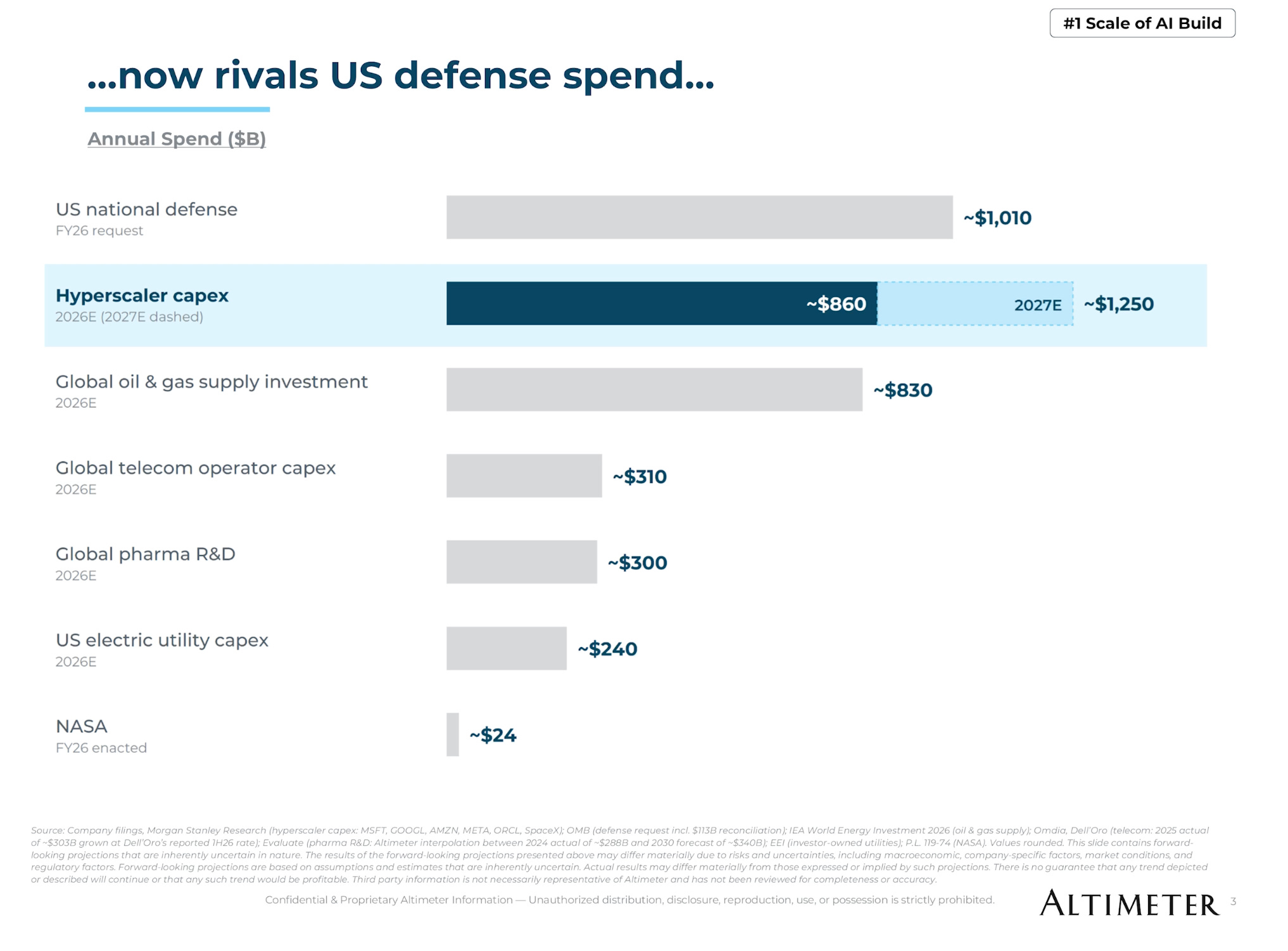
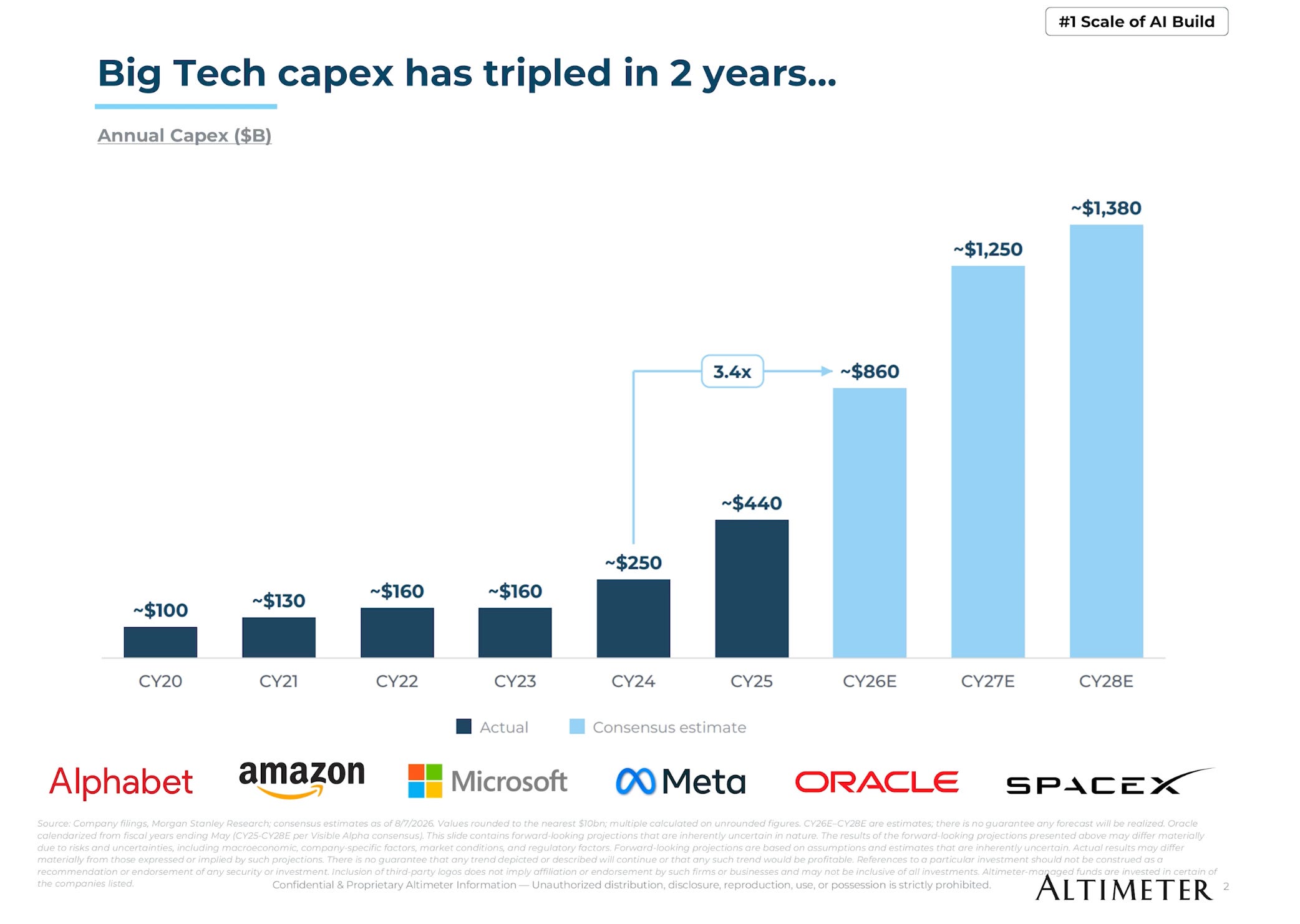
With AI-related CapEx approaching $860B annually, Apoorv explains where the money is going, why compute ownership is becoming a major competitive advantage, and how the shift from chatbots to autonomous agents is reshaping the market.
We discuss AI valuations, data center constraints, inference economics, cybersecurity, and why he believes we’re still in the first inning of the AI supercycle.
𝐓𝐈𝐌𝐄𝐒𝐓𝐀𝐌𝐏𝐒
(00:00) Apoorv Agrawal, Partner at Altimeter Capital
(00:42) How big is the AI boom, really?
(03:40) Apps and models grew 100x
(05:46) From chatbots to agents
(08:47) Top AI users grew 17x
(11:33) The four seasons of AI
(13:31) The most capital-efficient scale-up ever
(16:10) Inside Apoorv's viral Stanford class
(20:00) Who gets hurt by data center limits
(22:36) Anthropic vs. OpenAI at the frontier
(25:27) Why open source is evergreen
(27:57) Open source is six months behind
(31:50) SpaceX is now an AI business
(35:18) Elon's mastery of atoms and bits
(37:28) Google Cloud is growing 103%
(41:15) The new growth benchmarks: 10x, 3x, 2x
(43:10) Why founders are the leading indicator
(44:49) Why cyber is AI's next big market
(47:56) Why the Anthropic IPO will succeed

Brought to you by:
Brex—The intelligent finance platform: cards, expenses, travel, bill pay, banking—wrapped into a high-performance stack. Built for scale. Trusted by OpenAI, Anthropic, Vercel, Granola, Deepgram, & Sourcery.. teams that move fast AF. visit → brex.com/sourcery

Harvey—The AI platform built for legal work, is helping the best firms and companies close deals faster. More than 200,000 lawyers, 80% of the Am Law 100, and over 20% of the Fortune 500 build with Harvey. Visit: Harvey.ai
Zone—develops next-generation data center campuses, partnering with AI companies, site developers and technology leaders to bring compute online faster and at scale. Visit: zonefrontier.com
Mercor—The human intelligence behind frontier AI. Frontier labs and leading enterprises use Mercor to turn the knowledge of 5M+ experts into the data, evals and benchmarks that make AI better at real work. Visit: http://mercor.com/sourcery
VCX—VCX is the public ticker for private tech, allowing investors of all sizes to invest in venture capital. View The Portfolio at GetVCX.com
Deel—Deel is the global people platform that helps startups hire, manage, pay, and equip anyone, anywhere. Trusted by more than 35,000 fast-growing companies, Deel is the people platform that just works, so teams can scale without the chaos. Visit: deel.com/sourcery
Public—Investing platform Public is the world's first agentic brokerage. You can invest across stocks, options, bonds, crypto, event contracts, & more, then automate anything with AI Agents. Seriously, just tell an Agent what you want—from "Set up a buy-the-close, sell-the-open strategy for me" to "Automatically sweep any cash over $10k from my bank to my brokerage account." Agents can monitor markets, run strategies, & manage your cash 24/7. Get started: public.com/sourcery
Altimeter’s Apoorv Agrawal on the ***4 Seasons of AI***
Apoorv Agrawal is a Partner at Altimeter, where he leads AI and software investing. Altimeter co-led Anthropic’s Series H, & OpenAI is the firm’s largest investment. Ahead of the listing, Brad Gerstner said Altimeter Capital planned to invest $5 billion in the Anthropic IPO, which is five times the most he has put into any prior IPO.
Apoorv led Altimeter’s investments in OpenAI, Glean, XBOW, Baseten & Parloa. He started his career as an engineer at Palantir and teaches an annual course at Stanford on the economics of the AI stack.
This conversation was recorded ahead of Anthropic’s IPO. It covers the 4 companies setting the pace of the AI market, open source, compute constraints, how growth gets benchmarked at scale, and cyber as the next large AI workload.
Apoorv shares new Altimeter market slides, watch here for more.
→ Listen on X, Spotify, YouTube, Apple
AI CapEx Now Rivals the US Defense Budget
Big tech CapEx on AI is about $860B this year, more than triple what it was 2 years ago. As a share of GDP, it is already above the railroad, oil and gas, telco, and shale booms.
“It’s about $860 billion this year, over tripled in the last 2 years. And to put that in perspective, it’s now rivaling the US defense spend.”
The spend is distributed differently from the cloud economy. In cloud, Salesforce, Adobe, ServiceNow and their peers make about $600B of application revenue on roughly $300B of infrastructure and $80B of semiconductors. In AI, models and apps make about $140B to $150B, supported by a much larger semiconductor base.
The mobile era followed the same order. Value went first to semiconductors, then to infrastructure and devices, and then to software and apps.
“While the economy has grown 6X in the last 2, 3 years, the apps and model side of it has grown about 100X in the same time.”

AI Usage Has Shifted From Chatbots to Agents
The chatbot era started with ChatGPT in November 2022. About 80% of chatbot use is knowledge retrieval, meaning finding answers and planning tasks. Coding and automation now make up about 80% of agentic use. Altimeter’s own investment team runs swarms of agents.
“Sometime end of last year, the start of this year, we entered what I call the agentic AI era. These are long-running agents, swarms of agents, and the primary use case for those is very different. It’s coding, agentic automation, and by the way, this is not just for technical users. This is for sales, marketing, support teams, investment teams.”
Apoorv expects a 3rd phase. The candidates he names are proactive agents, much longer-running swarms, and large models performing surgery on smaller models.
“I don’t think this is the last phase shift we’ll see. I’m sure there’ll be a phase 3 of AI that people use.”
The Top 10% of AI Users Are Pulling Away
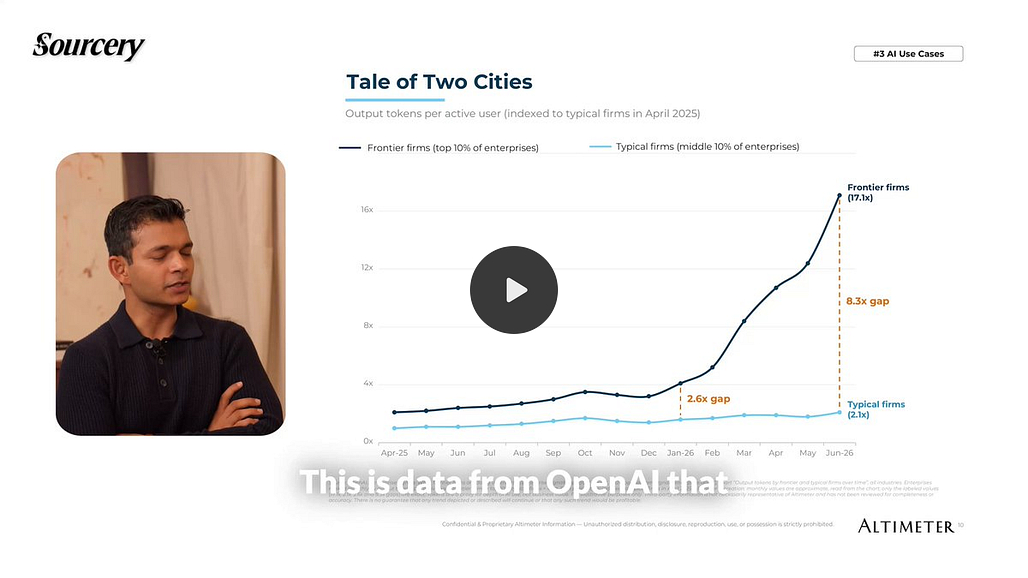
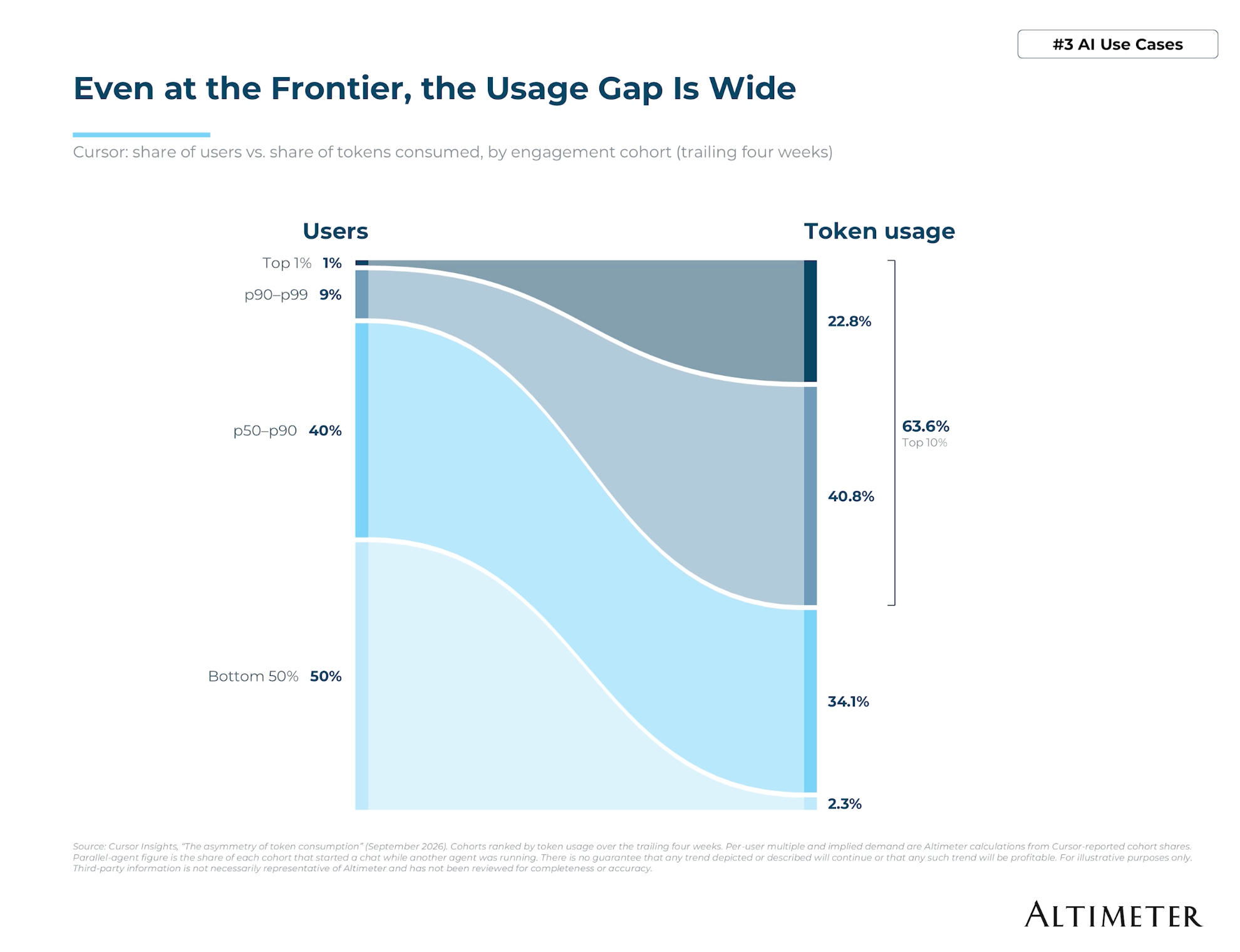
OpenAI’s public data shows a widening gap between its heaviest and median customers. At Cursor, the top 10% of users account for two-thirds of all tokens.
“Over the last year, year and a half, top 10% of their customers have grown their usage 17x, while their median customer has grown their usage 2x. And so the gap between a frontier firm and a median firm using AI is widening.”
Internet adoption is close to saturated. AI adoption is still accelerating.
“There’s a power law in usage, but that is what creates the opportunity for a catch-up for the rest of the population as AI adoption grows, and I would say that’s the biggest gap in AI right now, which is not everybody is using it like the power users are.”
Anthropic, OpenAI, SpaceX and Google Make Up the 4 Seasons
Apoorv splits the AI market into 4 seasons. Anthropic and OpenAI are the 2 frontier labs. SpaceX and Google are the infrastructure players, with large pools of compute they have monetized. Open source is a 5th, evergreen season.
“There’s 4 seasons of the year. I call them Anthropic, OpenAI, SpaceX, and Google, and honestly, the Anthropic S-1 has been a total treat.”
Meta is not one of the 4. When asked where Meta fits after its Muse model, Apoorv kept the frontier to Anthropic and OpenAI.
“I won’t count out open source, which is kind of the evergreen season. The rough mental model we have for open source is that about 20% to 30% of all AI spend will be on open source. The majority will be on closed source, but there’ll be a smaller part that’ll be on open source, and that’s also going to monetize.”

Anthropic Leads a Game of Emperors
Apoorv puts Anthropic in the lead at the frontier. Anthropic has grown 10X a year for 3 years and did about $17B of revenue in Q3. It has about 12,000 customers paying more than $100K a year and about 1,900 paying more than $1M. Fortune 500 customers that spend more than $100K on Anthropic say it is less than 0.1% of their total expenses.
“This is a very rare sauce, like I’ve never seen this before, a business that’s growing this fast with no customer concentration and a long runway to grow.”
According to Apoorv, Anthropic burned less than $10B of cash to reach a run rate of about $70B. The compute cost of serving $1 of revenue fell from 88 cents to 15 cents. Revenue per watt of compute went from about $16 to about $60. Anthropic runs its workloads across Google TPUs, Amazon Trainium, and Nvidia GPUs.
“They burned less than $10 billion to get to that number, and I mean, that has got to be the... like the books of history. I think it would be very hard to beat this level of capital efficiency while being deeply profitable.”
OpenAI Rebuilt Its Sales Bench After Code Red
OpenAI went into code red at the end of last year. ChatGPT now has more than 1.2B users. OpenAI ended September at about a $50B revenue run rate, ahead of its year-end guidance. On the sales side, it hired senior revenue leaders, including a former CRO of Wiz.
“I think about 2 jobs to be done, building and selling. On the building side, they’ve had an incredible set of models that have come out... that have defined the frontier. And in Q3, I would say both the products, so the Codex product, the ChatGPT work product, the models, have shown incredible performance.”
OpenAI also partnered with Baseten. Large customers can now spend part of their OpenAI commitments on open source models.
“You now have the big labs, OpenAI, making the choice that, ‘Hey, you can take your spend on OpenAI and spend it on open source models.’ I think it’s very smart of OpenAI to rise above the level of being a lab to becoming a platform.”

SpaceX Rents Compute at Spot Prices
SpaceX went public in June, raising $75 billion through the sale of 555.6 million shares priced at $135 each, and trades on Nasdaq under SPCX. About half of its revenue now comes from AI, with the rest from Starlink and launch. Apoorv names Sam Altman and Elon Musk as the 2 founders who made the compute bet early and got it right.

Neoclouds like CoreWeave and Nebius sell 1 to 3 year leases at roughly $10 to $20 a watt. SpaceX rents short-term compute at $25 to $50 a watt, at the high end of that range. Anthropic can pay those rates because it monetizes compute at $50 to $100 a watt. SpaceX recovers its CapEx in under a year. Most neoclouds take 2 to 3 years.
“We thought SpaceX was a space business, but turns out it’s an AI business.”
Google is also a SpaceX compute customer. Under a multi-year deal, Alphabet’s subsidiary will pay $920 million per month for approximately 110,000 Nvidia GPUs plus supporting CPUs, memory, and infrastructure. SpaceX’s targets for next year assume about 13 GW of compute monetized at or above current rates, so renewals by customers like Anthropic matter. asianetnews
“It’s like renting your home on a long yearly lease versus renting your home on Airbnb. There’s obvious questions with that, whether Anthropic will renew and so on. But I guess we’ll find out.”

Google Cloud Grows About 8X Faster Than Search
Apoorv calls Alphabet (GOOGL) a tale of 2 cities. The TPU business sits inside Cloud. Anthropic is a TPU customer and also has a commitment with Broadcom to lease TPUs. Oracle was the first outside cloud provider to offer them, and OpenAI has reportedly considered them.
“On one side, they’ve got a search business that is slowing down... But you’ve got this cloud business that is half the size of search, but growing 8X faster.”
“Every time I think of Google, I say, ‘Don’t forget Google.’ ... It’s probably a change of guard and change of seasons inside of Google.”
Open Source Runs About 6 Months Behind the Closed Frontier
The best open source model today performs about where the closed frontier was 6 months ago, and open source has kept that gap steady. Buyers choose it for control, cost, and sovereignty.
“Pick an AI native company that wants to leverage their learnings from their interactions with a customer to fine-tune a smaller specific model that allows them to serve their customer better while, by the way, having a much smaller model, a much cheaper cost of inference, and fully harnessing the data flywheel within themselves. You own that intelligence as opposed to renting that intelligence.”
Groq CEO Jonathan Ross has said about 35 companies run 99% of all inference. The top 5 are the labs. The next 30 are AI-native startups, which are the fastest adopters of open source tokens. Banks, healthcare companies, and other enterprises are starting to follow.
Apoorv expects Baseten, Fireworks, and Modal to share the inference market the way AWS, GCP, and Azure share cloud. Baseten is adding routing, sandboxes, and other platform tools, and is moving toward a hyperscaler model.
“Open source is not free. As open source, you still have to go build the cluster that’ll serve your model. And that’s, we believe, the primary place a lot of gross margin will accrue.”

A 10 to 15 GW Shortfall Hits Neoclouds Hardest
Altimeter expects the US to end the year with 35 to 40 GW of compute capacity online. Forecasts called for another 40 to 50 GW next year. After the recent US data center results, Apoorv estimates next year could come in 10 to 15 GW short.
Hyperscalers hold the largest pools of capacity and set the price where compute is bought and sold, though their own expansion plans are at risk. In Friday’s selloff, Micron, Sandisk and CoreWeave each fell by double digits. CNBC
“What happens to the neoclouds? What happens to new startups that were, let’s say, not the top 5 in the line, but let’s say 17th in the line? I think for them, this is existential. For them, this is a much bigger question than it is for the hyperscalers.”
“I think the answer is chips are going to win, data centers are going to win, clouds are going to win, models are going to win.”

Best-in-Class Growth Now Runs 10X, 3X and 2X by Scale
Cursor is rumored to have gone from about $1B to $10B this year, Cognition is on a similar curve, and Baseten has grown 10X in each of the last 2 years. OpenAI ended last year at about $20B, and Altimeter estimates it will end this year at $70B to $80B. Google Cloud is growing more than 100% at triple-digit billions.
“What was true in software, which is that you could triple, triple and double, double, is no longer best in class... It’s 10X at single billion, 3X at double-digit billion, and maybe doubling at triple-digit billion is probably best in class.”
Altimeter treats the founding team as the leading indicator, and Apoorv points to Michael Truell at Cursor and to his former colleague Bob McGrew. McGrew worked at PayPal, was an early engineer at Palantir, helped develop the forward-deployed engineer model, and led research at OpenAI before starting his new company, which Altimeter has backed.
“The guy’s got a track record of just picking the most ambitious bets. I think it’s talent like that that is a leading indicator. Obviously, the numbers are a lagging indicator.”

Cyber Is the Biggest Emerging AI Workload
Software engineering is the largest AI workload, and quant firms are heavy but concentrated spenders. Apoorv sees cyber as the biggest emerging market, which Elon Musk summed up as “zero day, every day.”
“Offensive actors now have this new toolkit, which is incredibly potent, that can go check every single door and window and make sure if it’s unlocked, find the most critical vulnerability, and exploit it.”
One recent example was a vulnerability in Google Chrome, which about 1B people use every day. It would let an attacker take control of a computer after a single click on a link. Companies are moving from annual penetration tests to continuous testing as they ship software. No standalone cyber company has broken out yet.
“The edge that you get in using frontier models is so high that I think it’ll be the frontier companies. Today that’s OpenAI and Anthropic that are likely to serve that demand.”
Anthropic Priced at $83 and Fell 8.5% on Day 2
Anthropic’s IPO priced after this interview was recorded. The company priced its IPO at $83 per share, above its expected range, valuing the Claude AI maker at $1.5 trillion, and raised $81.34 billion in the largest initial IPO share sale ever. The stock opened at $111.50 and closed its first day as a public company at $97.17, up $14.17 or 17.1% from its $83 IPO price.
On Friday, Anthropic shares fell 8.5% to close their first full day of trading, as concerns about the artificial intelligence trade continued to drag tech stocks lower. The stock traded as low as $83.05 on Friday, down more than 14% on their second day of trading. In the broader market, the Dow and S&P 500 entered a correction while the Nasdaq sank 5% to erase its 2026 gains. A day earlier, SpaceX shares fell approximately 4% on November 19 as the debut rally faded. OpenAI is reportedly targeting a listing in 2027. Anthropic falls nearly 9% in first full day of trading as tech stocks get shellacked (CNBC)
On tape, Apoorv put the valuation at 11 to 14 times forward GAAP revenue. That was against a rumored $1.5T to $2T range and his estimate of $140B to $150B in revenue next year. The $83 pricing lands at the low end of his range.
“It’s not a heroic multiple. It’s completely reasonable based on current market comps.”
“I think this is the best business I’ve had the good fortune, as a student of the markets, to study... This is the private Mag 7. This is likely to be the leading companies for the next decade and more.”
→ Listen on X, Spotify, YouTube, Apple
More X Clips

The material presented on Molly O’Shea’s website are my opinions only and are provided for informational purposes and should not be construed as investment advice. It is not a recommendation of, or an offer to sell or solicitation of an offer to buy, any particular security, strategy, or investment product. Any analysis or discussion of investments, sectors or the market generally are based on current information, including from public sources, that I consider reliable, but I do not represent that any research or the information provided is accurate or complete, and it should not be relied on as such. My views and opinions expressed in any website content are current at the time of publication and are subject to change. Past performance is not indicative of future results.
Paid Ad. Agents are an experimental AI tool. Its output may be inaccurate and is not investment advice. Public Holding’s, Inc. makes no guarantees about its accuracy or reliability—verify independently before use. Brokerage accounts & services provided by Open to the Public Investing, Inc. See additional disclosures at: https://public.com/disclosures/agenticdisclosures.