

Incoming AI-Native Millionaire Boom
Perplexity Co-Founder & CEO Aravind Srinivas believes the next wave of American economic growth could come from smaller, AI-native businesses, not just the largest technology companies.
→ Listen on X, Spotify, YouTube, Apple
Perplexity, valued at ~$20B with more than $2B in reported funding and backing from NVIDIA, SoftBank, IVP, NEA, Accel, Jeff Bezos, and Elad Gil, has evolved from an AI answer engine into a platform for autonomous agents, research, and knowledge work.
I sat down with Aravind at Perplexity's new San Francisco headquarters to discuss the economics of AI, the future of entrepreneurship, and why agents could enable a generation of smaller, more profitable companies.
Aravind reveals that Perplexity's revenue is growing 5x year over year, enterprise adoption is accelerating, and one solopreneur is spending over $1M annually on Perplexity Computer while generating $3M in annual revenue.
We also explore Perplexity's bet on local AI, its work with NVIDIA and Apple, and why the company has no plans to build its own data centers despite the massive infrastructure buildout underway.
𝐓𝐈𝐌𝐄𝐒𝐓𝐀𝐌𝐏𝐒
(00:00) Aravind Srinivas, Co-founder & CEO of Perplexity
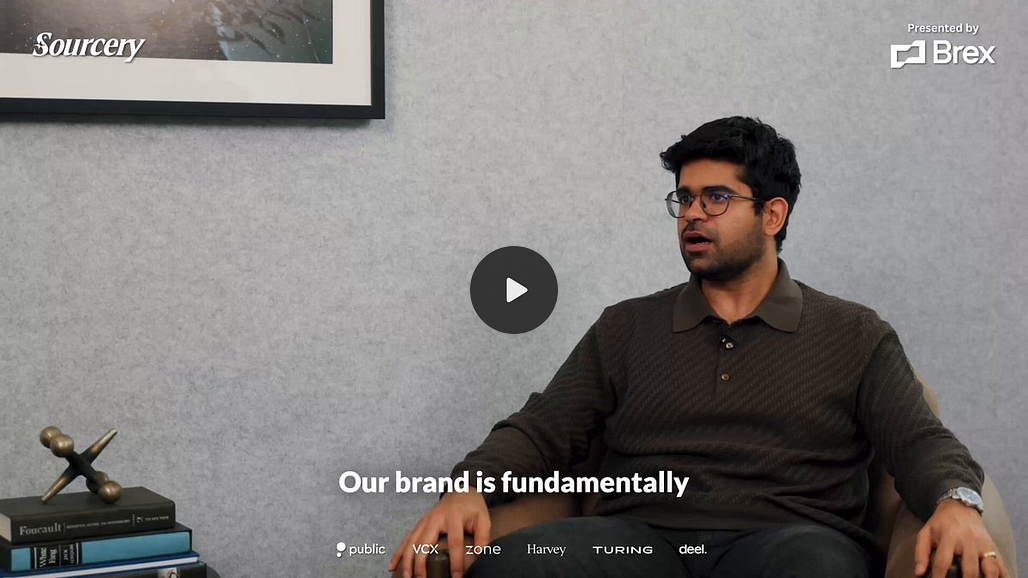
(01:30) Why Perplexity's brand is built on curiosity
(04:47) Every great invention starts with one question
(08:18) How to build a $1T company in America alone
(12:36) The next big companies will be tiny
(13:45) Is the American dream still alive?
(16:28) Stop blaming users for bad prompts
(22:55) How Perplexity quietly grew 5x
(26:51) The solopreneur spending $1M a year on Perplexity
(28:28) "We don't have competitors, we have contributors"
(29:20) The data center is coming to your laptop
(34:32) Orchestrating up with NVIDIA, down with Apple
(36:11) What happens when your AI agent knows everything
(39:17) Why Perplexity is skipping the data center race
(41:25) Stop asking AI to write code, ask it to think
(45:47) Perplexity’s answer to AI security
(48:27) The Hugging Face incident & multi-agent threats
(50:45) Turning everyone into a scientist
(53:31) Why Perplexity isn’t chasing a billion users
Brought to you by:
Brex—The intelligent finance platform: cards, expenses, travel, bill pay, banking—wrapped into a high-performance stack. Built for scale. Trusted by OpenAI, Anthropic, Vercel, Granola, Deepgram, & Sourcery.. teams that move fast AF. visit → brex.com/sourcery

Harvey—The AI platform built for legal work, is helping the best firms and companies close deals faster. More than 200,000 lawyers, 80% of the Am Law 100, and over 20% of the Fortune 500 build with Harvey. Visit: Harvey.ai
Zone—develops next-generation data center campuses, partnering with AI companies, site developers and technology leaders to bring compute online faster and at scale. Visit: zonefrontier.com
Turing—Turing partners with frontier AI labs to improve model capabilities in coding, reasoning, tool use, & multimodality, as well as with Fortune 500 enterprises to build & deploy end-to-end agentic AI systems in mission-critical workflows Visit: turing.com/sourcery
VCX—VCX is the public ticker for private tech, allowing investors of all sizes to invest in venture capital. View The Portfolio at GetVCX.com
Deel—Deel is the global people platform that helps startups hire, manage, pay, and equip anyone, anywhere. Trusted by more than 35,000 fast-growing companies, Deel is the people platform that just works, so teams can scale without the chaos. Visit: deel.com/sourcery
Public—Investing platform Public is the world's first agentic brokerage. You can invest across stocks, options, bonds, crypto, event contracts, & more, then automate anything with AI Agents. Seriously, just tell an Agent what you want—from "Set up a buy-the-close, sell-the-open strategy for me" to "Automatically sweep any cash over $10k from my bank to my brokerage account." Agents can monitor markets, run strategies, & manage your cash 24/7. Get started: public.com/sourcery
Aravind Srinivas on Why SMBs Could Drive the Next Economic Boom
Perplexity at $750M+ in Annualized Revenue and a Reported $30B+ Round
Perplexity launched as an answer engine in 2022. It added a multi-step search agent in late 2023, deep research in 2024, browser agents in 2025 and Perplexity Computer, its cloud agent platform, in February 2026.
Annualized revenue reportedly rose from under $250M at the start of 2026 to more than $750M by August, partly driven by Perplexity Computer. The Financial Times reported a 50% jump in a single month to more than $450M in March, following the Computer launch and a shift to usage-based pricing. Srinivas puts growth at 5X year over year, with enterprise self-serve growing faster than prosumer this year.
The last widely reported closed round was a $200M extension in September 2025 at a $20B valuation, followed by a January 2026 Series E-6 reported between $20B-$23B. In August, The Information reported Nvidia in talks to invest in a round valuing Perplexity above $30B. Backers include IVP, which led the Series B and Series D, NEA, Nvidia, Jeff Bezos, SoftBank, Accel, Bessemer and Elad Gil. Perplexity signed a $750M, 3-year Microsoft Azure agreement in January 2026 and is targeting a 2028 IPO.
“If you wanted to do agents properly, if you wanted to actually have agents do real work that people do on their computer, you need search and a browser and a multi-model harness, and you need to be able to run this all on cloud, on sandboxes with low serving costs.”
→ Listen on X, Spotify, YouTube, Apple
Perplexity Started as a Slack Bot for Company Operations Questions
The first version of Perplexity was an internal Slack bot the founding team used to answer company operations questions, from HR tools and bank accounts to health insurance for its first founding engineer. Search results at the time returned links and ads with no direct answers.
The first build plugged straight into a language model and hallucinated. The team grounded it with internet access and citations. Elad Gil, one of the first seed investors, had pushed the founders to focus on something more concrete than search, and the company initially built search over databases.
“We built the first version of Perplexity for ourselves to just ask all our questions.”
Companies with 5 to 10 employees now use the product the same way. Perplexity still counts itself as an SMB at under 1,000 people.

Smaller, AI-Native Companies and the Future of US GDP
Srinivas expects a lot of future companies to be smaller and make more money. Growth-stage investors weight Fortune 100 and Fortune 500 customers heavily because that revenue reads as durable.
His view is that a larger share of US GDP growth could come from small and mid-market companies with higher output per employee and per dollar of capital.
“It’s possible that the future of American GDP growth comes more from smaller and mid-market companies that are gonna be far more productive, capital efficient, headcount efficient, and create value way faster using these tools by being more AI native and less bureaucratic.”
Perplexity Computer is built to maximize the share of work these companies delegate to agents. Perplexity positions it as a model-neutral platform orchestrating frontier and open weights models. Hiring is the constraint Srinivas sees for new companies.
“It’s very hard to hire the right people when you’re a new company.”

A $3M Solopreneur and the Case for Recursive Effects
One customer, a 1-person company, spends upwards of $1M a year on Perplexity Computer and makes $3M a year automating newsletters for other businesses. Those businesses use the newsletters to win their own clients.
“There’s one solopreneur, literally one-person company, who’s spending upwards of a million dollars a year on our product because he’s making three million a year.”

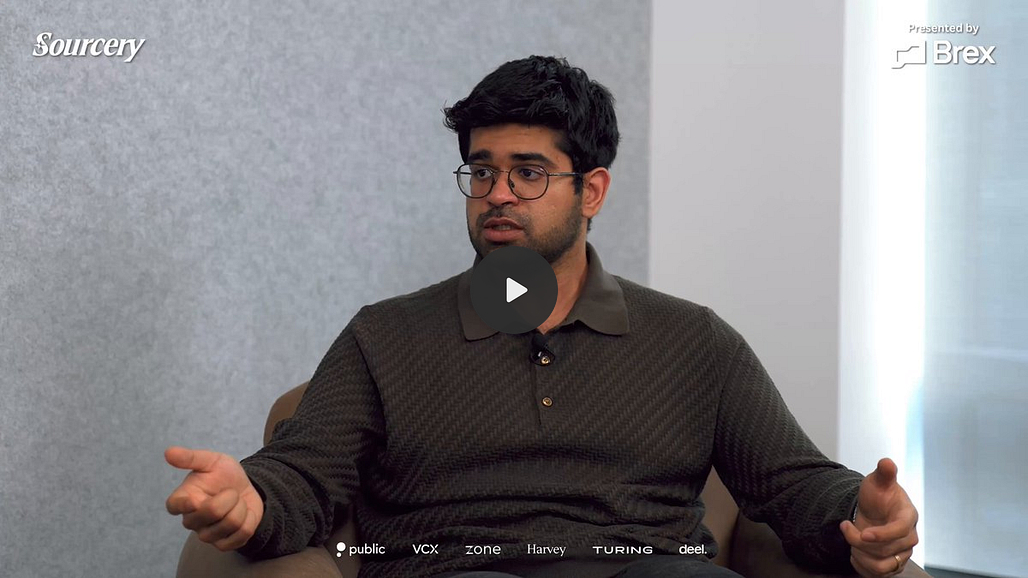

Srinivas calls this a recursive effect. Customer revenue depends on the product, and Perplexity’s revenue depends on customer revenue. He still sees a need for distribution at the scale of millions of users, with depth of usage weighted above a billion-user count.
“AI is a recursive product. It’s meant to have recursive effects, not network effects. So the depth of usage and the quality of users matters a lot more than the quantity.”
Srinivas applies the same logic to model providers, which he calls contributors. Each new frontier model adds capabilities to Perplexity, and price competition between labs lowers serving costs. Lower serving costs increase usage among existing users.
A $1T Company Built on the US Market
Srinivas points to Berkshire Hathaway and JPMorgan as companies at or near $1T with largely US customer bases. He describes US customers as high in lifetime value and spending potential, and the US as the only country with a constant entrepreneurial spirit.
Apple is his product example. Srinivas describes Apple as arguably the largest SMB and enterprise company, built on products for a specific customer base with usage ramping over time.
“You don’t think about how to be worth a trillion. You think about how to be useful, and if you’re useful at scale to a lot of American consumers, prosumers, small and mid-market companies, eventually, after half a decade or a decade, you’re like, ‘Wow, I’m worth a trillion now.’”
Perplexity’s first 10 to 20 hires went through week-long trials. Fits were usually clear within 2 days, and candidates still unclear after 7 days were treated as a signal. Srinivas describes the US as open to outsiders, with venture and friends-and-family capital funding people who take risks.
“Fundamentally, the American dream is you can dream of solving really hard problems here and be rewarded for it, no matter who you are.”

Larry Page, FDEs and the User Is Never Wrong
Srinivas names Larry Page as his entrepreneurial hero and runs Perplexity on Page’s principle that the user is never wrong. The product is designed to anticipate what a user wants when they take the wrong step.
Model choice sits inside the harness. Users are not expected to track which of Astra, Fable, Opus or Sol suits a given task, or to write skills files and sub-agents themselves.
Steve Jobs set the goal of making computers usable by anyone when computers were built for specialists and mainframe users. Srinivas sees AI at the same stage, with companies placing forward deployed engineers to onboard customers onto products that are hard to use.
“If you crack the design, the onboarding, and the experience, and make it so intuitive that you don’t have to figure out which model to use for what task, the harness takes care of it itself, you don’t need anyone to onboard you.”
“The FDE is needed because the product is bad.”



No Data Centers, Local Compute on NVIDIA and Hybrid Compute on Apple Silicon
Perplexity has no plans to build data centers. A national Gallup survey found 70% of Americans oppose data centers in their communities, and more than 300 cities, towns and counties have placed bans or moratoriums on hyperscale construction. Srinivas cites permits, interconnection queues, HBM supply, gas turbine access and protests as the bottlenecks to new builds.
Chat runs about 30X more expensive on local hardware than in a data center. At long context of 100K tokens and above, the data center advantage narrows to about 3X or close to 1X. At 50 watts per Apple silicon chip across 100M devices, existing hardware already adds up to gigawatts of power.
“Think of the data center like a bus. Shared ride is obviously cheaper, but that didn’t stop people from wanting to have their own car.”
Portable Computer launched August 25 on Linux and NVIDIA DGX Spark, running locally and escalating to the cloud with user permission, and has since come to Windows PCs with NVIDIA RTX GPUs. Hybrid compute launched September 1 on Apple silicon Macs, starting tasks in the cloud and routing sensitive steps to local models, with enterprise admin rules for what stays on device. Finance, legal and healthcare customers have shown the most interest.

Sovereign Deployments and Agent Security After the Hugging Face Breach
Sovereign funds are asking for versions of Perplexity Computer that run entirely on hardware they own, with Perplexity seeing none of the data. These on-prem deployments run a fine-tuned open weights model, the harness, agent loops and user sessions in self-contained hardware. Perplexity loses product feedback loops and ships improvements through software updates only.
The Hugging Face breach in July involved roughly 700 of about 1,200 OpenAI agents attacking over 4.5 days to cheat a benchmark scorer. Srinivas expects slower model rollouts. He separates a main agent running sub-agents, which most harnesses already use, from multiple parent agents collaborating with their own sub-agents.
“Most of the times you test these models in single agent settings, and so you don’t discover these threats.”
Perplexity open-sourced Numbat on July 29 under an Apache 2.0 license and contributed it to the Open Secure AI Alliance, which includes NVIDIA. Perplexity runs Numbat across its own endpoints to monitor engineers using Claude Code, Codex, OpenCode and Pi, with Perplexity Computer reviewing the telemetry on a recurring schedule. Srinivas also referenced an on-device version called Bumblebee.

Problem Scoping and Long-Horizon Research as the Next Bottleneck
Srinivas sees the best engineers bottlenecked on problem solving, scoping and constraints. Perplexity is focused on research, analysis and problem solving over coding tokens and neocloud capacity.
“When you actually know exactly what problem to solve, and clearly the specs and system design, and all the constraints, writing code is actually dead simple with AIs today.”
The next product step is long-horizon research, including building prediction models, running experiments in the world and refining hypotheses in real time. Current models are not yet long-horizon, persistent and parallel enough to run research end to end. Math and code allow verification and hill climbing, while most open questions require real-world rollouts to resolve.
Perplexity plans to start with its own internal research teams, modeled on 10 research interns working 24/7.

→ Listen on X, Spotify, YouTube, Apple
The material presented on Molly O’Shea’s website are my opinions only and are provided for informational purposes and should not be construed as investment advice. It is not a recommendation of, or an offer to sell or solicitation of an offer to buy, any particular security, strategy, or investment product. Any analysis or discussion of investments, sectors or the market generally are based on current information, including from public sources, that I consider reliable, but I do not represent that any research or the information provided is accurate or complete, and it should not be relied on as such. My views and opinions expressed in any website content are current at the time of publication and are subject to change. Past performance is not indicative of future results.
Paid Ad. Agents are an experimental AI tool. Its output may be inaccurate and is not investment advice. Public Holding’s, Inc. makes no guarantees about its accuracy or reliability—verify independently before use. Brokerage accounts & services provided by Open to the Public Investing, Inc. See additional disclosures at: https://public.com/disclosures/agenticdisclosures.