


EVERYTHING EXCHANGE
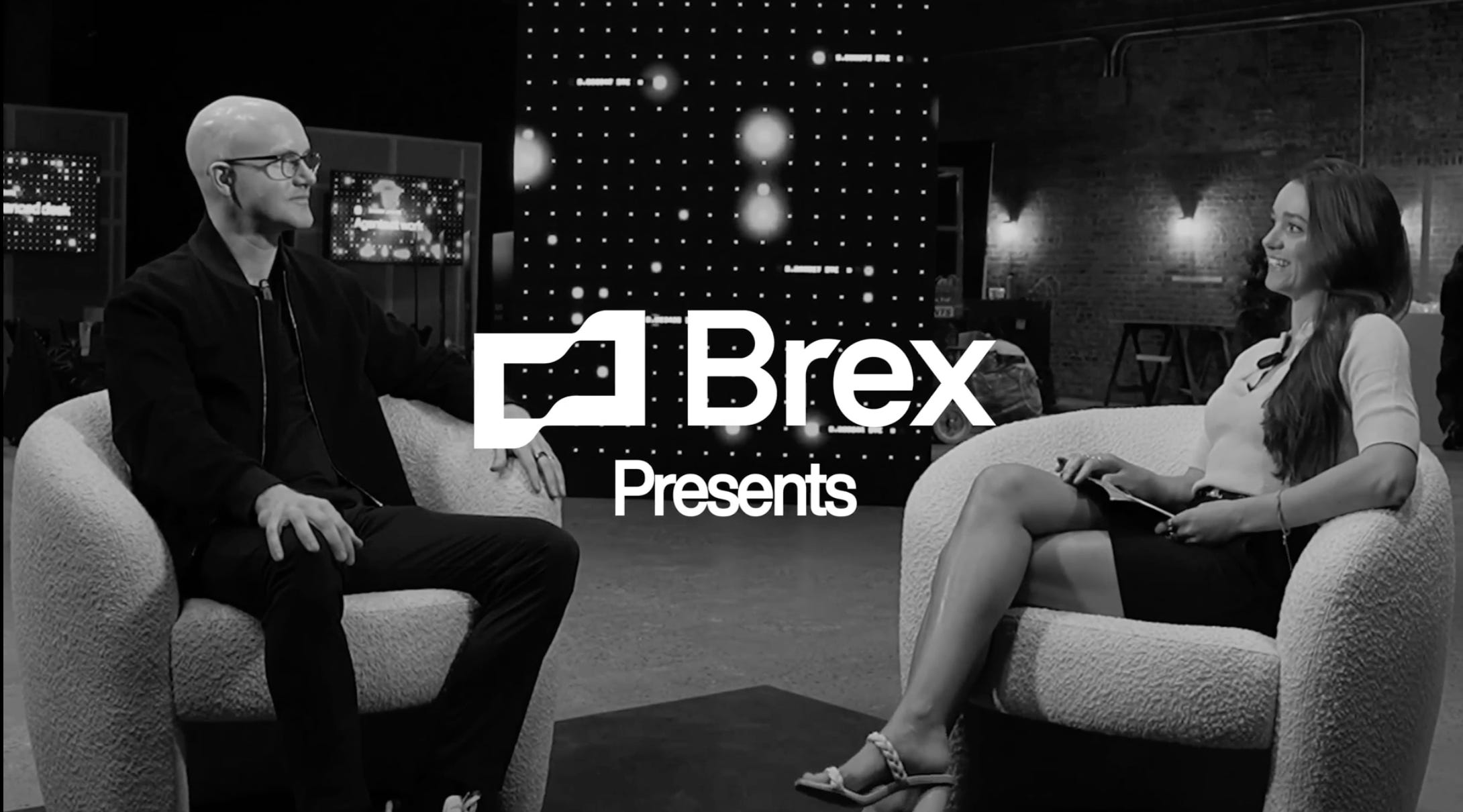
Brian Armstrong, Co-Founder & CEO of Coinbase, takes us BTS of the Coinbase System Update.. going deeper into how Coinbase is rebuilding around intelligence & making investing more accessible for the entire world.
→ Listen on X, Spotify, YouTube, Apple
We cover tokenized equities, an SEC-registered AI agent advisor, and the unified global liquidity approvals that bring Coinbase's offshore and US order books together. Brian explains why 4 billion people remain unbrokered, how the Everything Exchange works, and where pre-IPO perps fit as nearly $4 trillion in new IPOs come to market (SpaceX, OpenAI, Anthropic).
On AI: 1,200 full-time agents now work at Coinbase, team sizes are shrinking to as few as 1 person, and intelligent routing to open source models is flattening the company's AI cost curve.
Brian also gets into economic freedom, his time in Argentina, accredited investor reform, NYT hit piece, & the mentors he leans on.
BIG thank you to the New York Stock Exchange for video production.
𝐓𝐈𝐌𝐄𝐒𝐓𝐀𝐌𝐏𝐒
(00:00) Brian Armstrong, Co-Founder & CEO of Coinbase
(00:45) Backstage before the Announcements drop
(01:47) Why Tokenized Stocks never worked before until now
(03:58) Inside Coinbase Advisor: The SEC-Registered AI Investment Agent
(05:36) The real mission behind every Coinbase product
(06:55) Does the average American feel economically free?
(08:42) What Argentina taught Brian about Capitalism
(11:16) Why younger generations are drifting toward Socialism
(13:01) What Roblox reveals about the next generation
(13:57) Why no one in Argentina plans for the future
(18:17) How Crypto is rewriting financial infrastructure
(20:20) The Strategy behind Coinbase's "Everything Exchange"
(21:28) Building the most trusted brand in the Crypto Industry
(23:49) Prediction Markets, Dry Powder & Reading Market Cycles
(26:07) The Pre-IPO loophole Coinbase built for everyone else
(28:18) Why Coinbase wins the super app war
(29:40) The tweet that got 24 million views
(32:22) Will AI actually kill jobs?
(36:03) How Brian stays on top of everything
(38:19) Founder Energy vs. Operator Energy
(39:33) AI has a branding problem
(46:41) Will Anthropic and OpenAI just build every company?
(48:12) Who is Coinbase's real competitor?
(51:25) The Announcement Brian is most excited about
(53:03) Getting $4 trillion of new IPO wealth onto Coinbase
(54:08) The mentors who shaped Brian Armstrong
Brought to you by:
Brex—The intelligent finance platform: cards, expenses, travel, bill pay, banking—wrapped into a high-performance stack. Built for scale. Trusted by teams that move fast. visit → brex.com/sourcery

Turing—Turing partners with frontier AI labs to improve model capabilities in coding, reasoning, tool use, & multimodality, as well as with Fortune 500 enterprises to build & deploy end-to-end agentic AI systems in mission-critical workflows Visit: turing.com/sourcery
VCX—VCX is the public ticker for private tech, allowing investors of all sizes to invest in venture capital. View The Portfolio at GetVCX.com
Deel—Deel is the global people platform that helps startups hire, manage, pay, and equip anyone, anywhere. Trusted by more than 35,000 fast-growing companies, Deel is the people platform that just works, so teams can scale without the chaos. Visit: deel.com/sourcery
Public-–Investing platform Public just launched Generated Assets, which lets you turn any idea into an investable index with AI. With Generated Assets, you can build, backtest, refine, and invest in any thesis with AI. Gone are the days of one-size-fits-all ETFs. Try it today: public.com/sourcery
Merge—The leading provider of customer-facing integrations and agentic tools for frontier LLMs, Fortune 500 organizations, and B2B SaaS companies. Visit: https://merge.dev
Brian Armstrong: Tokenized Stocks, AI Agents, & Rebuilding Coinbase Around *Intelligence*
Brian Armstrong, co-founder and CEO of Coinbase, sat down with Sourcery backstage ahead of the Coinbase System Update, a twice-yearly event where the company details everything it built in the prior half. The conversation moved across tokenized equities, an SEC-registered AI advisor, the structure of private markets, and how a regulated financial company is reorganizing itself around AI.
→ Listen on X, Spotify, YouTube, Apple
Putting Stocks on Crypto Rails
Coinbase is moving stocks onto crypto rails backed one-to-one by the underlying share, rather than as the synthetics and derivatives that earlier products relied on. Armstrong drew the parallel to stablecoins, where a trusted, fully backed token unlocked broad adoption. The same dynamic, in his framing, is now within reach for equities as market structure legislation advances.
The reach of the product is the point. “There’s actually about 4 billion people in the world today who are unbrokered. They don’t have access to any high-quality US investments.” Tokenized stocks are designed to trade 24/7, settle on chain, and move as easily as any other token, including peer-to-peer transfers.

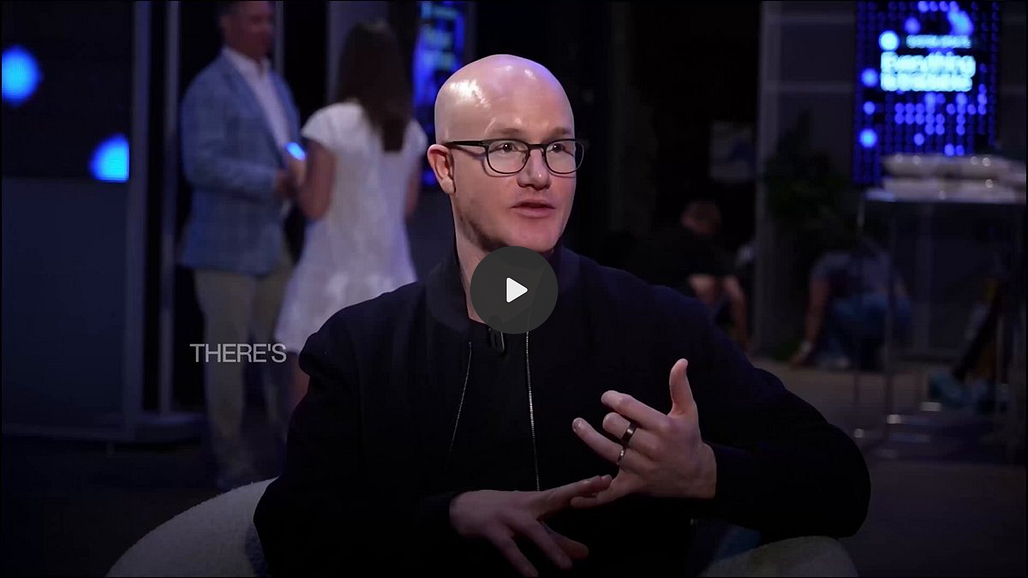
Armstrong positioned Coinbase as the natural issuer of that one-to-one token. “Coinbase is the most trusted brand in crypto.” The company holds the underlying stock, mints a token on top of it, & opens access to holders worldwide who previously had no route into US companies.

An SEC-Registered AI Advisor
Coinbase Advisor is built directly into the Coinbase app and can research, conduct trades, run tax loss harvesting strategies, and handle financial education in plain English. The distinguishing move is regulatory. Rather than disclaim its output, Coinbase registered the agent itself. “We’re the most trusted brand in crypto. Why don’t we build this the right way & actually make it real investment advice?”

That required a conversation with the SEC about registering an AI agent as the investment advisor, not a human behind it. Armstrong said the regulator agreed. “They let us register an AI agent as an SEC-registered investment advisor,” with the result that the guidance the product gives can be described as investment advice.
The human remains in the loop on recommendations today, with the agent researching and proposing while the user approves. Armstrong framed the data this generates as a long-term asset. The company is collecting it to build what he called a frontier model for investing, on the view that scaling laws apply to that data set the way they apply to any other.

Economic Freedom as the Operating Thesis
The product roadmap sits inside a broader argument about economic freedom. Armstrong tied Coinbase’s mission to research correlating high-freedom economies with outcomes beyond GDP per capita, including happiness, environmental treatment, conditions for the poorest 10%, and reduced corruption, war, and infant mortality. “We believe that economic freedom is a foundational necessity for all civilizational progress.”

His year in Argentina is the reference case. He described how hyperinflation and weak property rights reshape behavior, pushing people toward short horizons and away from the 10 to 20 year timelines that wealth generation and company building requires. “It really changes the entire fabric of society to have high inflation and low economic freedom in a negative way.” High inflation, in his account, harms the poorest most, since they hold wealth in cash while the wealthy access inflation-resistant assets.
Armstrong was direct about his economic priors. “We believe capitalism is a good thing, and we want everybody to have a piece of it.” On the generational drift toward socialism, he argued the case has to be remade each cycle. “Every generation has to kinda learn this from first principles if they haven’t been exposed to it.”

The Everything Exchange & the Case Against Accredited Investor Rules
The Everything Exchange is Coinbase’s attempt to make every asset class tradable in a single account. “How do we get every asset class in the world tradable in one account?” The customer benefit Armstrong cited is capital efficiency, since assets in one place support better margin and credit, alongside 24/7 trading for anything running on crypto rails.

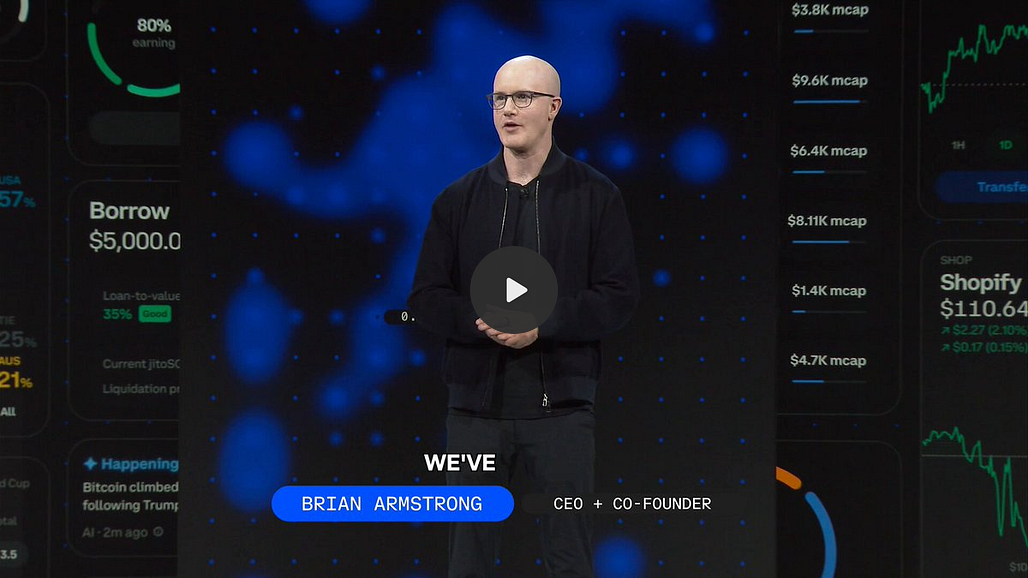
That framing led into private markets, where Armstrong was sharpest. With nearly $4 trillion in new IPOs coming to market, he argued AI companies have absorbed much of the world’s risk capital. “People are just trying to get as much of their risk capital into SpaceX, OpenAI, and Anthropic right now.” Coinbase’s answer is pre-IPO perps, which launched alongside SpaceX before it went public and, per Armstrong, saw significant volume.
His critique of the accredited investor regime was the core of the segment. The rules, designed to protect retail, in his view produce the opposite. “It makes it so only rich people can get richer. It’s like the most regressive tax.” Retail can only access many companies once they are already valued in the trillions, after the upside has accrued. His proposed fix swaps the net worth threshold for a knowledge test. “The better way to do it would be a financial literacy test.”


Rebuilding the Company Around Intelligence
Internally, Coinbase is reorganizing around AI in ways that show up in the engineering metrics. “The amount of code being shipped per developer is up about 2X year over year,” with top engineers shipping on the order of 100 pull requests a week. Armstrong said the company is taking those outlier builders and using them to train the rest of the organization.
Team structure is changing with it. The traditional pod of 10 is compressing to two to four people, and in some cases one. “In some cases, we’re seeing a one-person team,” because the human works alongside roughly 10 AI agents that create pull requests and designs and participate in Slack. By Armstrong’s estimate, “there’s about 1,200 full-time agents working at Coinbase now,” measured by agent working hours against a typical 40 to 60 hour week.
Crucially, he tied the output gains to quality rather than against it. “We’re actually seeing the rate of bugs and incidents go down per line of code shipped.” The next reach is recursive self-improvement, where agents aggregate customer feedback, plan and draft the code, and a human reviews a batch of changes each day rather than editing each one. Armstrong’s emphasis was on updating the context that generates the work, not the work itself.
On unit economics, Coinbase built intelligent routing on top of an open source project and modified it, sending simpler queries to cheaper models. Open source models run roughly 3 to 6 months behind the frontier but about 99% cheaper for inference. The result is that token usage keeps growing while cost growth flattens. “My guess is that within 12 to 18 months, 80% of our workloads will be going toward models that are 99% cheaper,” with the remaining 20% reserved for frontier-level tasks aka “IQ-maxxxxxxing.”

Building the Financial Rails for the Agentic Economy
Armstrong’s view of where this leads is an economy run by orchestrated agents. “You’re increasingly gonna talk to one agent. That agent is gonna orchestrate hundreds of thousands of other agents.” Those agents pay for goods and services and hire other agents into teams, which requires payment infrastructure built for very small, very frequent transactions.
The constraint is identity. Agents cannot hold a piece of government-issued paper or fill out a CAPTCHA, so they need their own financial accounts and self-custodial wallets. Coinbase is powering this through its base MCP API, giving agents a way to transact natively. Armstrong called this the infrastructure layer for the agentic economy and the announcement he was most excited about.
On the labor question that sits underneath all of it, Armstrong landed in the optimistic camp.
“AI is gonna eliminate tasks & toil. It’s not gonna eliminate jobs, in my view.”
His expectation is that smaller average team sizes let companies do more things, employment stays roughly constant, and work becomes optional over the long term while most people still choose to work, much as podcasting or running a company would not have counted as work a century ago.
He was equally clear about who builds what. Armstrong does not expect the large model labs to build every company, arguing they are focused on broadly applicable foundational models and are unlikely to enter regulated financial services. That leaves room for vertical frontier models, including the investing model Coinbase intends to build on its own customer data.
Distribution, Media, & Standing for a Position
The final throughline was posture. Armstrong spends roughly 80% of his media time on new media, including podcasts, Substack, + X, and about 20% on traditional outlets, mostly to reach policymakers and readers over 50 or 60. His argument is that companies should own their distribution and publish directly.


He recounted a negative New York Times piece that followed Coinbase’s Mission First blog post and described how little it ultimately moved the business. “It took getting a negative article or two, which was scary at first, to realize it just didn’t matter.” That realization, in his telling, freed him to be more creative and more confident rather than optimizing for optics.
The advice he drew from it was a stance, not a tactic. “I think you should just have an opinion, stand for it, and don’t apologize.” He extended the same logic to AI’s reputation, arguing the labs would be better served by making the case for the technology directly than by fearmongering or inviting regulation.
He closed on the people he learns from, citing the idea that “you’re the average of your five closest friends,” naming Marc Andreessen on policy + comms, and Tobi Lutke on building an AI-native organization, and describing a structured mastermind cadence of monthly meetings & an annual trip that keeps those relationships current.
This was so much fun, really enjoyed spending more time with the Coinbase team & having a sneak peek into their latest updates. Check out more by following Coinbase & follow Brian on X.. you won’t be disappointed.
→ Listen on X, Spotify, YouTube, Apple
The material presented on Molly O’Shea’s website are my opinions only and are provided for informational purposes and should not be construed as investment advice. It is not a recommendation of, or an offer to sell or solicitation of an offer to buy, any particular security, strategy, or investment product. Any analysis or discussion of investments, sectors or the market generally are based on current information, including from public sources, that I consider reliable, but I do not represent that any research or the information provided is accurate or complete, and it should not be relied on as such. My views and opinions expressed in any website content are current at the time of publication and are subject to change. Past performance is not indicative of future results.
Paid Endorsement. Brokerage services by Open to the Public Investing Inc, member FINRA & SIPC. Advisory services by Public Advisors LLC, SEC-registered adviser. Crypto trading provided by Zero Hash LLC, licensed by the NYSDFS. Generated Assets is an interactive analysis tool by Public Advisors. Output is for informational purposes only and is not an investment recommendation or advice. See disclosures at public.com/disclosures/ga. Matched funds must remain in your account for at least 5 years. Match rate and other terms are subject to change at any time.