

AI's "Drug Pushers" & Sovereign AI
Andrew Feldman, Co-Founder & CEO of Cerebras Systems, joins Molly O'Shea at the RAISE Summit in Paris to talk all things chips, inference, AI deals, & IPO.
→ Listen on X, Spotify, YouTube, Apple
Recorded 2 months after Cerebras went public at a $56B valuation and popped to roughly $95B on its first day, this conversation covers the $20B+ OpenAI deal, why inference is the new battleground, the state of the AI data center build-out, and Feldman's take on the circular deals reshaping the industry.
We also get into what it means to create 1,000 millionaires, how co-design between hardware and software actually works, data centers in space, and why Feldman thinks AI could mean the next generation never knows anyone who dies of cancer.
Cerebras (Nasdaq: CBRS) builds the WSE-3, a single wafer-scale chip with 4 trillion transistors and 900,000 cores, and the CS-3 system it powers.
Special thank you to Brex, MongoDB, & AssemblyAI for helping make this RAISE AI Summit mini-series in Paris, France happen.

𝐓𝐈𝐌𝐄𝐒𝐓𝐀𝐌𝐏𝐒
(00:00) Andrew Feldman, Co-Founder & CEO at Cerebras Systems
(00:49) Why hardware suddenly became the coolest industry in tech
(01:51) What changed at Raise AI Summit
(03:01) Inside the $20 billion Cerebras - OpenAI deal
(05:50) What actually changes two months after an IPO
(06:32) Turning 1,000 employees into millionaires
(07:52) Staying sane during an AI gold rush
(10:44) Life after the IPO plateau
(11:45) The truth about the global data center shortage
(12:56) Why data centers are borrowing jet engines for power
(14:44) Are data centers really headed to space?
(15:37) The shift to designing chips and software together
(17:39) The biggest misconception about co-designing chips and software
(18:31) Inside SpaceX's multi-billion dollar AI deals
(20:06) NVIDIA's playbook for locking out competitors
(20:54) The hidden cost behind free tokens
(22:52) Andrew's response to Karp's sovereign AI thesis
(24:18) AI's biggest win might be curing cancer
(26:50) Peptides and biohacking
(28:00) How AI could finally fix the broken education problem
(29:46) The mentors who shaped Andrew Feldman's career
Brought to you by:
Brex—The intelligent finance platform: cards, expenses, travel, bill pay, banking—wrapped into a high-performance stack. Built for scale. Trusted by OpenAI, Anthropic, Vercel, Granola, Deepgram, & Sourcery.. teams that move fast AF. visit → brex.com/sourcery

MongoDB–Millions of developers and more than 65,200+ customers across industries – including ~75% of the Fortune 100 – rely on MongoDB for their most important applications. With integrated capabilities for operational data, search, real-time analytics, & AI-powered data retrieval, MongoDB helps organizations everywhere move faster, innovate more efficiently, & simplify complex architectures. visit → mongodb.com/ai
AssemblyAI–Millions of developers use AssemblyAI to power their voice ai apps & features. One API gives you access to best-in-class speech-to-text, voice agent, & speech understanding models for both pre-recorded and real-time audio. Granola, ClickUp & HeyGen are scaling with AssemblyAI - get $50 of free credits today → AssemblyAI.com/sourcery
Andrew Feldman on the $20B Bet, Creating 1,000 Millionaires, & What’s Actually Happening with AI Deals
Andrew Feldman, Co-Founder & CEO of Cerebras, joined Sourcery at the Raise Summit in Paris, 2 months after the company’s IPO. He covered the $20B OpenAI deal, why inference has become the center of gravity in AI compute, and why he believes the data center build-out is already behind.
He also weighed in on the circular deals reshaping the market, the difficulty of hardware-software co-design, and the case for AI in medicine and education.
→ Listen on X, Spotify, YouTube, Apple
Corporate Adulthood
Cerebras priced its IPO at $185 for a $56B valuation and opened at $350, one of the largest US tech IPOs in years. A first-day pop briefly carried its market cap to roughly $95B before it settled, and the stock now trades around a $60B valuation following a Q1 report that pressured the stock on a gross-margin forecast Feldman later called misunderstood on CNBC.
Feldman does not frame the IPO as a finish line. “Getting to an IPO is not the end of a journey. It’s sort of a plateau. It’s the arrival at corporate adulthood. It is the achieving one plateau so that you can climb others, & our opportunity’s gotten bigger.”
The main post-IPO change he cited was inbound volume, aka people wanting things from him. “If you get 80 emails a day of different people asking you for something, that’s not work. That’s just this range of people who want something of one form or another. To meet you, your time, for you to present, for you to donate to their cause.”
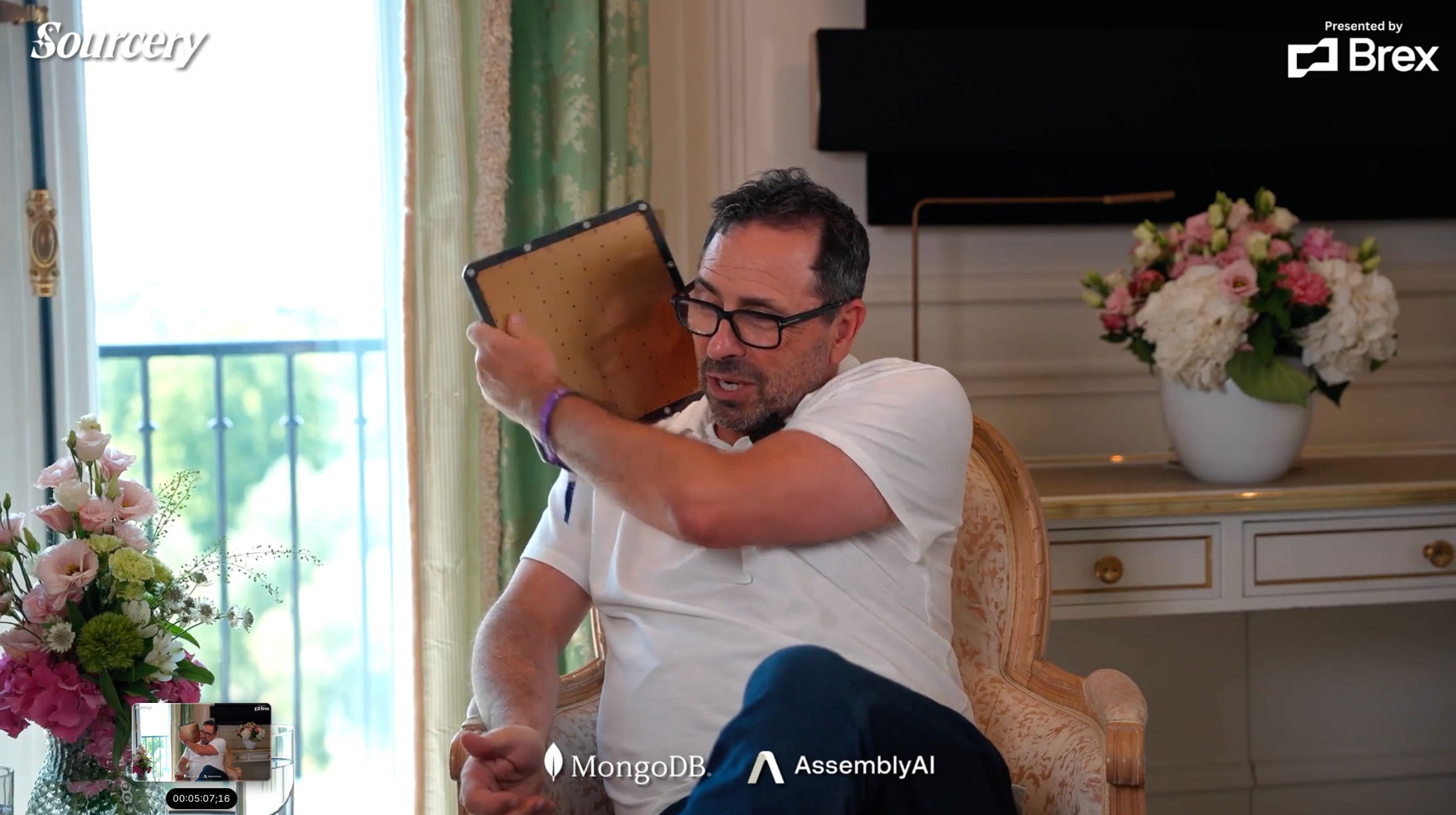
He also addressed the physical chip-on-the-shoulder image he posted after the IPO, and why he wanted to keep that tone as a public-company CEO. “People assume that as a CEO of any size or an entrepreneur that it’s always peaches & cream, & it’s just not the case. There’s enormous amount of hard work. There’s sacrifice that you make & that your family makes. They see you less, & it’s not for a little bit. It’s for years.”


The $20B Deal & Why Inference Won
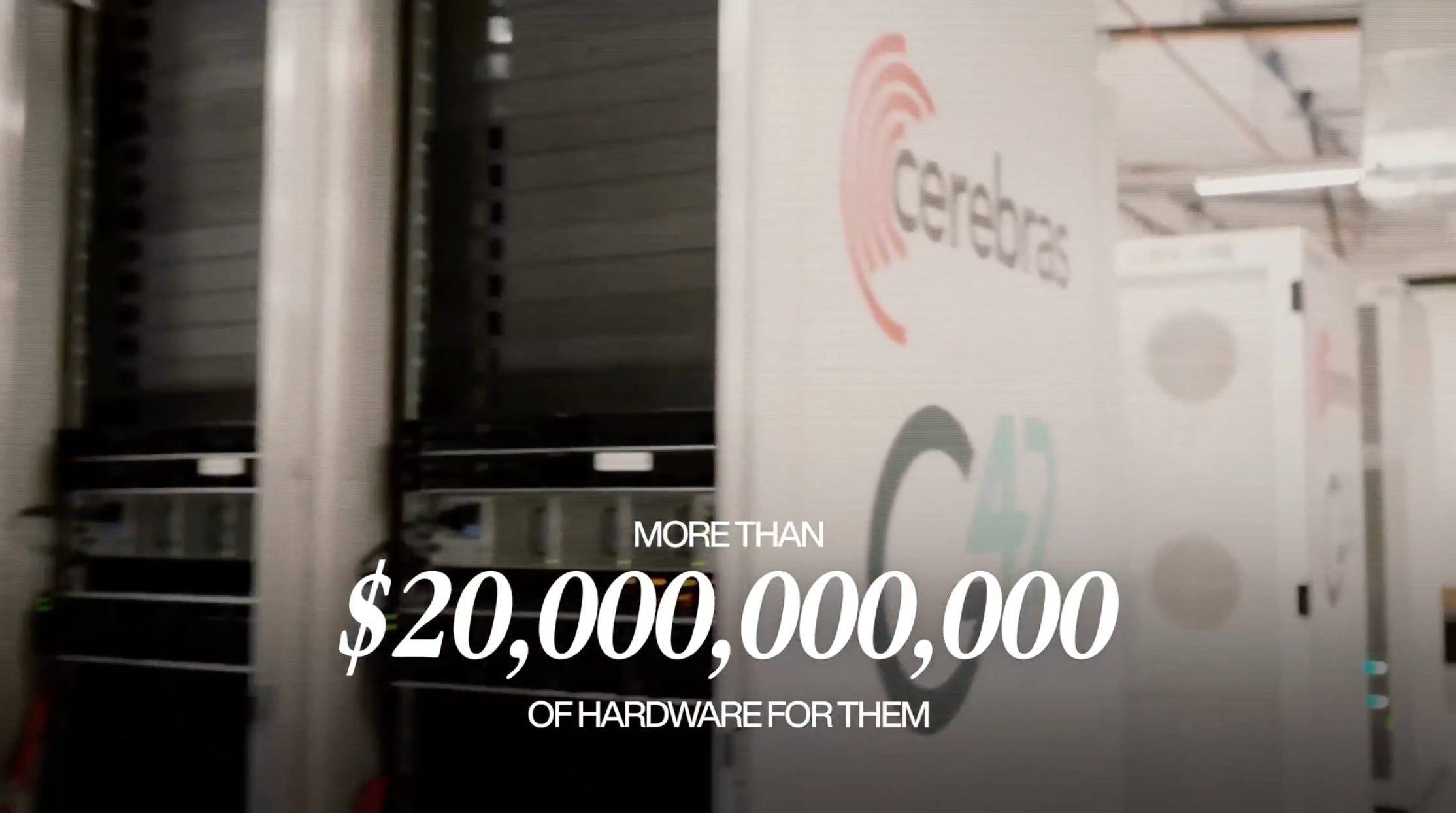
The OpenAI agreement, announced in January, is the largest commercial driver behind Cerebras. “We announced in January a huge partnership, one of the biggest deals done in Silicon Valley history. We’ll be doing more than $20 billion of hardware for them over the next several years.” Public reporting puts it at 750MW of inference compute over 3 years, accounting for the majority of a backlog near $24.6B.
The deal reflects a broader shift in where value is moving, from training the models to running them. Feldman traced the logic from creation to consumption, and landed on speed as the differentiator. “We make AI with training, & we use AI with inference. And so as the models and as the AI we made becomes useful, everybody wants to use it, & inference is the mechanism through which we use it. And so now we have smart AI, & people wanna use it. When they wanna use it, they want it to be fast, & that’s where we come in, & where the fast is not by a little bit but by 20x.”
The underlying product is the WSE-3, a single wafer-scale chip with 4 trillion transistors and 900,000 cores, packaged into the CS-3 system, roughly the size of a mini-fridge. On public benchmarks the chip has reached about 2,500 tokens per second per user on Llama 4 Maverick, more than double Nvidia’s DGX B200 on the same model. His 20x figure is a broader comparison against typical GPU cloud throughput rather than the head-to-head B200 number.


We Are Behind
Against the common view that AI infrastructure is racing ahead of need, Feldman argued the opposite. Asked whether the industry is building for future demand or trying to catch up, he was direct. “We are behind.”
The reason is that physical infrastructure moves far more slowly than AI demand arrived. “Data centers had historically moved at the speed of real estate. Somebody would decide to build a building, and two years later, after permits, they poured concrete, & the building would go up. Two years ago, nobody cared about AI. The AI explosion’s happened so quickly. We’ve outstripped the demand for compute, for memory, and where do these things go? They go to these buildings, & we haven’t made them fast enough.” The binding constraint, in his telling, is capacity.
Cerebras is moving on both fronts. On July 9 the company announced a roughly 7x expansion of CS-3 production with Flex in Milpitas, alongside a plan for 200MW of AI compute across Europe by late 2027, with initial sites in France and the Nordics supporting OpenAI workloads. Feldman noted the scramble is reshaping the data center itself, with operators reaching for fuel cells and jet engines to power parts of the stack that had gone unchanged for about 20 years.
The same demand pressure is driving talk of moving compute off the planet entirely. Feldman sees a genuine fit for wafer-scale in orbit, since a single large chip sidesteps the problem of getting many small ones to communicate, but he was measured on the timeline. “I don’t think we’re in danger in the near term of having a data center in space. I think it’s more than five years away.”
AI “Drug Pushers”
Feldman was direct on the circular deals reshaping the market, framing his concern around their purpose. “I’m concerned that they are ways frequently for Nvidia to exercise market strength. They’re ways for Nvidia to use their balance sheet to limit competition. If they invest in a Neo cloud, the Neo cloud is less likely to use a non-Nvidia chip. If they invest in a model builder, there’s pressure not to use other people’s chips. That’s what I’m more worried about.”
He carried the same logic to the free compute credits being handed to startups, & did not soften the analogy. “I think these are drug pushers. Here, little girl, try a little bit. Just a little bit.” His solve for founders is to take the offer without becoming reliant on it, spreading demand across suppliers including AMD & Cerebras. “They should take it and then never be dependent. That never ends well.”
Even from inside the industry, he said, the true shape of many headline deals is hard to read, with some carrying real commitments and others little more than announcements. He offered the GPU-leasing market as an example of how the current dynamic emerged, tracing it back to X’s spare capacity. “X had available capacity because their Grok model wasn’t used very much. So they had these GPUs that were sitting around, & so they leased a whole block of them to Anthropic. And they looked up & said, ‘Whoa, that’s a pretty good idea.’”


That skepticism connects to the sovereign AI debate, recently pushed by Alex Karp on CNBC, over whether companies and nations should own the full stack. Feldman’s version is narrower, built around optionality rather than ownership. “You shouldn’t be dependent on Nvidia. You shouldn’t be dependent on one model maker. What you’d like to be as a nation or as a big company is you like to have choices.” The exception is proprietary data. “If you have unique data, be sure you don’t give that away, & you get the credit for your data, & it doesn’t help make somebody else’s model better.”

Co-Design & the Hard Part
If there is a durable edge in this cycle beyond raw speed, Feldman locates it in co-design, developing hardware and software together rather than separated by an operating system. He framed it as a break from how the industry historically worked.
"Historically you made chips & you ran software on them. AI has gotten so large & speed is so important that what they're doing is they're thinking about the design together. What changes could we make in software that would advantage the hardware, or as we're designing the hardware, what changes could we make that would make the software easier to run?"
He pointed to Cerebras's visibility into OpenAI's roadmap, and Google's development of the TPU alongside its Gemini and DeepMind teams, as the clearest examples.
The catch is that co-design is far harder than it sounds, and the assumption that it just takes goodwill misses the real friction. “The misconception is that it’s easy and all you need to do is get in a room. The software guys think one way. The hardware guys think a slightly different way. Anything you do to make it easier to write the software makes it harder to do the hardware. And these are really hard trade-offs.”
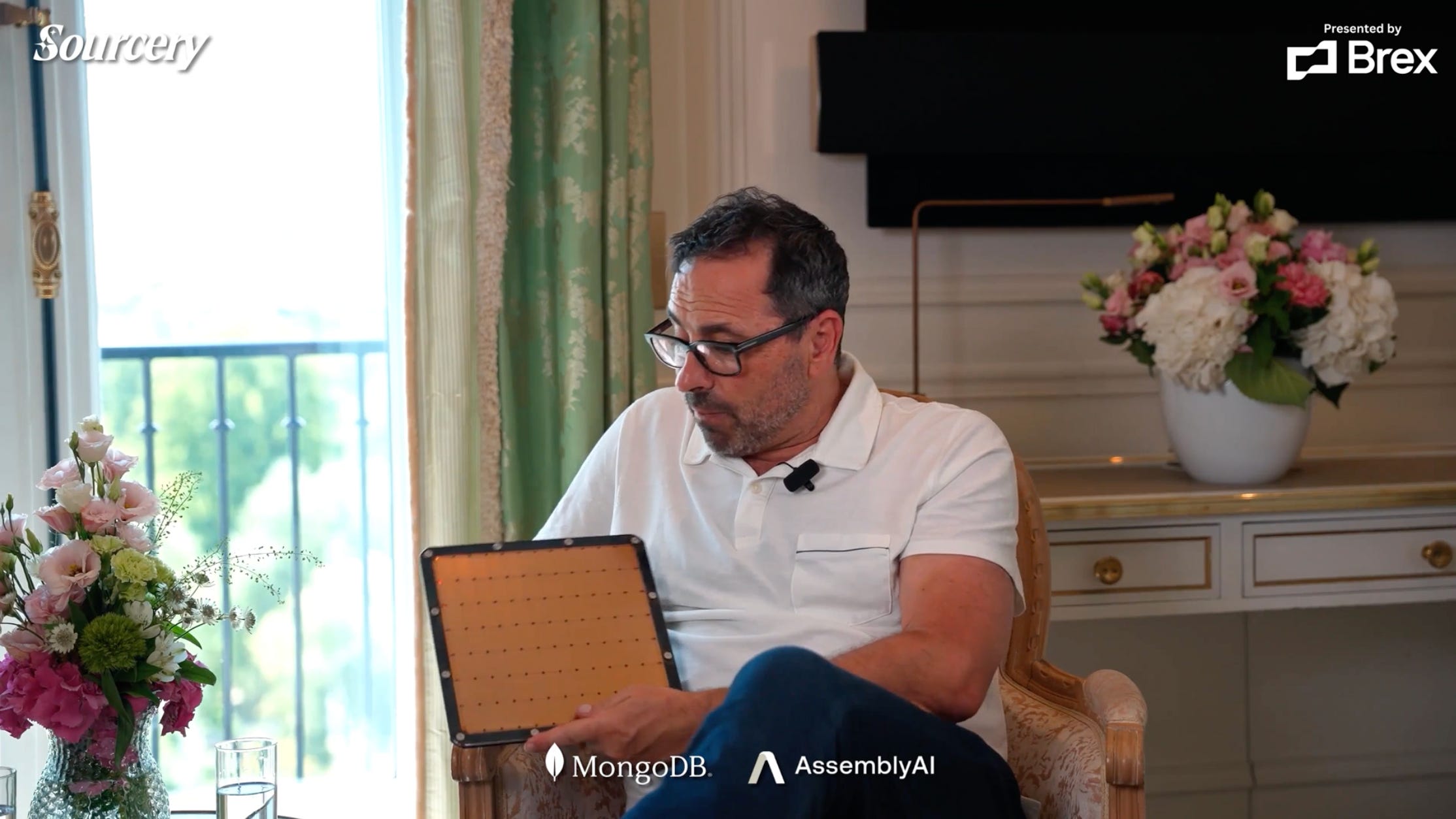
The product itself remains a strikingly physical object. Feldman described a chip that dwarfs anything else on the market yet still slots into standard infrastructure. “While we build this super big chip, the chip that’s like 58 times larger than any other chip, it goes in a metal enclosure that’s about the size of a fridge for a dorm room. And we put a couple of those in a standard rack.” Independent write-ups put the die closer to 50x a conventional GPU depending on the comparison, so 58x reflects his and Cerebras’s own framing.

The Case for AI
Asked about the broader upside of AI, Feldman pointed first to medicine. “We have a chance for our children or the next generation not only to not die from cancer, but to not know anybody who died from cancer. I think that is a real, achievable goal in 25 years. When we think about what AI can do, writing better code is cool, and there’s a huge market for that. But I think what it can do to better humanity is rid us of the number one killer of adults.”
He extended the point to self-driving, arguing machines already outperform human drivers, and to drug discovery, citing Brian Armstrong’s New Limit and the broader wave of longevity and GLP-1 work. On AI risk, he argued critics tend to weigh only one side. “The problem with the doomers is they’re only looking at one side of the ledger. To look at this with clear eyes, you gotta look at both sides of the ledger. You gotta say, ‘Look, we’re gonna use a lot of power.’ It’s true. And AI has some real risks. It’s true. And on the other side of the ledger, here’s some things it can do really differently.”

He used education as his central example. “We’ve known for 2,000 years the right way to educate children, and we never do it. Ever. We knew that the right way to educate Alexander the Great was to have a tutor, and the smartest tutor, Aristotle was, and that you teach each child differently. With AI, we can do that. We can get you a tutor that’s right for you, and what’s more, the tutor can be running in the background saying, ‘Look, 3% of students make this type of error, and the best way to teach them to overcome this weakness is with this approach.’”
Creating 1,000 Millionaires & Founder Lessons
Feldman has now taken 2 companies to major liquidity events, and he measures them partly by the wealth they created for the people who built them. His last company minted roughly 100 millionaires. Cerebras, at IPO, produced close to 1,000, a figure he clarified refers to current and former employees, not investors.
He was careful to separate that from chasing money as a goal. The people he wants to work with, he said, build hard things whether or not they are in fashion. “For the type of people I love working with, they like building stuff, & they like building hard stuff when it paid a little, when it was out of fashion. When hardware was uncool, they were still building hardware, because that’s what they like to build.”
What makes the wealth creation meaningful to him is the asymmetry of what employees put in versus what investors do. Investors are diversified across many bets; an early employee is not.
“When someone bets five or seven years of their career, & a career is 30 years, they’re betting a sixth of their professional career. And when you get to deliver for them, that’s a great feeling & one I’m proud of every day.”
Asked who helped him get there, Feldman credited venture capitalist Pierre Lamond and former Veritas CEO Mark Leslie, both for their standards. “There was a venture capitalist named Pierre Lamond, and he’s now in his 90s. He invested in us at Cerebras when he was the ripe age of 84. He’s forgotten more about making chips than I’ll ever know.” Leslie, who ran Veritas, was the other name, one of the “wise people” he said taught him to demand a great deal of himself and others.
Day to day, he pointed to his 5 co-founders, all carried over from his previous company, with a wry note that “five is, in almost every case, too many founders.” His summary of why it works came back to the same idea that ran through the rest of the conversation, that the work itself is the point.
“Chasing money is not the path to money. The path to happiness is working on projects you like, with colleagues that are interesting, for people with integrity. And if you do that, the money will come.”
→ Listen on X, Spotify, YouTube, Apple
The material presented on Molly O’Shea’s website are my opinions only and are provided for informational purposes and should not be construed as investment advice. It is not a recommendation of, or an offer to sell or solicitation of an offer to buy, any particular security, strategy, or investment product. Any analysis or discussion of investments, sectors or the market generally are based on current information, including from public sources, that I consider reliable, but I do not represent that any research or the information provided is accurate or complete, and it should not be relied on as such. My views and opinions expressed in any website content are current at the time of publication and are subject to change. Past performance is not indicative of future results.
Paid Endorsement. Brokerage services by Open to the Public Investing Inc, member FINRA & SIPC. Advisory services by Public Advisors LLC, SEC-registered adviser. Crypto trading provided by Zero Hash LLC, licensed by the NYSDFS. Generated Assets is an interactive analysis tool by Public Advisors. Output is for informational purposes only and is not an investment recommendation or advice. See disclosures at public.com/disclosures/ga. Matched funds must remain in your account for at least 5 years. Match rate and other terms are subject to change at any time.