


Sleepwalking Into a Crisis
David Friedberg, CEO of Ohalo, & Co-Host of All-In joins Sourcery to share his take on America's 250th anniversary, reflecting on where does the country actually stand? And how do the bottom 50% get left behind?
This is a real damn masterclass.
→ Listen on X, Spotify, YouTube, Apple
He argues the wealth gap is widely misunderstood, pointing to roughly $183 trillion in total US household net worth, compared to about $8 trillion held by billionaires and $4 trillion by the bottom half of Americans. His view is that the rich didn't take everything. Instead, the bottom 50% never got to own the productive assets that created the last 50 years of wealth, as Friedberg puts it: "The truth is that the bottom 50% were left behind because of bad tax policy, because of spending in healthcare, housing, and education, & because we didn’t give them access to owning capital.”
“I don’t blame Americans for finding themselves in the situation that they’re in. I blame the bad policy that brought us to this moment.”
“This can’t just be a CCP psyop. It’s coming from a place of hurt, of turmoil, of fundamental struggle.”
“I’m saying everyone is right, but we need to be honest about what has happened to get us here and what the right path is to get us out of it.”
Friedberg breaks down the policy decisions he believes created today's affordability crisis, including a tax code that taxes capital below labor, a Social Security system invested in Treasury bonds instead of equities since 1982, the shift away from pensions after ERISA, & government policies that drove housing, healthcare, & education costs higher. He argues those are the failures that have created the conditions driving the rise of socialism in America.
"Americans should feel good about America. We just have to fix the policies."
BIG thank you to David for coming on to share what he’s been working on behind the scenes, this was INSANE. So much research & data. A lot to learn from.
𝐓𝐈𝐌𝐄𝐒𝐓𝐀𝐌𝐏𝐒
(00:00) David Friedberg, CEO at Ohalo Genetics & Co-Host at All-In
(01:11) Is California functionally bankrupt?
(02:28) The real reason Americans can't afford anything anymore
(12:13) Why a wealth tax is really government theft
(21:22) Why blaming billionaires is a political strategy, not a solution
(25:33) How Socialism grows like a virus
(30:40) Inside Trump Accounts: a 401(k) for every American
(34:22) Why rational arguments can't compete with viral outrage
(40:56) Jeff Bezos's radical fix for the wealth gap
(45:47) 5 years till Social Security is bankrupt
(46:35) Is AI actually coming for your job?
(50:29) The K-shaped economy
(55:39) Five things America needs to fix to survive
(59:21) David's research process
(1:02:54) "It's about making Americans feel good again"
Brought to you by:
Brex—The intelligent finance platform: cards, expenses, travel, bill pay, banking—wrapped into a high-performance stack. Built for scale. Trusted by OpenAI, Anthropic, Vercel, Granola, Deepgram, & Sourcery.. teams that move fast AF. visit → brex.com/sourcery

Turing—Turing partners with frontier AI labs to improve model capabilities in coding, reasoning, tool use, & multimodality, as well as with Fortune 500 enterprises to build & deploy end-to-end agentic AI systems in mission-critical workflows Visit: turing.com/sourcery
VCX—VCX is the public ticker for private tech, allowing investors of all sizes to invest in venture capital. View The Portfolio at GetVCX.com
Deel—Deel is the global people platform that helps startups hire, manage, pay, and equip anyone, anywhere. Trusted by more than 35,000 fast-growing companies, Deel is the people platform that just works, so teams can scale without the chaos. Visit: deel.com/sourcery
Public-–Investing platform Public just launched Generated Assets, which lets you turn any idea into an investable index with AI. With Generated Assets, you can build, backtest, refine, and invest in any thesis with AI. Gone are the days of one-size-fits-all ETFs. Try it today: public.com/sourcery
David Friedberg on America’s Future
David Friedberg joined Sourcery to discuss the state of the US economy in the country’s 250th year. The conversation covered the structure of American wealth, California’s fiscal position, the policy decisions he identifies as the root of the affordability crisis, and the reforms he argues should replace the wealth tax proposals now circulating in California & Washington.
→ Listen on X, Spotify, YouTube, Apple
The Wealth Distribution Data
Friedberg’s starting point is the wealth data he says most people get wrong. Citing Federal Reserve figures, total US household net worth stands at $183 trillion. Billionaires hold roughly $8 trillion of that. The bottom 50% of Americans hold roughly $4 trillion. Extending the top cohort down to households worth $50 million or more raises its share to about $23 trillion, which still leaves roughly $158 to $170 trillion, the large majority, with the middle class.
The standard concentration narrative misses where American wealth actually sits. The middle class with ~$158T, largely through equity ownership in 401(k)s and home equity, captured most of the gains of the last half century. The failure is concentrated in the bottom 50% at $4T, which was never positioned to own productive assets at all.
“It’s not like the rich have taken everything from the poor. That’s not true. The truth is that the bottom 50% were left behind because of bad tax policy, because of spending in healthcare, housing, and education, & because we didn’t give them access to owning capital.”
That exclusion, in his view, is the material basis for the socialist momentum in current politics, and government spending has functioned as fuel on the fire rather than a corrective.

California’s Fiscal Position
We started this conversation all the way back at the Hill and Valley Forum in March, with Friedberg’s hot take that “California is functionally bankrupt.” The evidence lays in the current state budget, which he puts $30 to $40 billion short and bridged with an accounting maneuver, plus another $30 to $40 billion in new spending proposed through a constitutional amendment on this year’s ballot. Layered on top of that is a pension cliff and what he described as the largest tax increase in California history, in a state that already carries the highest tax rates in the country.


While California is actually not an isolated case, it’s certainly the big bus hurdling to the edge of the cliff. The state is running ahead of a national trajectory shaped by policy decisions made in the mid-20th century, and the symptoms are the same everywhere. Costs for housing, education, and healthcare have outpaced incomes for most of the population, while asset owners have pulled away.
“The cost of everything has run away from the majority of Americans. They can’t afford stuff. The majority of Americans can’t afford to pay housing, they can’t afford their student loan, they can barely afford food, they definitely can’t afford healthcare, and they don’t know if they’ll ever be able to buy a home.”

3 Structural Missteps in Tax Code, Social Security, & Pensions
The first misstep in Friedberg’s account is the inversion of capital and labor taxation. Capital gains are taxed at 15% to 20% while labor income is taxed at roughly 40%, despite capital compounding on its own once accumulated. He argues the rates should have been flipped from the start, with labor always taxed less than capital, and that the inversion is a direct driver of the wealth gap.
The second is the 1982 change to Social Security, which directed the trust fund’s assets exclusively into US Treasury bonds yielding an average of 3.5% per year. The fund holds $2.7 trillion today, all of it lent to a government that has already spent the proceeds. “If you had put all the extra money that was put into Social Security since 1982 into the S&P 500, the Social Security Trust Fund would have an extra $37 trillion in assets sitting in it today.” Those assets would have belonged to the bottom 50%, the same cohort that today holds $4 trillion.
The third is the retirement divergence that followed the 1974 ERISA law. In 1980, 40% of Americans had a pension plan. Today it is under 8%. Government workers held at 90% coverage across the same period. Private-sector workers were pushed into 401(k)s, which turned out to be the better structure because they held equities, and that equity ownership is how the middle class built its $170 trillion. The bottom 50%, relying on Social Security, received a 3.5% Treasury yield instead of a share of American business. He also cited the Congressional Budget Office timeline that Social Security reaches insolvency within 5 years.
Affordability Crisis in Education, Healthcare, & Housing
Friedberg attributes the cost explosions in all 3 categories to the structure of federal involvement. In education, unlimited federal student lending removed every pricing constraint. Loans flowed to any student, at any school, for any degree, regardless of price or likely income outcome, and institutions responded by expanding administrative staff 6x over 30 years against flat enrollment while raising tuition continuously. The result is 45 million Americans who graduated with student loan debt in the last 10 years. “If you end the federal student loan program, I think you solve 90% of the problem in education.”
Healthcare follows the same mechanism. With the federal government as the dominant payer, providers price against a counterparty with no discipline, and costs rise across the system.
In housing, postwar policy pushed universal homeownership and concentrated most household net worth in a single asset. Once that happened, sustaining middle-class wealth required policies that push home prices up every year, which priced the next generation out. “Because we made everyone put all of their net worth in their home, and therefore we had to keep home prices going up to keep everyone’s net worth going up, people got screwed.”
His broader claim is that without reforming the federal role in housing, education, and healthcare, costs continue to compound and no tax change matters.

Wealth Tax Debacle & Property Rights
Friedberg opposed California’s proposed wealth tax on constitutional rather than personal grounds, noting he is not a billionaire & would not be directly affected. His objection rests on private property as a founding principle, and he anchored it in John Adams, who wrote that property must be secured or liberty cannot exist, & who warned that once society admits property is not sacred, anarchy & tyranny commence.
“Property must be secured, or liberty cannot exist.”
“The moment the idea is admitted into society, that property is not as sacred as the laws of God, & that there is not a force of law & public justice to protect it, anarchy & tyranny commence.
If ‘Thou shalt not covet,’ & ‘Thou shalt not steal,’ were not commandments of Heaven, they must be made inviolable precepts in every society, before it can be civilized or made free.” — John Adams
His practical concern is threshold creep. Current proposals have variously targeted net worths above $50 million, then $10 million, and $1 million, and the floor keeps moving lower & lower. “Once you open the door that says the government can take any of your property, suddenly all property is the government’s property, which leads to mob rule.” Beyond the principle, he argues the tax fails on its own terms. It drives capital flight, deepens discontent, and does nothing to address the actual problem, which is that the majority of Americans own no assets.
The episode connected this to Brian Singerman’s earlier appearance on Sourcery, where the former Founders Fund partner argued a wealth tax would ultimately hit the middle class harder than the top 1%. On why the proposals persist anyway, Friedberg pointed to electoral incentives. “It’s a lot easier to claim an enemy, get elected, than it is to fix a difficult policy problem.”

Proposed Reforms on Taxes & Universal Ownership
Friedberg’s alternative agenda starts with inverting the tax code he criticized. Capital gains rise to 40%, income taxes fall, borrowing against unrealized gains becomes a taxable realization event, tax-free asset transfer loopholes close, and the step-up in basis at inheritance ends. He also endorsed eliminating income tax entirely for the bottom 50% of earners, roughly those under $75,000 per year, a proposal put forward by Jeff Bezos, noting that cohort contributes only about 3% of total tax revenue. On the argument that a 40% capital gains rate would deter investment, “What are you gonna do with your excess capital if the tax rate is 40% versus 20%? You’re not gonna invest it now? Of course you’re gonna invest it.”
The ownership side of the agenda builds on the structure behind the new Trump Accounts, also called Invest America Accounts. Friedberg wants Social Security converted to the same model immediately. Sell the trust fund’s $2.7 trillion in Treasuries, buy the S&P 500, and give every American an individual account holding equities. He would apply the same conversion to government pension plans, which he called poison on the grounds that they either bankrupt the states or fail the retirees depending on them.
The unifying metric he proposes for the country is economic mobility, defined concretely as converting 2% of Americans from labor to capital each year. At that rate, within 50 years every American would hold enough invested capital to make work a choice rather than a requirement. His argument against socialism runs through the same metric. Redistribution locks the population into labor permanently, while ownership is the only mechanism that moves people out of it.
The Invest America Accounts for Children
The Invest America accounts we pointed to launched on July 4, 2026, timed to the country’s 250th anniversary. Created under the One Big Beautiful Bill Act through the Invest America Act, with Senator Ted Cruz as lead author and Altimeter’s Brad Gerstner as the originator of the concept dating to 2020, the program seeds $1,000 from the US Treasury into an account for every US citizen child born between January 1, 2025 and December 31, 2028. The default investment is an ETF tracking the S&P 500, funds are locked until 18, fees are capped at 0.10%, & contributions are capped at $5,000 per year, with employers able to add up to $2,500 within that limit. At 18 the money carries traditional IRA tax treatment & can go toward education, a first home, or starting a business.

Invest America’s calculator, which assumes a hypothetical 10.5% annual return in line with long-run S&P 500 total returns, shows the $1,000 seed plus $25 per month reaching $22,466 by age 18. The accounts have no spending deadline. Left invested with the same $25 monthly contribution continuing, the balance reaches $2,040,857 by age 60. With an $100/mo contribution that account can hit over $6.5M!
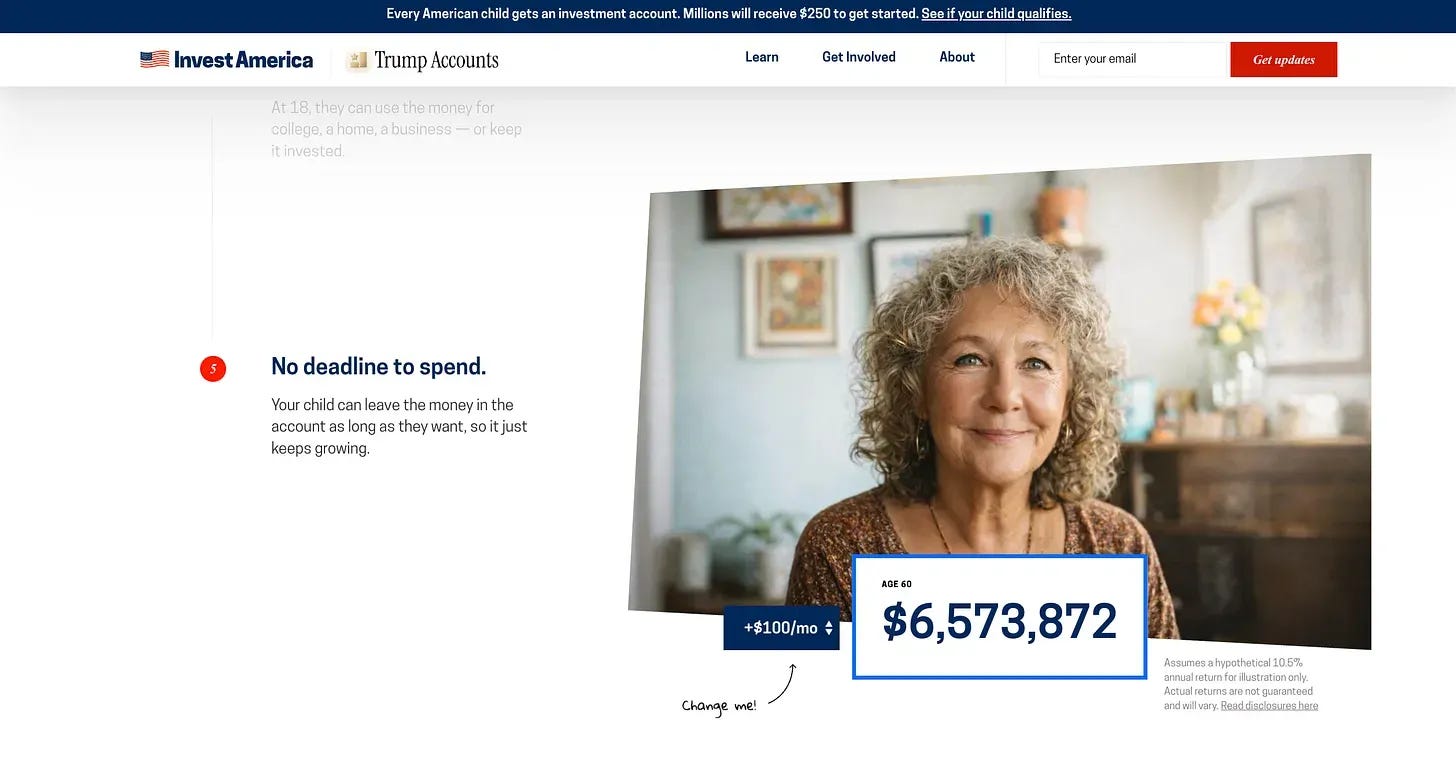
Comparatively, an account funded at the $5,000 annual maximum is estimated by the administration to reach roughly $271,000 by 18 alone. Set against the 3.5% average Treasury yield Social Security contributions have earned since 1982, the same $1,000 seed would reach roughly $1,860 over 18 years.
Early traction has been substantial. Per the Treasury Department, more than 6M accounts were opened in the first weeks, 1.4 million of them receiving the seed contribution, and 86% of opened accounts belong to families earning under $200,000 per year. The Michael and Susan Dell Foundation pledged $6.25 billion to deposit $250 into the accounts of 25 million children age 10 and under in qualifying ZIP codes, Micron announced employee matching up to $1,000 per child, and Gerstner has predicted more than $100 billion in additional private commitments over the next 12 months, saying tens of billions are already committed but unannounced.
However, Gerstner & Friedberg describe the relationship to Social Security differently. Gerstner has called Social Security a sacred promise and described the accounts as “additive & create positive optionality for future generations” in a direct reply to Ro Khanna. Friedberg wants Social Security converted into the same structure. “So we’re at day one of Trump Accounts, or Invest America Accounts, or whatever they end up being called. Obviously, it turns a lot of people off by calling them Trump Accounts. But the idea is right. It’s a 401(k) for everyone. Social Security needs to flip into being a 401(k) for everyone tomorrow.” Critics point out that Social Security is structured as a guaranteed benefit while index accounts carry market risk, & a stretch of weak returns would land directly on account holders.

AI, Jobs, & the K-Shaped Economy
Friedberg rejected the claim that AI is currently eliminating jobs. “As soon as AI starts deleting jobs from the economy, I will change my position on this, but I need to see it factually happen first.” A 1963 Newsweek article predicted mainframes would eliminate American jobs, after which mathematician, statistician, accounting, and service employment all grew. The 1980s desktop era produced the same magazine covers and the same outcome, a boom in desk jobs.
In his framing, each computing wave raised the leverage of the worker operating it. A person using the mainframe, the desktop, or AI produces 10-100x more, becomes worth more as the operator of the tool, and growing businesses hire more of them. That is productivity and growth, not displacement. He paired the argument with skepticism about the current cycle, referencing the token bubble conversation and questioning whether enterprises are getting the value they are paying for.
On the K-shaped economy Ray Dalio raised in their March conversation, Friedberg reframed the divergence as wealth rather than jobs. The bottom 50% cannot save because costs consume their income, so they cannot accumulate assets, while savers compound wealth and spending on the other side of the K. The fix runs through lower costs and rising incomes rather than redistribution.
While on the income side, he pointed to company-led workforce training already underway, including Meta’s programs for software engineers, and plumbers, electricians, and contractors. Companies profiled on Sourcery run the same playbook, including Senra Systems, the SpaceX-alumni wire harness company in LA that trains workers with no prior background in 4 weeks, down from a 2-year timeline, and Hadrian in manufacturing. Friedberg’s view is that this is the market working as intended, with the caveat that the trend needs to be tracked.
A Libertarian Arguing Against His Own Interests
Friedberg was direct that this agenda cuts against his own politics. He identifies as a hardcore libertarian, a political philosophy that prioritizes individual liberty, private property rights, & minimal government taxation & intervention in markets & personal life. A reform agenda built on higher capital gains rates, closed transfer loopholes, & an ended step-up at inheritance runs opposite to that framework, and it would fall hardest on people in his position.
“I’m a hardcore libertarian, so all of this is foreign to me. What am I doing talking about charging more taxes? At the end of the day, we do live in a society with other people. Libertarianism works well if you’re willing to leave people behind and you don’t expect that the social structure will become disordered over time, but it does become disordered over time.”


Joe Lonsdale has made a version of the same point, that he is rich but would pay 90% in taxes if it actually worked. Friedberg agreed on the same condition.. i.e. if the money actually produces results.
“Right, if your money goes to something good. And this is why the money that’s being paid into Social Security & pension plans should not go into the government coffers. It should go into your own account. If you’re an individual putting money from your paycheck into something, why are you putting it into the government? You should have a healthcare account. You should have an education account. You should have a retirement account. These should be your accounts to manage, not the government.”
→ Listen on X, Spotify, YouTube, Apple

The material presented on Molly O’Shea’s website are my opinions only and are provided for informational purposes and should not be construed as investment advice. It is not a recommendation of, or an offer to sell or solicitation of an offer to buy, any particular security, strategy, or investment product. Any analysis or discussion of investments, sectors or the market generally are based on current information, including from public sources, that I consider reliable, but I do not represent that any research or the information provided is accurate or complete, and it should not be relied on as such. My views and opinions expressed in any website content are current at the time of publication and are subject to change. Past performance is not indicative of future results.
Paid Endorsement. Brokerage services by Open to the Public Investing Inc, member FINRA & SIPC. Advisory services by Public Advisors LLC, SEC-registered adviser. Crypto trading provided by Zero Hash LLC, licensed by the NYSDFS. Generated Assets is an interactive analysis tool by Public Advisors. Output is for informational purposes only and is not an investment recommendation or advice. See disclosures at public.com/disclosures/ga. Matched funds must remain in your account for at least 5 years. Match rate and other terms are subject to change at any time.
Good stuff. The end of the interview is the key thing for any would-be politician running in the next few years. Whether you are/were for Trump or not, there is no denying people don't feel good about America right now. People in it, and people outside of it. The politicians that will do well will be the ones that run a Reagan/Obama-like, hope-filled, aspirational campaign. At least that's what I want to believe. It'll probably be the same demonizing-the-enemy (perceived or real) nonsense. Hide yo kids hide yo wives.
Here’s an idea, maybe instead of giving money to people by tying them more into the stock market, maybe we don’t do that. All of this is just a ruse to force us to keep paying for the AI buildout with our power bills.
https://pulpitfortruth.substack.com/p/the-country-works-for-the-market