


HUMANOID TOUR
For the first time ever, Figure is opening every door. Sourcery gets the first full tour of Figure's humanoid robotics campus with Founder & CEO Brett Adcock — and we see everything.
→ Listen on X, Spotify, YouTube, Apple
Figure is the first-of-its-kind AI robotics company bringing a general purpose humanoid to life, designing, building, & testing every robot in-house. Brett gives us an exclusive look through every department on their San Jose campus: BotQ Factory, Testing, Design, Demos & more.
System integration lab: where robots are stress-tested with software faults & physical pushes
Helix AI: team floor where the controls & neural network engineers train the vision-language-action model that runs onboard every Figure robot
Reinforcement learning & stability testing: where Figure demos the Vulcan project — surviving a lost knee mid-task
Home: environment where Figure 03 autonomously tidies a living room using their Helix neural network (no teleoperation)
BotQ: manufacturing facility where heads, batteries, and limbs come together on the assembly line, including the custom-built battery line & end-of-line burn-in bays
Industrial design studio: (opened publicly for the first time!!) housing every generation of Figure robot ever built, including: Figure 01 with its Frankenstein forearms, Figure 02, & the sleek Figure 03 that recently appeared at the White House, plus the evolution of Figure's hands & feet
On our walk/talk Brett shares why he believes humanoid robots may achieve AGI before any other form factor, why Figure pivoted entirely from hand-coded controls to neural networks, & teases that Figure 04 will be their "iPhone 1 moment."
This was so much fun!
Big thank you to Brett & the Figure team for opening the doors to us!
𝐓𝐈𝐌𝐄𝐒𝐓𝐀𝐌𝐏𝐒
(00:00) Inside Figure’s Robotics Campus
(00:48) The humanoid factory
(03:18) First robot guest at the White House
(05:29) Controlling a robot with infinite poses
(10:46) The truth about robot failures
(13:00) Attacking a humanoid robot
(16:12) Building a general purpose robot
(23:05) The "Never Fall" protocol
(28:56) Is the home robot teleoperated?
(33:36) Leasing a 24/7 robot
(35:01) Can a humanoid build a real car?
(43:32) From flying robots to humanoids
(45:59) The hidden path to physical AGI
(56:21) Figure's secret design studio
(01:00:44) Figure 4: The biggest leap in robotics
(01:06:25) Training robots in spandex
(01:10:26) Westworld, TIME Magazine, and Deadmau5
Brought to you by:
Brex—The intelligent finance platform: cards, expenses, travel, bill pay, banking—wrapped into a high-performance stack. Built for scale. Trusted by teams that move fast. visit → brex.com/sourcery

Turing—Turing accelerates superintelligence by helping frontier AI labs improve model capabilities and enabling enterprises to deploy end-to-end AI systems inside mission-critical workflows. Visit: turing.com/sourcery
VCX—VCX is the public ticker for private tech, allowing investors of all sizes to invest in venture capital. View The Portfolio at GetVCX.com
Deel—Deel is the global people platform that helps startups hire, manage, pay, and equip anyone, anywhere. Trusted by more than 35,000 fast-growing companies, Deel is the people platform that just works, so teams can scale without the chaos. Visit: deel.com/sourcery
Public-–Investing platform Public just launched Generated Assets, which lets you turn any idea into an investable index with AI. With Generated Assets, you can build, backtest, refine, and invest in any thesis with AI. Gone are the days of one-size-fits-all ETFs. Try it today: public.com/sourcery
Merge—The leading provider of customer-facing integrations and agentic tools for frontier LLMs, Fortune 500 organizations, and B2B SaaS companies. Visit: https://merge.dev
Inside Figure: The Humanoid Robot Company Building Toward AGI
→ Listen on X, Spotify, YouTube, Apple
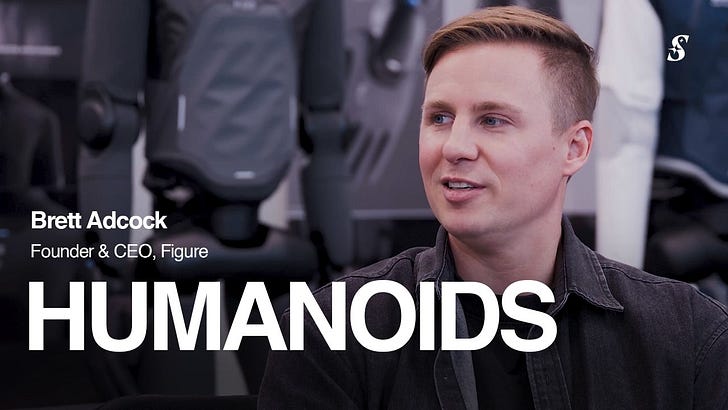
Founder ^ CEO Brett Adcock guided us through every department of the company’s humanoid headquarters, from the system integration lab to the manufacturing floor to the previously off-limits design studio housing every robot Figure has ever built. What follows is the most complete public look at Figure to date.
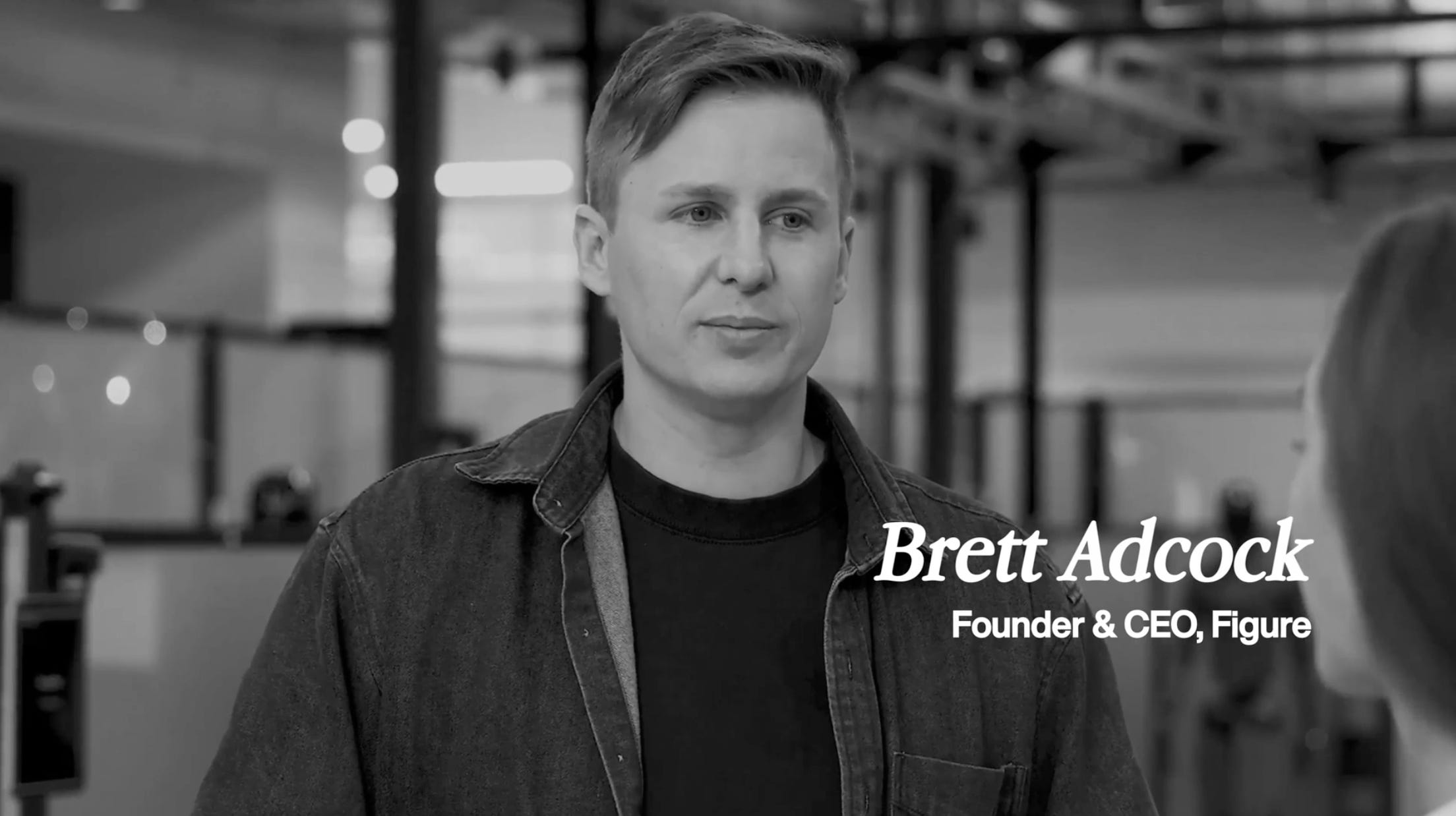
Figure is a pure-play humanoid robotics company founded less than four years ago. The company designs, builds, and tests its robots entirely in-house, with roughly 500 employees across the company and a few hundred robots on campus at any given time.
“My goal for this building is I want more robots, humanoid robots, than humans walking around.”
Lobby & Charging Bay: Robots That Run Themselves
The tour begins in Figure’s lobby, where humanoid robots greet visitors, hold concierge-style conversations, and dock themselves on inductive charging pads built into the floor. The robots charge through their feet at two kilowatts, running for four to five hours on a charge, all without human intervention.
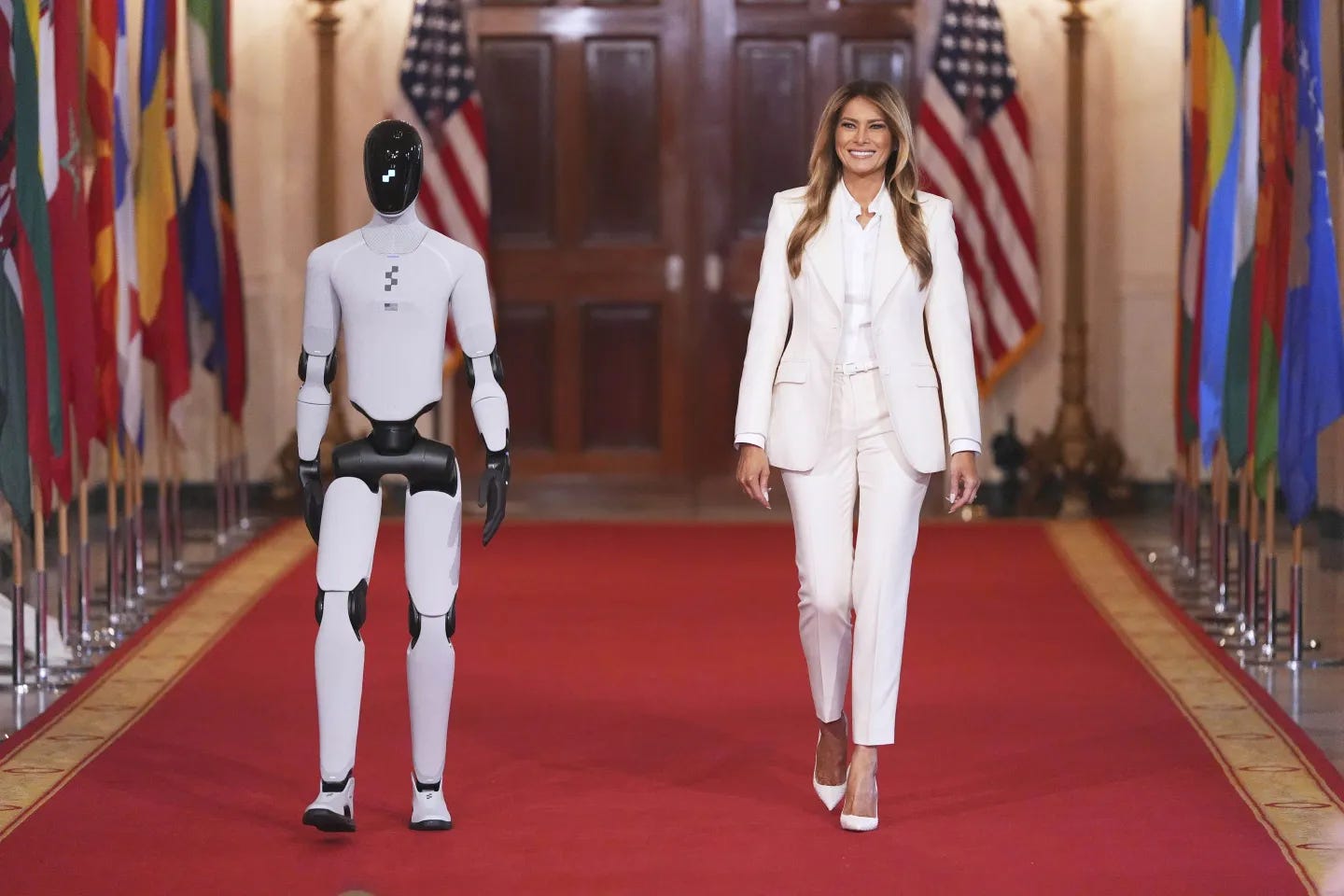
One robot in the lobby wears an American flag patch. It was, Brett explains, part of the first humanoid robot deployment in White House history just one week before our visit.
“We got a call asking to be basically the first humanoid group ever to put robots in the White House. So last week we basically had the first humanoid robots in history there, doing stuff, talking, greeting folks.”
The fleet operates 24/7 with no human babysitter. Robots dock at around 10 to 15% battery, and another robot rotates in off the dock to continue work, a swap that takes about 30 seconds. This continuous operation is the foundation for everything else Figure is doing.

System Integration Testing: Trust But Verify
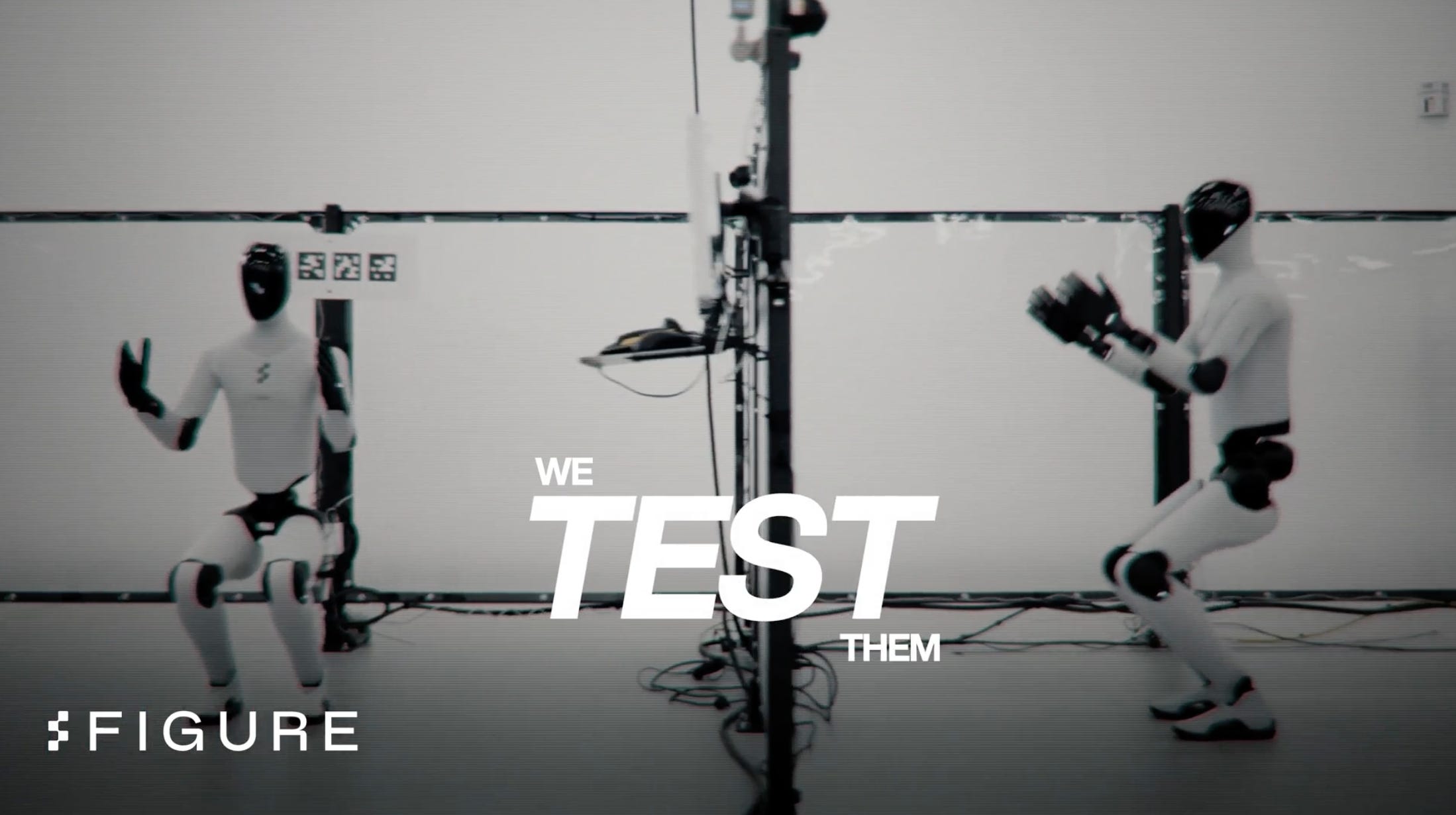
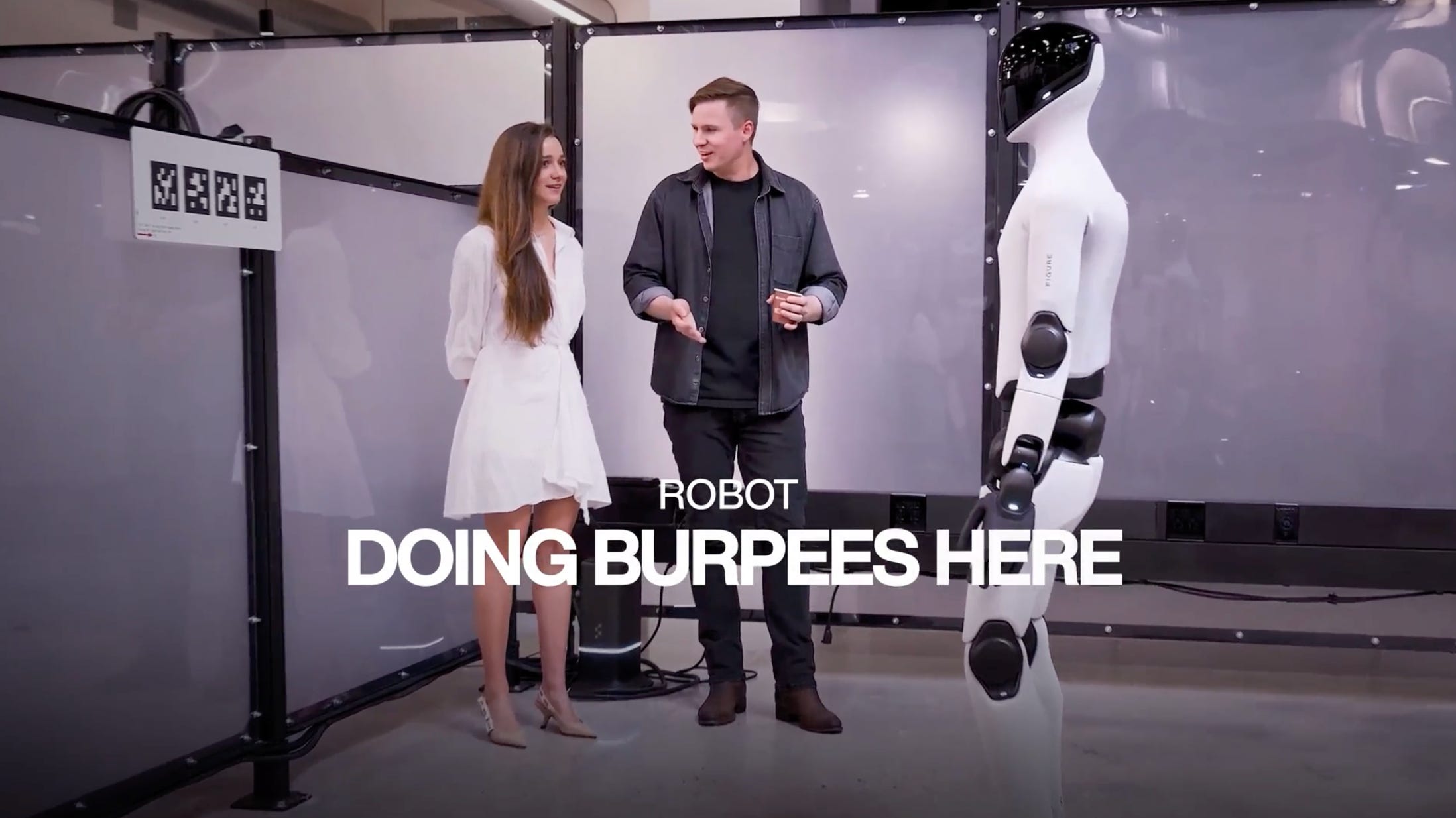
Inside the main engineering building, dozens of robots run nonstop in test bays, doing burpees, squatting, getting up off the ground, and stress-testing every new piece of hardware or software before it ships. The banner over the lab reads “Trust But Verify,” and the team’s job is to find every possible failure mode before robots leave the building.
The mathematical complexity of controlling a humanoid is staggering. With roughly 40 motors that can each rotate 360 degrees, the number of possible body configurations is, as Brett put it, “360 to the power of 40… more body positions than atoms in the universe.” That’s why Figure abandoned traditional code-based control entirely. “You can code your way out of this. And I think that’s a full dead end. Or you can run an AI first strategy in a market. And that’s what we do here at Figure.”
Most of Figure’s failures today are no longer hardware. “Hardware’s gotten really robust. It’s basically a software issue.” The team runs durability and reliability tests every single day, validating new cameras, structural components, neural network weights, and firmware before any change reaches the broader fleet.
Helix AI Floor: Neural Networks Replace Code
Figure’s controls and AI team, which Brett calls “one of the best controls teams in the world,” works on the same floor as the test bays. Their product is Helix, Figure’s proprietary vision-language-action model that runs onboard every robot. Helix takes camera input and outputs joint-level commands for the entire body 50 to 200 times per second.
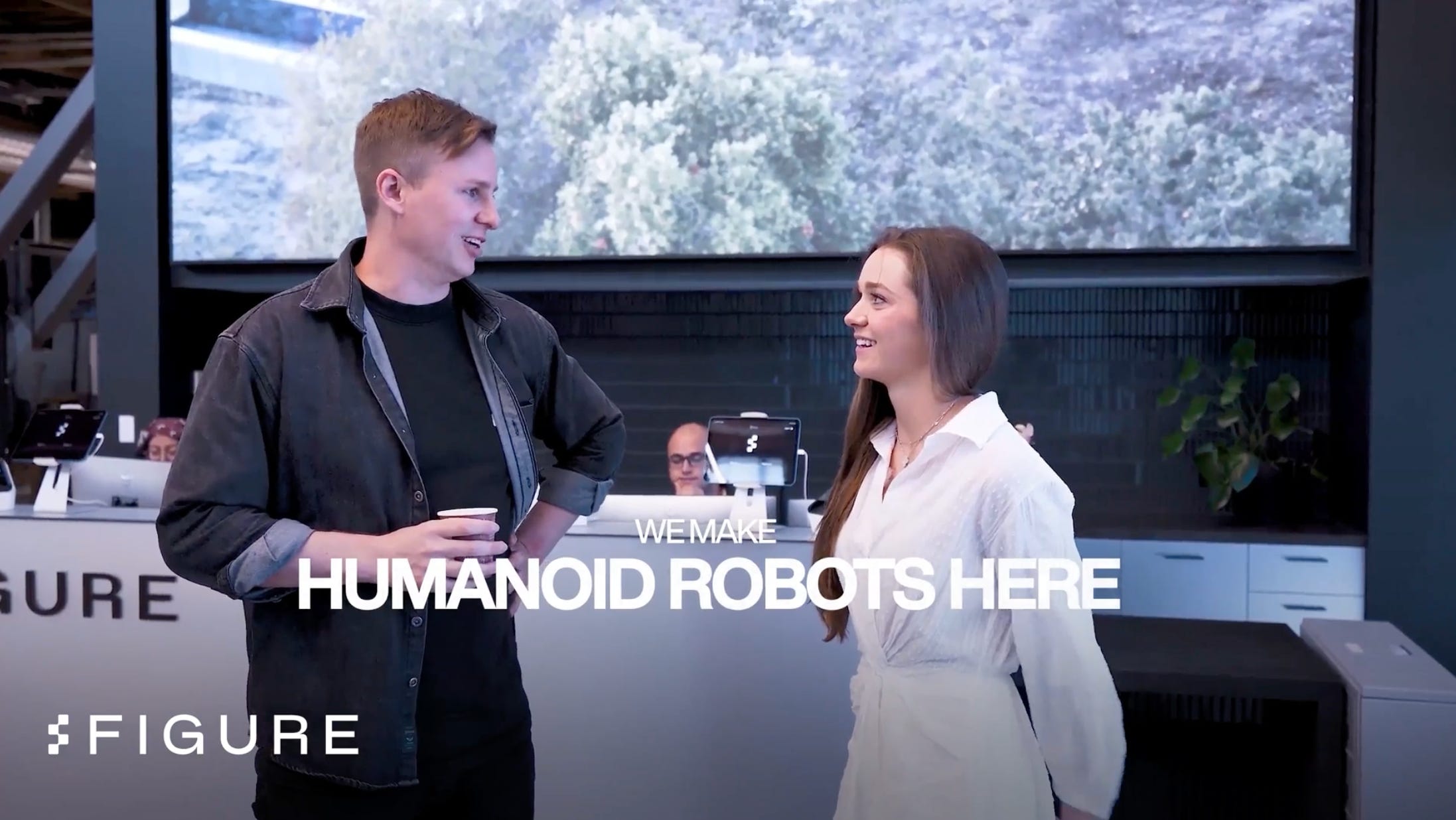
The team has fully transitioned from a model-based control stack to reinforcement learning. As Helix lead Moritz explained during the tour, the team simulates every conceivable real-world disturbance, including friction, gravity variations, and external forces, inside a physics simulator, trains the controller in that environment, and then “zero-shots” the policy onto the physical robot. I tested it firsthand by pushing the robot as hard as I could.. surprisingly, it really did feel heavy, sort of like human resistance, and absorbed each shove, staying upright the whole time.
Figure’s “Never Fall” initiative goes further. The Vulcan project allows the robot to lose a knee, hip, or ankle joint mid-task and still hobble safely to a charging station. “Months ago, we’d lose a knee, the robot would just fall. Now the robot loses a knee, it can either continue to do work or it can just hobble off, and another robot comes in and fills in.” All of this is learned inside a single neural network controller.

Home Environment: Tidying a Living Room
In a mocked-up home space, a Figure 03 robot autonomously tidies a living room, wiping down a table, putting away cups, and cleaning up toys. It’s running entirely on Helix, with no teleoperation. “There are rumors that these are teleoperated,” I noted. Brett’s response: “For sure, not teleoperated. These robots are running purely autonomously from an onboard AI policy called Helix running onboard the robot in the torso.”
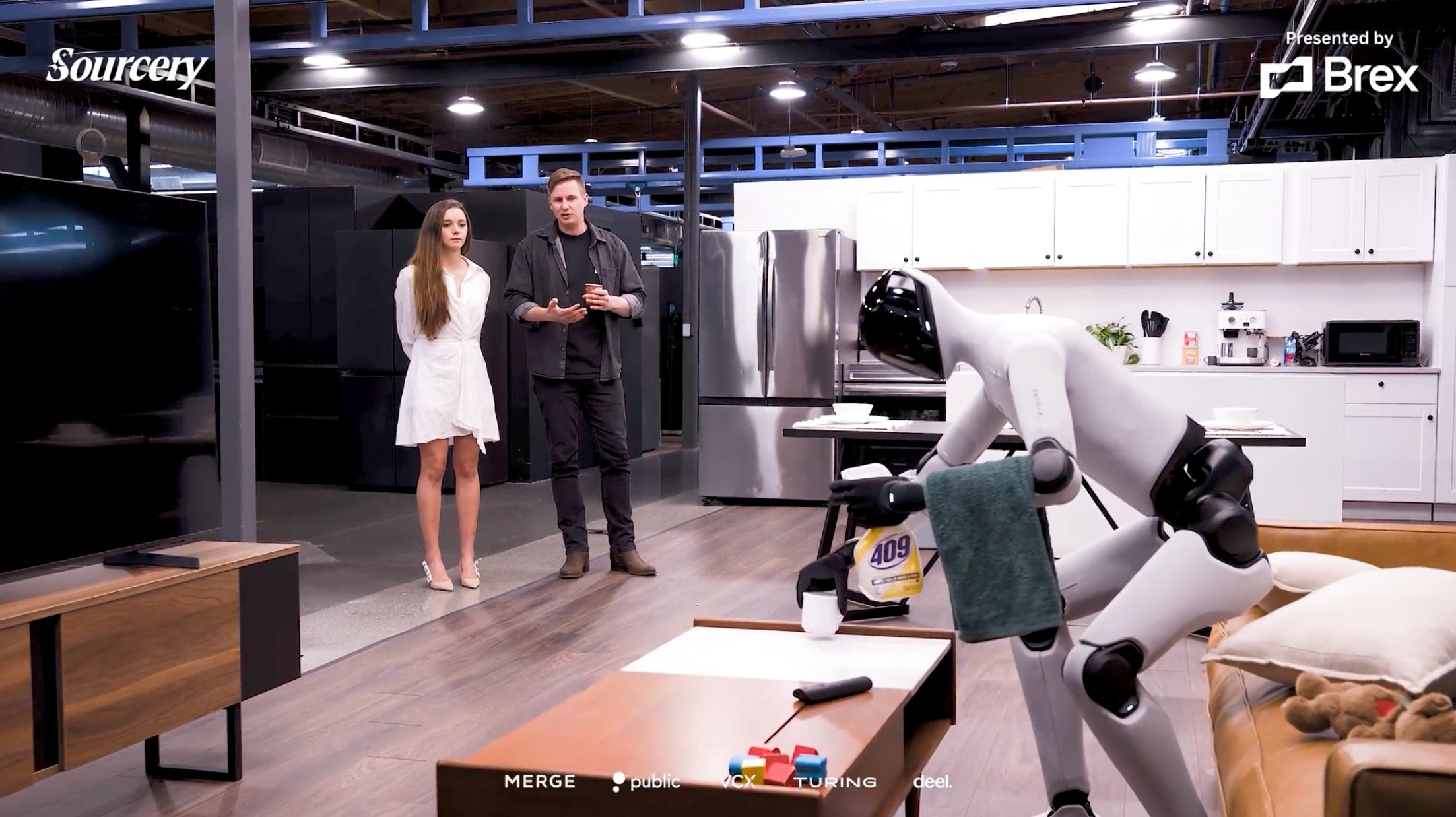
The same neural network that handles housework also handles commercial use cases like logistics and manufacturing. That generality is the entire point. “The reason why humans are so great is the same humanoid can go over and do logistics and healthcare and manufacturing, or do dishes, just like we can.” Figure trains a single model and deploys it across every environment.
The home product isn’t yet for sale, but the target pricing is concrete. Brett wants to lease the robot for “somewhere like a car lease, maybe like four or five, six hundred bucks a month.” For Brett personally, the killer use cases are obvious: laundry every day, dishes every day, and tidying the house multiple times daily.
BotQ: The Manufacturing Floor
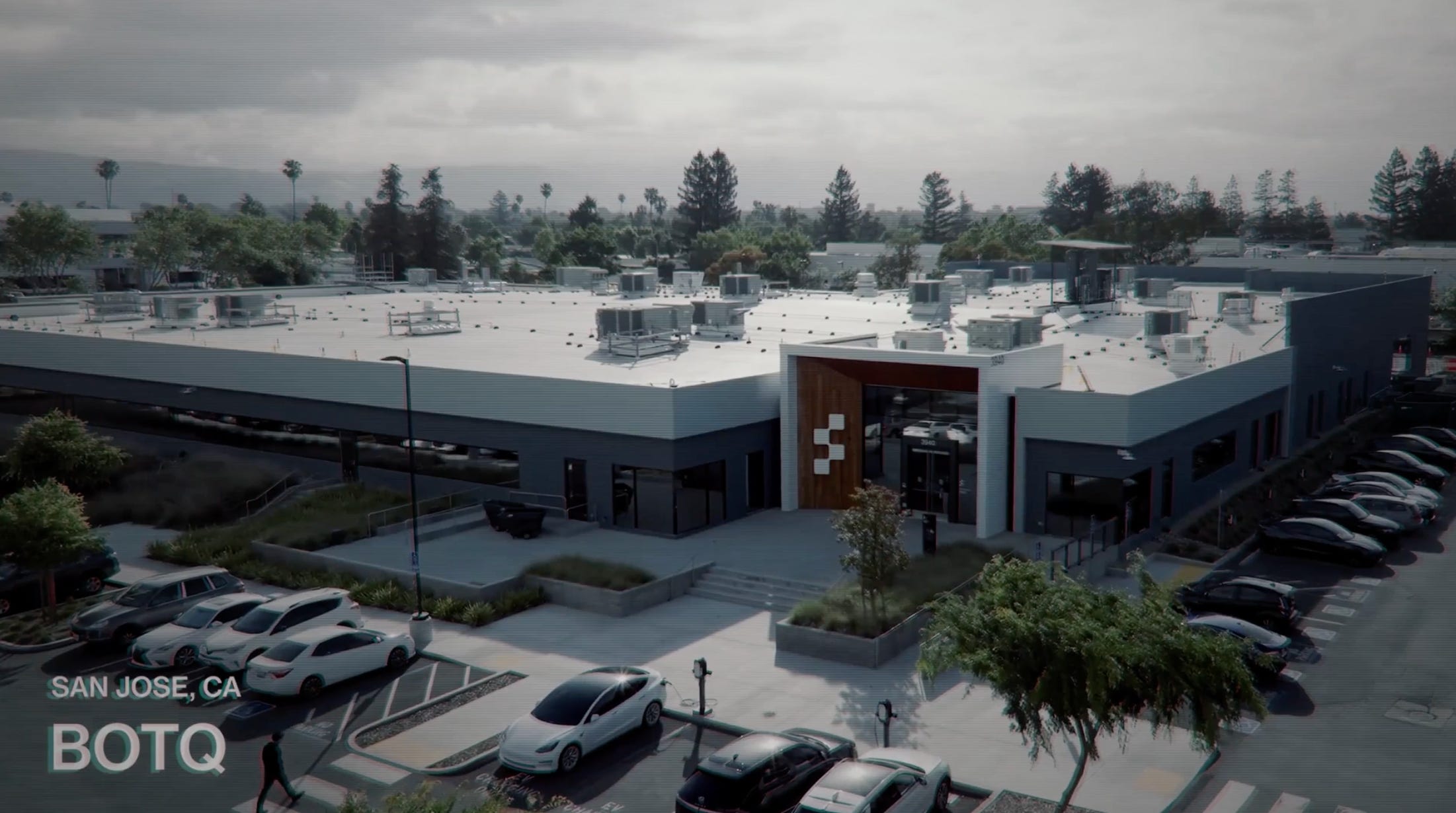
Next door, Figure manufactures every robot at a facility called BotQ, short for “robot HQ.” This is where heads, batteries, arms, legs, hands, and torsos are built and assembled. Figure designs and builds nearly all of it in-house, including the custom machine that performs cell-level testing and voltage balancing on every battery pack.
Each battery is a 2.25 kilowatt-hour pack engineered with aircraft-grade thermal runaway protection. “The requirement is you want no flame to ever exit the pack. You don’t want a robot on fire out in the world.” Figure has never had a robot catch fire. The pack is also structural, designed to absorb impact loads during a fall without compromising the cells inside.
The cost reductions across generations have been dramatic.
Figure 01 cost hundreds of thousands of dollars per unit because it was optimized purely for development speed.
Figure 03 brought that down by roughly 90%, to well under $100,000 per robot.
In March, Figure built more robots in a single month than it had in the company’s entire history combined. Eventually, Brett wants the lines fully automated: “It’ll just be full lights out manufacturing. We’ll have robots only building robots.”

BMW & the First Car Built by a Humanoid
Walking past a parked BMW X3 between buildings, Brett reveals one of Figure’s most significant commercial milestones. The car was built last year on a BMW factory body shop line where Figure deployed humanoid robots for six months. It is, to Brett’s knowledge, “the first car in the world built by a humanoid robot that we’re aware of.”
Brett bought the first four units off that line. Three sit on Figure’s campus and one is parked at his house. “It’s a collector’s item now.” The deployment served as the first major proof point that Figure’s hardware and software stack could survive a real industrial environment, with the speed, accuracy, and reliability bar set by human factory workers.
That bar is high, and Brett is candid about how hard it remains. Robots have to operate safely, almost never fault, self-correct when they do, and match human performance on speed and precision. “When they do fault, they need to understand that and self-correct. And then we need to be able to do useful human work at human performance. So that’s a hard bar to hit.” The BMW deployment was the first time Figure cleared it.
The Grid: Last Line of Defense
Adjacent to BotQ sits a separate facility called The Grid, named in homage to a sci-fi film. Brett, a self-described “total sci-fi geek” whose favorite film is Contact, uses The Grid as the last validation step before any code or hardware change reaches a customer. “You don’t want robots having any problems. We want to run them close enough to heavy operations that we would see out in the real world.”
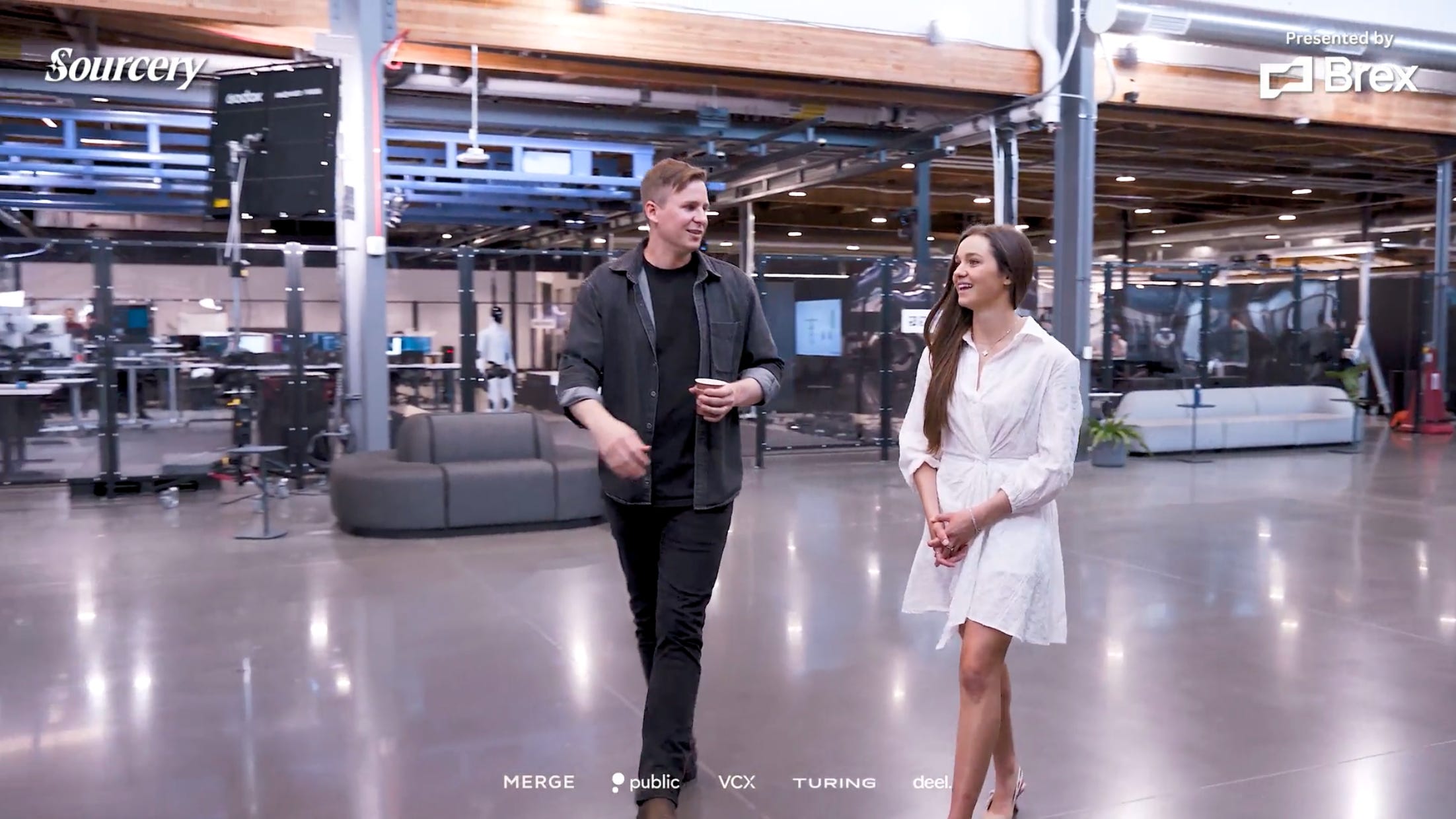
The Grid runs robots 24/7 under simulated client-site conditions, including holidays, weekends, and 2 to 3 in the morning shifts. The goal is to expose any failure that wouldn’t surface in shorter testing cycles. By the time a robot leaves The Grid, it has been pushed harder than most customers will ever push it.
Together, The Grid, BotQ, and the System Integration Lab form a three-stage pipeline: build, validate, and stress test. Brett sees the operational discipline of running this pipeline at scale as one of Figure’s biggest competitive moats.
“We have to be very diligent about when we find issues, how to track them, how to do fault analysis really quickly, & then how to solve them across the global fleet.”

The Design Studio: Every Figure Robot Ever Built
The final stop, and one Figure has never opened publicly before, is the industrial design studio. Lined up in sequence are Figure 01, Figure 02, and Figure 03, plus prototype hands and feet from every generation. Figure 01, the first-generation robot, walked within a year of the company’s founding. “We had Figure 01 walking before we were a year old. We think it’s probably one of the fastest times in human history.”

Figure 01 was a “cyberpunk” robot with a backpack-mounted battery and the company’s first attempt at a tendon-driven hand, an architectural choice the team eventually abandoned. To pivot quickly, Brett swapped foot motors into the forearm, creating an oddly bent wrist that bent halfway up the arm.
Figure 02 moved the battery into the torso, tripled the compute, and adopted an aircraft-style exoskeleton structure where the outer skin carries the load.
Figure 03 reduced weight, slimmed the silhouette, added soft foam padding, introduced cleanly swappable fabric clothing, and integrated tactile-sensing hands.
But the robot Brett is most excited about is the one not yet on display.
“We’re like almost in flip phones. And now we’re entering like iPhone One moment. I think maybe Figure 04 will be our first iPhone One moment for this, where it’s just radically different.”

Hand Evolution: 5 Generations
In the design studio, Brett unveils something Figure has never publicly shown before: the original tendon-driven hand from Figure 01. Modeled after human biological architecture, the hand placed motors in the forearm and used tendons to drive each finger. Brett now considers it the wrong engineering choice. “We learned a lot about the hand of like, why it’s probably not the right direction. So our first generation hand is, how do we get a really dexterous hand built, which is really good for intelligence and AI. And it ended up becoming the wrong engineering choice.”
The pivot away from tendon drives created an unexpected design problem. To replace the wrist motors quickly, Brett repurposed motors from the robot’s feet, resulting in a wrist that bent halfway up the forearm. “I was so ashamed. I’m like, we’re gonna get this thing out… and I don’t think I’ve ever had a single person in three years ask why the forearm was like this.”
Figure has now iterated through five generations of hands, culminating in a recently teased high-degree-of-freedom hand with human-equivalent dexterity. Brett considers this the most critical component in the entire roadmap to AGI. “If we want to solve AGI and get to human intelligence in the physical world, it’s all going to start here with the hands for us.” The reasoning: humanoids need to passively learn from human video at scale, and the robot’s hand needs enough degrees of freedom to map every human motion at test time.
The Spandex Data Operation
Walking between buildings, I saw employees in full spandex suits around campus. Brett confirms Figure runs a large-scale motion capture operation to train Helix on human movement. “We’re trying to do joint-level tracking and different types of data collection, learning from humans. Our training set is, how do we, like, we’re a humanoid, we need to learn from humans at scale.”
This data engine is what powers Helix’s generalization. Figure runs both internal motion capture sessions and external collection in real-world environments, building a dataset of human joint movements and image-conditioned action policies. It’s also the bottleneck. “The biggest blocker for us now of going from where we’re at today to large-scale deployment is data. We need an enormous amount of data, diverse, really high quality, across the world.”
When Figure deploys robots at customer sites, the data flywheel will close. Robots will collect operational data, send it to centralized training jobs, and receive over-the-air policy updates with the latest Helix weights. Brett notes the company is committed to anonymizing user data, with the focus on robot state information rather than personally identifiable content.
How Figure Got Here So Fast
Asked how a four-year-old company built one of the most complex robots ever attempted, Brett points to his prior company Archer Aviation, where he built electric vertical takeoff aircraft. The underlying architecture, he argues, is nearly identical.
“My company before this designed flying robots at Archer, and it’s got the same properties. We have a battery pack, electric motors, control software, embedded systems, and sensors. That’s a robot.”
Archer’s aircraft are, in Brett’s words, “highly over-actuated,” with variable-pitch propellers, tilting leading-edge actuators, and moving flaps across the wings and tail, totaling 24 degrees of freedom. Figure 03 has just over 40. The systems engineering DNA carried over directly.
“When I started Figure, we had a very crisp and clear vision for the product and engineering roadmap. And we just went really hard, building a team to 40 and putting the right resources in place to design stuff really fast.”
That speed shows up in the gap between vision and execution. Figure 01 walked inside a year. Figure has now manufactured hundreds of robots, deployed them with BMW, run them autonomously in a home, and put them in the White House, all in under four years.
The Path to AGI
Closing out the tour, Brett returned to the bigger thesis behind Figure. The company isn’t building robots to replace specific jobs. It’s building them as the physical embodiment for general intelligence itself. “It actually might be the case that we get to artificial general intelligence first in these embodiments,” he said. “Real world interaction with our environments, that’s the last missing piece to get to true AGI.”
Whether or not that turns out to be right, what’s undeniable after walking the campus is the operational discipline behind it. Figure has compressed roughly a century of automotive-style hardware development into less than four years, while simultaneously running a frontier AI lab, a manufacturing operation, and a 24/7 deployment fleet. Few companies in the world are attempting all four at once.
The first full tour of Figure makes one thing clear: humanoids are no longer a research project. Figure is a real an industrial company building toward a future where humanoids do dishes, build cars, and possibly arrive at general intelligence, one trained policy at a time.
→ Listen on X, Spotify, YouTube, Apple

But wait, there’s MORE..
The material presented on Molly O’Shea’s website are my opinions only and are provided for informational purposes and should not be construed as investment advice. It is not a recommendation of, or an offer to sell or solicitation of an offer to buy, any particular security, strategy, or investment product. Any analysis or discussion of investments, sectors or the market generally are based on current information, including from public sources, that I consider reliable, but I do not represent that any research or the information provided is accurate or complete, and it should not be relied on as such. My views and opinions expressed in any website content are current at the time of publication and are subject to change. Past performance is not indicative of future results.
Paid Endorsement. Brokerage services by Open to the Public Investing Inc, member FINRA & SIPC. Advisory services by Public Advisors LLC, SEC-registered adviser. Crypto trading provided by Zero Hash LLC, licensed by the NYSDFS. Generated Assets is an interactive analysis tool by Public Advisors. Output is for informational purposes only and is not an investment recommendation or advice. See disclosures at public.com/disclosures/ga. Matched funds must remain in your account for at least 5 years. Match rate and other terms are subject to change at any time.