

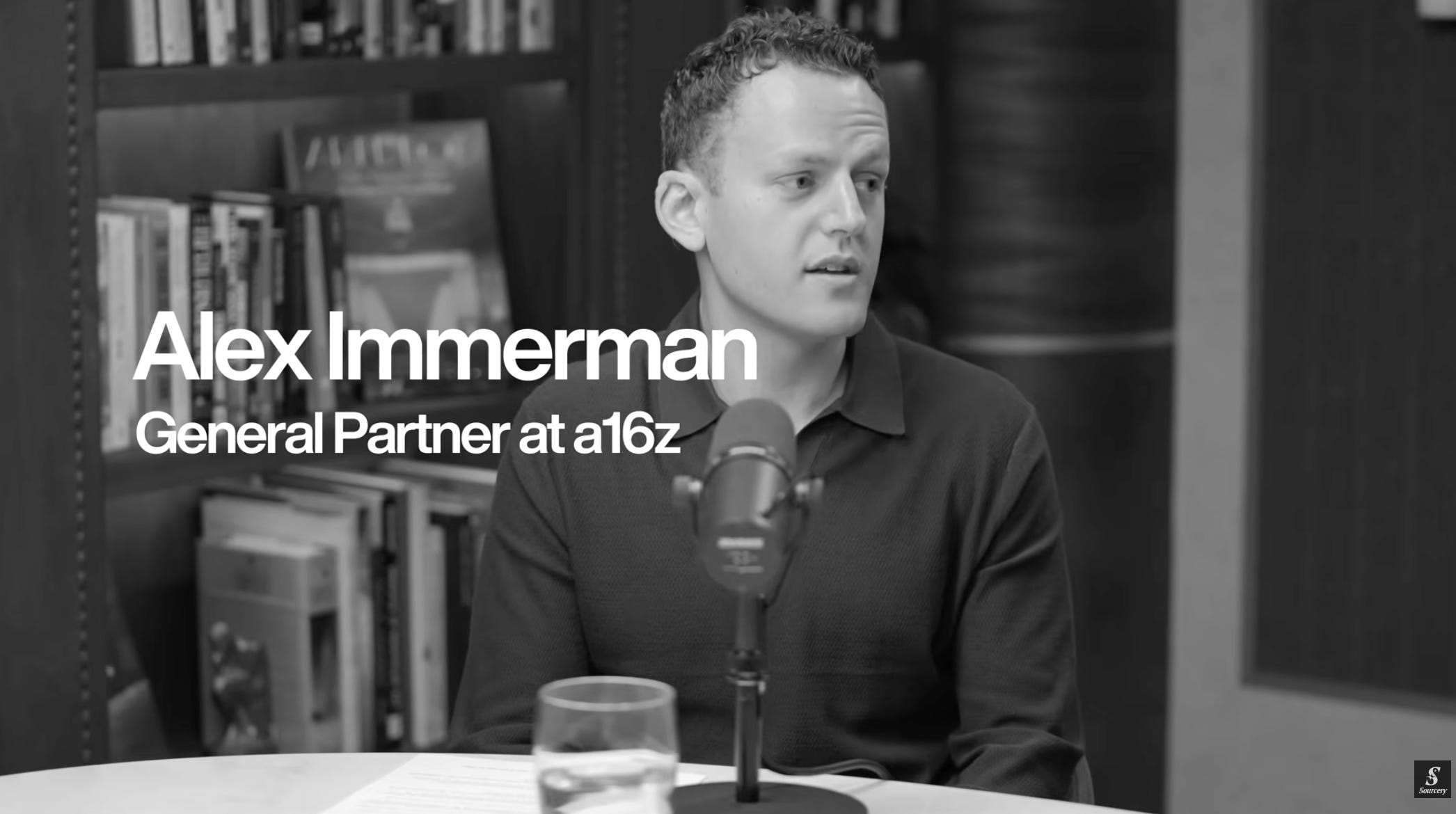
Alex Immerman, General Partner on Growth at Andreessen Horowitz (a16z), joins Sourcery to break down how one of Silicon Valley’s most influential firms is investing across AI, fintech, autonomous vehicles, and growth-stage software.
→ Listen on X, Spotify, YouTube, Apple
With a fresh $6.75B Growth fund, a16z Growth now manages over $22B across five Growth funds. Alex discusses how a16z evaluates category leaders, what separates private markets from public markets today, and why firms are rethinking old metrics in the AI era. He also goes deep on some of a16z’s highest-profile portfolio companies and investments including Waymo, Kalshi, Coinbase, Robinhood, Stripe, Revolut, ElevenLabs, Flock Safety, and more.

We cover:
The Marc Andreessen Value Lesson: Cadillac or Steak Knives?
Why private markets now hold much of the highest-growth opportunity
Underwriting Waymo’s growth & the future of autonomous driving
Why a16z backed Kalshi
ElevenLabs, voice AI, & how breakout AI companies build defensibility
The new AI underwriting framework: growth, engagement, retention, & margins
How a16z scaled from startup VC to capturing 18% of all U.S. venture dollars
Why market leaders capture outsized value and how a16z thinks about winning
If you enjoy interviews at the intersection of venture capital, AI, fintech, public markets, and frontier technology, subscribe to Sourcery for more.
𝐓𝐈𝐌𝐄𝐒𝐓𝐀𝐌𝐏𝐒
(00:00) Alex Immerman, GP a16z
(00:53) Flock Safety: The most underrated company in America
(03:43) Private vs public market growth gap
(04:43) Do gross margins matter in AI companies?
(06:33) Waymo’s growth and $16B funding round
(08:13) The future of ride sharing and autonomous vehicles
(10:01) Where the value in self driving tech will accrue
(12:27) Tesla FSD vs Waymo’s full stack approach
(13:50) The growing brand power of Waymo
(15:43) What comes after autonomous cars? Humanoid robots
(17:41) Are people really worried about AI taking over?
(18:55) Inside ElevenLabs’ $500M funding round
(22:12) The real world use cases of voice AI agents
(22:55) How a16z invested in Kalshi
(24:11) Why Kalshi over Polymarket?
(26:35) Prediction markets vs g*mbling
(29:33) Is fintech making a comeback?
(32:44) Why stablecoins are becoming important
(33:30) Lessons from Coinbase founder Brian Armstrong
(34:19) How a16z evaluates growth companies
(36:52) Where startups spend money: R&D vs marketing
(38:44) Why startups need a strong Act 2
(40:08) Why venture outcomes are getting bigger & bigger
(42:24) Why backing the market leader matters
(43:49) The best books for founders
(44:59) How a16z built its media machine
(47:03) Who will be the first Trillionaire?
Brought to you by:
Brex—The intelligent finance platform: cards, expenses, travel, bill pay, banking—wrapped into a high-performance stack. Built for scale. Trusted by teams that move fast. visit → brex.com/sourcery

Turing—Turing delivers top-tier talent, data, and tools to help AI labs improve model performance, and enable enterprises to turn those models into powerful, production-ready systems. Visit: turing.com/sourcery
VCX—VCX is the public ticker for private tech, allowing investors of all sizes to invest in venture capital. View The Portfolio at GetVCX.com
Deel—Deel is the global people platform that helps startups hire, manage, pay, and equip anyone, anywhere. Trusted by more than 35,000 fast-growing companies, Deel is the people platform that just works, so teams can scale without the chaos. Visit: deel.com/sourcery
Public-–Investing platform Public just launched Generated Assets, which lets you turn any idea into an investable index with AI. With Generated Assets, you can build, backtest, refine, and invest in any thesis with AI. Gone are the days of one-size-fits-all ETFs. Try it today: public.com/sourcery
Top 5 Key Lessons
1. The fastest-growing companies are still private
Public software companies growing 30%+ are increasingly rare, while many private AI companies are scaling at multiples of that pace. Growth investors now find the most explosive expansion in private markets rather than public equities.
2. AI companies are rewriting traditional SaaS metrics
Some AI companies launch with 0–50% gross margins due to model costs, forcing investors to look deeper at engagement, retention, workflows, and data defensibility rather than just headline margins.
3. Category leaders capture the vast majority of value
In technology markets, the winner often accumulates disproportionate market cap. Venture investors increasingly focus on backing the market leader early, because second place can mean dramatically smaller outcomes.
4. Autonomous vehicles could massively expand the transportation market
Ride-hailing today represents less than 1% of vehicle miles traveled in the U.S., suggesting robotaxis like Waymo could unlock a much larger market rather than simply competing with Uber or Lyft.
5. The scale of venture outcomes is increasing dramatically
Historically the top 1% venture outcome was roughly $1.5B. Today it’s closer to $10B, and could reach $40B within the next decade as technology markets expand globally.

Inside a16z’s $22B Growth Fund:

Andreessen Horowitz has grown from a startup venture firm in 2009 into one of the most influential capital allocators in technology. Today the firm manages more than $22B across five Growth funds, recently raising a new $6.75B vehicle to continue investing in category-defining companies.
Across that platform, the Growth team has invested in companies such as Waymo, Kalshi, Coinbase, Robinhood, Stripe, Revolut, ElevenLabs, Flock Safety, Harvey, EliseAI, Hebbia, Roblox, Anduril, and Sardine.
In a conversation on Sourcery, General Partner Alex Immerman outlined how the firm evaluates breakout technology companies, how AI is changing the metrics investors use, and why the scale of venture outcomes continues to expand.
The discussion reveals a clear theme: the center of gravity for innovation and growth has shifted toward private markets and AI-native companies.
The Fastest Growth in Technology Is Happening in Private Markets
One of the most striking shifts in the technology landscape is the divergence between private and public market growth rates. While public technology companies once represented the fastest-growing segment of the economy, that dynamic has changed.
Today, many of the most rapidly expanding companies remain private for longer periods, particularly in AI and frontier technology sectors.
As Immerman explains:
“If you were to scan public internet software, fintech, there are fewer than five companies growing north of 30% this year. We didn’t invest in a company last year growing under 30%.”
This dynamic is partly driven by the scale of opportunity in emerging markets such as artificial intelligence. AI companies are reaching extraordinary revenue levels at unprecedented speed.
“If you look at OpenAI and Anthropic alone, those two companies added as much revenue last year as half of the public cloud universe excluding the Mag Seven.”
For growth investors, this means the most explosive opportunities increasingly appear before companies reach public markets.

AI Is Forcing Investors to Rethink Traditional Software Metrics

Artificial intelligence is not just producing new products—it is reshaping how investors evaluate businesses.
Historically, venture investors relied heavily on classic SaaS benchmarks such as high gross margins, predictable revenue growth, and capital efficiency. AI companies challenge those assumptions.
Many AI startups begin with far lower gross margins due to the cost of running large language models and inference infrastructure.
“A lot of these AI companies are showing up with zero to 50% gross margins, and we’re used to looking at companies that have 70% gross margins.”
This forces investors to ask a deeper question: are those margins temporary, or do they reflect structural weaknesses?
“Are the lower margins because of LLM costs? If they are, we can make sense of that.”
Instead of focusing solely on traditional metrics, growth investors are increasingly analyzing engagement and usage behavior to determine whether a product is becoming essential to users.
“Engagement is a leading indicator of retention.”
In other words, strong product engagement often signals that a company is building the type of durable platform that can eventually produce high margins at scale.

Physical AI & the Expansion of Massive Markets
Beyond software, AI is beginning to reshape physical industries. One of the clearest examples today is autonomous vehicles.
Andreessen Horowitz has invested in Waymo, the autonomous driving company spun out of Alphabet. The company recently raised capital at a $126B valuation, reflecting growing confidence in the long-term potential of robotaxi networks.
Early data from San Francisco suggests autonomous ride-hailing can gain market share rapidly once deployed.
“In San Francisco it got to 25% market share really quickly with very few cars.”
But the larger opportunity may not simply be replacing existing ride-sharing services. Instead, autonomous vehicles could dramatically expand the transportation market.
“Ride hailing in that aggregate large number I just shared is less than 1% of vehicle miles in the U.S.”
This implies that the current ride-hailing industry represents only a small fraction of the potential demand for autonomous transportation.
As costs decline and fleets scale, autonomous vehicles could unlock entirely new categories of usage.
All Eyes on Flock Safety

Among the companies in Andreessen Horowitz’s growth portfolio, Alex Immerman pointed to Flock Safety as one of the most underappreciated technology platforms in the country.
Flock builds a nationwide network of license plate readers and safety cameras that help law enforcement agencies identify vehicles linked to crimes and share intelligence across jurisdictions. The system allows investigators to move far faster than traditional investigative methods.
According to Immerman, the scale of the impact is already enormous.
“Flock solves over 2,800 cases every day.”
That volume translates into a meaningful portion of crime investigations nationwide.
“That’s about 15% of reported crime in America.”
Immerman noted that while the company occasionally receives attention when a major case is solved using the platform, the technology is quietly being used by law enforcement every day.
“When we look at it, that’s just a normal day in Flock’s life.”
The broader point, he said, is that companies like Flock demonstrate how software can deliver measurable real-world outcomes beyond traditional consumer or enterprise applications.
“There’s a lot of discussion about whether tech and AI are good for society. Flock is an incredible example.”
As AI and software continue expanding into sectors such as public safety, defense, and infrastructure, platforms like Flock Safety illustrate how technology can become a foundational layer for solving problems at national scale.
Venture Outcomes Are Growing at an Unprecedented Scale
Another major shift in the venture ecosystem is the increasing size of successful company outcomes. Historically, billion-dollar exits represented extraordinary results for venture-backed companies. Today, those outcomes are becoming far more common.
“Back then the top 1% outcome was a bit under one and a half billion dollars.”
In the current technology landscape, the scale of those outcomes has increased dramatically.
“Today that’s $10 billion.”
And if technology markets continue expanding globally, the next decade could produce even larger results.
“If you fast forward another eight to ten years, that’s $40 billion.”
This trend explains why venture firms like Andreessen Horowitz have raised significantly larger funds in recent years. As markets grow and companies stay private longer, the capital required to support those businesses also increases.
The venture model itself is evolving alongside the companies it finances.

The Larger Shift in Technology Markets
Taken together, these insights illustrate how quickly the structure of the technology ecosystem is changing.
Private markets now contain many of the fastest-growing companies. AI is reshaping the metrics investors use to evaluate businesses. Entire physical industries, from transportation to robotics, are being rebuilt by software.
And perhaps most importantly, the scale of potential outcomes continues to grow.
For growth investors, the challenge is identifying the companies capable of becoming the next generation of category leaders before those markets fully emerge.
The Marc Andreessen Lesson:
Cadillac or Steak Knives?

One of the most enduring principles inside Andreessen Horowitz comes from co-founder Marc Andreessen: in technology markets, first place captures the majority of value. Alex Immerman explained that Andreessen often illustrates this dynamic using a line from the film Glengarry Glen Ross:
“Alec Baldwin in Glengarry Glen Ross is managing a failing sales team and says: first place gets a Cadillac. Second place gets a set of steak knives. Third place, you’re fired.”
The quote highlights how dramatically outcomes diverge between the market leader and everyone else. In venture capital, the difference between backing the winning platform and backing a strong but secondary player can mean the difference between a generational return and a modest outcome.
As Immerman put it:
“In our business it is critical to back the market leader.”
That pattern appears repeatedly across the technology landscape. Google ultimately dominated search. OpenAI has established an early lead in foundation models. Stripe emerged as the core payments infrastructure layer for the internet economy. Coinbase became the most trusted regulated crypto exchange. ElevenLabs is rapidly defining the category in voice AI. Anduril has built one of the most important new defense technology platforms.
Across each of these markets, the leading company has captured a disproportionate share of adoption, capital, and market value.
“The market leaders accumulate most of the market cap in a given market.”
For venture investors, the implication is straightforward: the goal is not simply to invest in promising companies, but to identify the one that has the strongest path to becoming the defining platform in its category.
In venture capital, the difference between the leader and the runner-up is rarely incremental.
It is the difference between the Cadillac and the steak knives.
→ Listen on X, Spotify, YouTube, Apple

The material presented on Molly O’Shea’s website are my opinions only and are provided for informational purposes and should not be construed as investment advice. It is not a recommendation of, or an offer to sell or solicitation of an offer to buy, any particular security, strategy, or investment product. Any analysis or discussion of investments, sectors or the market generally are based on current information, including from public sources, that I consider reliable, but I do not represent that any research or the information provided is accurate or complete, and it should not be relied on as such. My views and opinions expressed in any website content are current at the time of publication and are subject to change. Past performance is not indicative of future results.
Paid Endorsement. Brokerage services by Open to the Public Investing Inc, member FINRA & SIPC. Advisory services by Public Advisors LLC, SEC-registered adviser. Crypto trading provided by Zero Hash LLC, licensed by the NYSDFS. Generated Assets is an interactive analysis tool by Public Advisors. Output is for informational purposes only and is not an investment recommendation or advice. See disclosures at public.com/disclosures/ga. Matched funds must remain in your account for at least 5 years. Match rate and other terms are subject to change at any time.