


Opendoor Policy
Last week, on earnings day, Opendoor CEO Kaz Nejatian opened the door, inviting me to come shadow him all day for his Q4’25 Financial Open House. I toured the office, sat in on an intense product meeting, got a BTS look of the livestream, and recorded a long-form Sourcery interview.
→ Listen on X, Spotify, YouTube, Apple
Getting an inside look of the live public turnaround of a company that was once trading around $0.50 per share, facing delisting risk, and fighting for redemption in full view of the market (with the backing of the $OPEN army behind it, of course), was something I’d never imagined I’d get access to.
How’d we get here?
Kaz stepped in after Opendoor’s market cap had collapsed to the low hundreds of millions and the iBuying model was widely written off. Instead of managing optics, he’s focused on fundamentals. He reviewed every employee and every invoice, cut millions in consulting spend including a $5M engagement he believed degraded quality, restructured workflows that once required 11 human touchpoints, brought the company back in person within days, and rebuilt incentives around a $1 salary and a performance based equity package worth up to $2.8B if long term targets are met.
This conversation is primarily about what it actually takes to attempt a public company turnaround in real time. We discuss speed as a learning mechanism, the power of a founder mentality, conviction under scrutiny, & the discipline required to build something durable.
We cover:
• The psychology of running a turnaround with quarterly earnings pressure
• What it means to optimize for what things are, not what they look like
• Why most public companies misprice long term growth
• The loneliness and pressure of being a founder type CEO
• Lessons from Tobi Lütke at Shopify on applying a near zero discount rate to future growth
• Refusing to sacrifice long term compounding for short term stock movements
• How to build conviction while everyone is watching in public markets
If you enjoy these deep dives, subscribe to Sourcery for weekly interviews with the founders, CEOs, and investors shaping technology and markets.
𝐓𝐈𝐌𝐄𝐒𝐓𝐀𝐌𝐏𝐒
(00:00) Kaz Nejatian, CEO Opendoor
(01:11) Near delisting and stepping in at a $0.50 share price
(04:20) Obsessing over Opendoor and planning to take it private
(07:00) Running a Public company without playing the Headline Game
(09:09) The $1 salary and being fully levered to the mission
(11:15) The stock follows the company, not the other way around
(13:00) Founder mentality and calling out the BS
(15:57) Reading every invoice and slashing consulting spend
(18:00) Paying millions to learn that cheaper means worse
(20:50) Keith Rabois on Opendoor
(23:10) Customer support said, “Have you heard of Google.com?”
(25:05) Hiring YC founders and rebuilding the company’s technical DNA
(27:35) Refusing to become a polished public CEO
(29:48) Attention to detail vs macro thinking
(33:09) The most-watched earnings call in history
(36:10) Posting on X, backlash, and quoting Max Weber
(38:50) The chance to own a piece of America
(41:34) Why speed beats over-optimizing risk
(43:28) Building a board you would pay to have dinner with
(48:01) The “weird” decisions
(51:54) Biggest lessons from Shopify CEO Tobi Lütke
Brought to you by:
Brex—The intelligent finance platform: cards, expenses, travel, bill pay, banking—wrapped into a high-performance stack. Built for scale. Trusted by teams that move fast. visit → brex.com/sourcery

Turing—Turing delivers top-tier talent, data, and tools to help AI labs improve model performance, and enable enterprises to turn those models into powerful, production-ready systems. Visit: turing.com/sourcery
Deel—Deel is the global people platform that helps startups hire, manage, pay, and equip anyone, anywhere. Trusted by more than 35,000 fast-growing companies, Deel is the people platform that just works, so teams can scale without the chaos. Visit: deel.com/sourcery
Public-–Investing platform Public just launched Generated Assets, which lets you turn any idea into an investable index with AI. With Generated Assets, you can build, backtest, refine, and invest in any thesis with AI. Gone are the days of one-size-fits-all ETFs. Try it today: public.com/sourcery
Inside Kaz Nejatian’s High-Stakes Public Turnaround
When Kaz Nejatian assumed the role of CEO of Opendoor, the company was trading at approximately $0.50 per share and facing potential delisting risk. The broader iBuying model had lost credibility following Zillow’s exit from the category, and investor skepticism toward asset-intensive housing technology businesses had intensified amid rising interest rates.
Recorded on the day of earnings, Nejatian outlined his approach to restructuring the company & rebuilding the operating system behind the business — centering on three primary themes: capital allocation discipline, operating velocity, & incentive alignment.
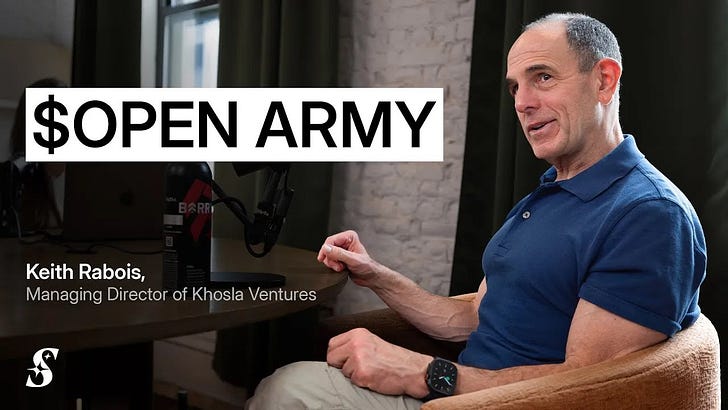
Keith Rabois, Board Chair, Opendoor:
“99% of everything that matters is the CEO.
The most important lesson for me over the last 25 years is if you have the right CEO things that people believe to be impossible are very possible, sometimes probable.
If you have the wrong CEO, almost nothing else matters.”

Incentive Alignment & Compensation
Nejatian structured his compensation around a $1 base salary and a performance-based equity package with an upside of up to $2.8 billion if long-term stock price targets are achieved.
He has also purchased over $1 million in company stock since joining.
He described the structure as a reflection of conviction rather than symbolism:
“There’s no one who’s more highly levered on Opendoor stock price than I am.”
He also acknowledged the downside exposure:
“Unless the stock price gets to levels that it has not been in, in a very, very long time, this will be a bad financial outcome.”
The compensation framework removes short-term cash incentives and ties economic upside directly to long-term equity performance. This structure contrasts with traditional executive compensation models that often provide greater insulation from downside risk.

The First Audit.
Nejatian’s first step as CEO was a comprehensive review of expenses and organizational design.
“I went through literally every single invoice the company had paid for the previous 12 months.”
He identified significant consulting expenditures, including a $5 million engagement that he characterized as strategically unhelpful.
“Do everything worse but cheaper.”
He concluded that this approach degraded quality while offering limited structural benefit. Consulting contracts were terminated, and decision-making was brought back in-house.
Nejatian also evaluated workflow design. In certain processes, as many as 11 human touchpoints were involved between initial customer engagement and final offer generation.
“Between the time you put your address in and you got an offer, there’d be 11 human beings who touched that.”
The objective since then has been to reduce manual intervention and automate core flows where possible.
“Zero human beings are in the loop in many of our flows.”
The rationale for automation is not solely cost reduction, but latency reduction. In a housing inventory model, underwriting accuracy, hold time, and contribution margin per home are sensitive to operational delay and pricing error.

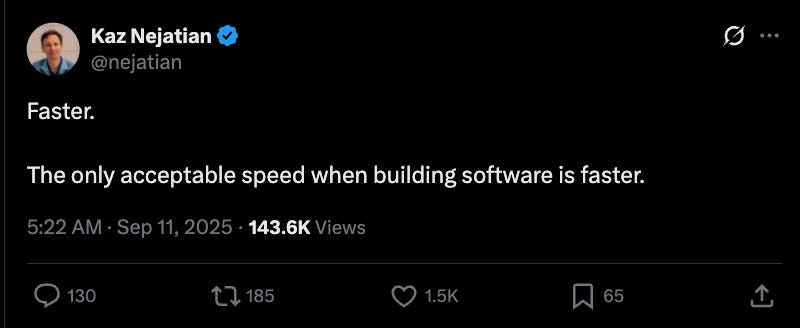
Building. Faster.
Nejatian repeatedly emphasized speed as a structural advantage. He framed companies as learning systems:
“All companies are a collective effort to learn. And if we learn faster, we do more.”
He rejected the view that slower decision-making reduces risk:
“People misprice risk in their head and they think waiting reduces risk. And in my experience, it just doesn’t.”
In asset-intensive businesses, slower iteration can increase exposure to market shifts and pricing errors. Faster feedback loops, in his view, improve capital efficiency and reduce cumulative risk.
“I will optimize my day-to-day work for what it is and not what it looks like.”
Track their speed in their public-facing weekly Accountable dashboard.

Founder Mentality
A recurring theme in the interview was what Nejatian referred to as “founder mentality.” He distinguished this from personality or charisma, instead framing it as structural accountability:
“If you go to Harvard Business School and imagine what a CEO looks like, it ain’t me. But I’m very good at building products.”
“Is someone sitting in the founder chair? Is there someone whose job it is to call bullshit on things?”
“We are not going to be a beta company. We’re a high alpha company.”
“In order to create things that have not been created before, you need exothermic energy.”
“I care a lot about the pixels. I care a lot about the API. I care a lot about the database.”

Lessons from Tobi Lütke, Shopify
Kaz Nejatian cites his time at Shopify under founder and CEO Tobi Lütke as foundational to his approach for operating Opendoor in the public markets.
Widely regarded as a “founder’s founder,” Lütke built Shopify from a niche commerce tool into a global infrastructure platform. Even after going public, he maintained a product-first and long-term orientation rather than managing toward short-term stock reactions.
Nejatian highlights several principles he absorbed:
Long-term compounding:
“People apply too large a discount rate to the future.”
“He would never sacrifice growth tomorrow for growth today.”
Public markets & valuation:
“The company drives the stock price, not the other way around.”
“Over time, the stock price converges with the company.”
Operating rigor:
Keith Rabois noted that when Kaz was promoted to COO at Shopify, he reduced G&A as a percentage of revenue from 14% to 4%, targeting 1% the following year. The lesson was not cost cutting for optics it was structural discipline.
The core takeaway he applies is straightforward: prioritize durable compounding, maintain capital efficiency, and allow long-term operating performance to determine valuation.

Housing Market Thesis
Nejatian maintains conviction in Opendoor’s underlying value proposition: reducing uncertainty in residential transactions. The traditional home-selling process is structurally inefficient and unpredictable:
“Selling a home is so painful because you list it and you have no idea what’s going to happen and how long it’s going to take.”
He contrasts this with Opendoor’s model, which is designed to introduce liquidity and certainty into the transaction:
“With Opendoor, there’s certainty and speed immediately.”
The broader thesis is that demand for transaction certainty persists regardless of macro conditions. The structural inefficiencies in the U.S. housing market — extended listing times, failed closings, contingent offers — create an opportunity for a balance-sheet-driven liquidity provider.
“When kids grow up in homes that their parents own, their life outcomes are better.”


The Board.
Nejatian was explicit that he did not want a ceremonial board. He contrasted two models of governance: passive directors versus engaged operators and investors who provide real pushback.
“You build a board such that people who are on the board get out of your way and show up to meeting once a quarter, have some shrimp cocktail, put up their hand, and then get back on the private jets and go away.”
He rejected that structure in favor of active engagement:
“Imagine having to do a song and dance in front of people where you know the answer will be yes. What is the point of that?”
Instead, he structured the board around people he would seek advice from independently:
“Who are the people where I would pay money to have dinner with them so they can talk about my job?”
He also noted the frequency of interaction:
“For my first months at the job, I talked to one board member at least every day.”
The expectation, as he framed it, is intellectual honesty and willingness to challenge:
“If it looks weird, please give me rope. If it is weird, push back. Ask me questions.”
From a governance perspective, the emphasis is on substantive oversight — capital structure durability, balance sheet risk, and structural economics — rather than passive approval. The board’s role, in his framing, is not to be a cheerleader but an accountability team during one of the most historic public turnarounds.

Opendoor Board of Directors
Kasra “Kaz” Nejatian – Chief Executive Officer and Director; former COO at Shopify and founder of fintech startup Kash.
Keith Rabois – Chairman of the Board; co-founder of Opendoor; Managing Director at Khosla Ventures; previously partner at Founders Fund and early executive/investor at PayPal, LinkedIn, Square and other tech companies.
Eric Wu – Director; co-founder of Opendoor; founder of real estate tech ventures including RentAdvisor and Movity; early-stage investor in tech startups.
Eric Feder – Lead Independent Director; President of LENX, LLC and senior operating executive at Lennar Corporation, a large U.S. homebuilder; former Vice Chairman at Rialto Capital.
Adam Bain – Independent Director; co-Managing Partner of 01 Advisors, a venture capital firm focused on high-growth technology companies; former COO of Twitter (now X Corp.) & President of Global Revenue & Partnerships at Twitter.
David Benson – Independent Director; former President of Fannie Mae, the largest provider of mortgage credit in the U.S.; has served in senior leadership roles in capital markets and finance operations.
Dana Hamilton – Independent Director; co-founder and President of real estate investment firm Ameriton LLC; former Senior Managing Director and Head of Real Estate at Pretium Partners, and senior executive at Archstone, a major apartment company.
→ Listen on X, Spotify, YouTube, Apple

Keith Rabois Quotes
“He’s both bold and ambitious, but very disciplined and rigorous and analytical. And that’s a rare combination. A company like Opendoor needs to be rigorous and analytical, but it can’t sacrifice the ambition and the boldness and the willingness to do things and push the envelope in creativity and innovate.”
“He was not only serving as the COO of Shopify, but he also ran the product team.”
“The company just has too much of a bloated G&A. It’s always had too much of a G&A that was way outta control.”
“One of the things he did at Shopify when he got promoted to be COO was cut their G&A as exp as a fraction of revenue from 14% to 4%. And I think they’re on target next year to be at 1%.”
“It’s even more important for a non-software based business to have a G&A that’s in line with the cost structure that’s in line with the cycles that real estate always goes through every decade.”
“Residential real estate is a $289 trillion asset class. It’s the largest in the world, and nobody’s really innovated in over 30 years of technology.”
“There’s no other place in the United States at any scale where you can sell your home instantly.”
“In a peak United States housing market, 6 million Americans buy a home. In a bad market, 4 million do. So it’s a pretty big variability there. So you need to be able to be profitable or break even in a market when only 4 million Americans transact.”
“We need a fixed cost structure that can be appropriate for both the high season and the low season. Residential real estate goes through cycles, and you need a fixed cost structure that can be appropriate for both the high season and the low season.”
“We need to move very fast. Lightning speed. We wanted someone with a founder mentality who moves to lightning speed 24/7. Period. And doesn’t accept excuses.”
→ Listen on X, Spotify, YouTube, Apple
The material presented on Molly O’Shea’s website are my opinions only and are provided for informational purposes and should not be construed as investment advice. It is not a recommendation of, or an offer to sell or solicitation of an offer to buy, any particular security, strategy, or investment product. Any analysis or discussion of investments, sectors or the market generally are based on current information, including from public sources, that I consider reliable, but I do not represent that any research or the information provided is accurate or complete, and it should not be relied on as such. My views and opinions expressed in any website content are current at the time of publication and are subject to change. Past performance is not indicative of future results.
Paid Endorsement. Brokerage services by Open to the Public Investing Inc, member FINRA & SIPC. Advisory services by Public Advisors LLC, SEC-registered adviser. Crypto trading provided by Zero Hash LLC, licensed by the NYSDFS. Generated Assets is an interactive analysis tool by Public Advisors. Output is for informational purposes only and is not an investment recommendation or advice. See disclosures at public.com/disclosures/ga. Matched funds must remain in your account for at least 5 years. Match rate and other terms are subject to change at any time.