

John Collison, Stripe
AI agents will completely rewire internet commerce.
Stripe processed $1.9T in 2025, up 34%. Now the company is rebuilding for an internet where AI agents, not humans, increasingly transact.
“Instinct is real, Muse is real. All these things are real.”
“Computer use is the ultimate backwards compatibility layer for the real world.”
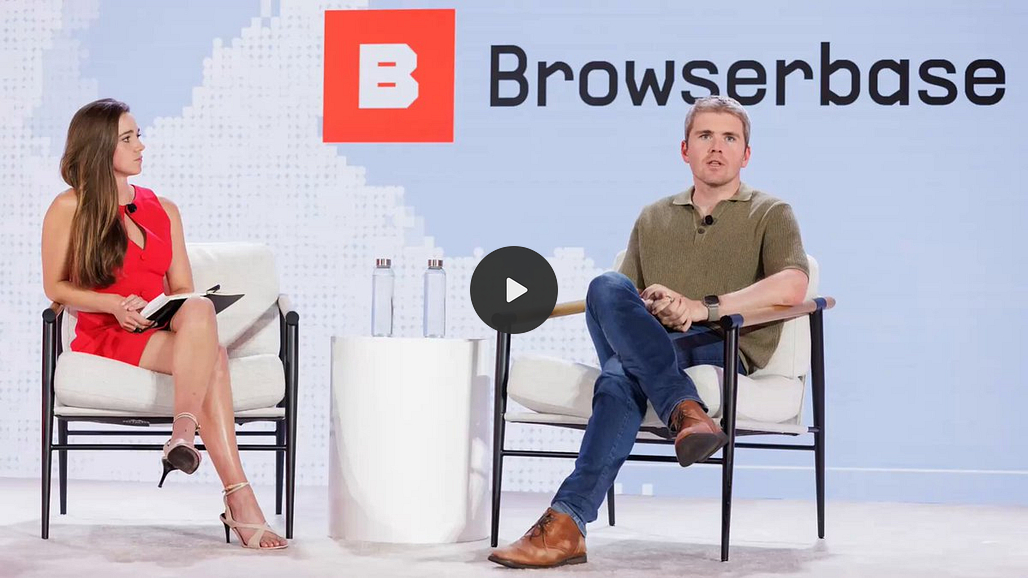
I sat down with John at Browserbase Navigate to talk agentic commerce, computer use, cybersecurity, how Stripe is rebuilding for AI & why Stripe considers 2026 the beginning of the “singularity epoch.”
→ Listen on X, Spotify, YouTube, Apple
John sees AI already showing up in new company creation. Stripe is seeing its highest rate of new firm creation in recent memory, while its 2026 Atlas cohort is tracking at 5x the revenue of the 2025 class.
We also cover Stripe’s recent acquisitions:
› Bridge + Privy, bringing crypto-native infrastructure & talent
› Metronome, usage-based billing for the AI era
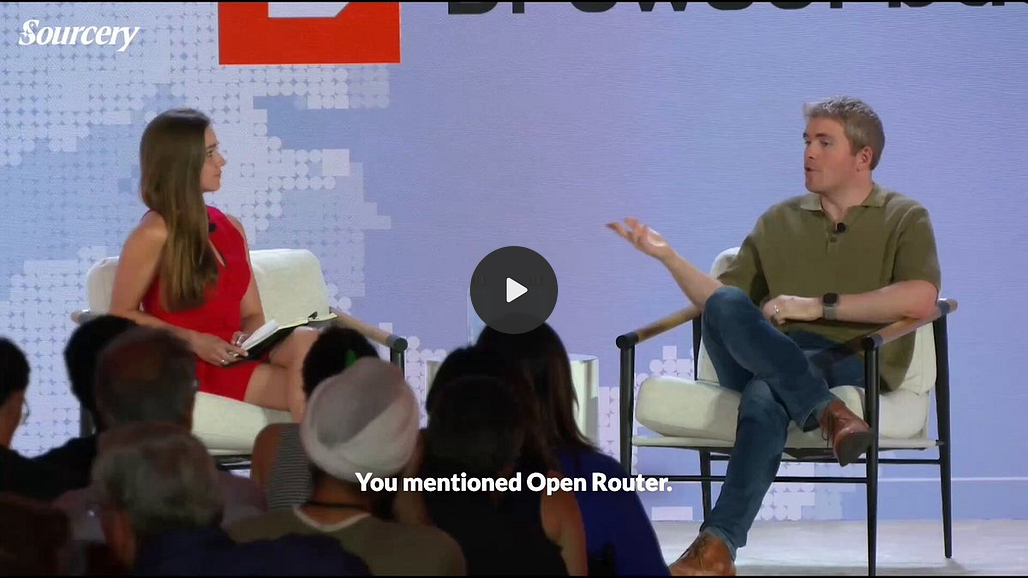
› OpenRouter, routing across multiple AI models as inference spend & model competition explodes
Browserbase is building the infrastructure for this shift, giving AI agents cloud browsers to navigate the existing web & take actions across it. Big shoutout to Founder & CEO Paul Klein IV & Erika Bricky for such a top notch event.

𝐓𝐈𝐌𝐄𝐒𝐓𝐀𝐌𝐏𝐒
(00:00) Stripe’s $1.9T & Rebuilding for AI
(00:31) Why Agents Will Replace Web Forms
(02:20) How AI Rewires Commerce & Product Discovery
(04:40) Why AI Could Mean More Cyberattacks
(06:49) Why Stripe Says the Singularity Started in 2026
(09:29) Stripe Is Rebuilding Its APIs for AI Agents
(11:38) Why Stripe Bought Bridge, Privy, Metronome & OpenRouter
(15:12) When Stripe Builds vs. Buys
(16:55) How AI Is Changing Stripe Internally
(20:39) How John Keeps Up With AI
(23:28) The Coming Good Bot vs. Bad Bot Problem
(24:53) 17 Years of Lessons Building Stripe
Brought to you by:
Brex—The intelligent finance platform: cards, expenses, travel, bill pay, banking—wrapped into a high-performance stack. Built for scale. Trusted by OpenAI, Anthropic, Vercel, Granola, Deepgram, & Sourcery.. teams that move fast AF. visit → brex.com/sourcery

John Collison on the Agentic Internet
Stripe Co-Founder John Collison sees computer use as a major unlock for AI agents, allowing them to interact with the existing internet without waiting for every website to build agent-specific infrastructure.
In our conversation at Browserbase Navigate, we get into how this changes commerce and product discovery, why Stripe acquired OpenRouter, how coding agents are forcing Stripe to rethink its own developer infrastructure, and how John stays current without completely succumbing to “AI psychosis.”


1. AI Agents & Computer Use
“Computer use is the ultimate backwards compatibility layer for the real world.”
John says one of the biggest unlocks for personal agents is mature computer use. Instead of waiting for every organization to build an API or MCP server, agents can interact with the websites and software that already exist.
He points to something as simple as renewing a driver’s license. An agent that knows your address and payment information can navigate the existing DMV interface and complete the task.
“Filling out a web form is not a value-add activity for anyone.”


2. AI Is Changing Product Discovery
“AI discovery is the new point of aggregation for commerce.”
John says his experience with AI-powered product research often surfaces niche brands and businesses he hadn’t previously heard of.
He sees this as potentially positive for the long tail of businesses. Products that are well-reviewed and liked online can become more discoverable, while existing aggregators will have to adapt to AI becoming another point through which consumers discover products.
“I think it’s quite a good story for the long tail of businesses.”

3. Why Stripe Acquired OpenRouter
“To believe in OpenRouter, you have to believe that more than one model will be used inside a business.”
John says businesses may use different models for different workloads and change those choices as new models become available.
He gives the example of sending a high-value user to a frontier model while routing a lower-value user to a lower-cost model. Stripe saw OpenRouter as furthest ahead in building the marketplace and infrastructure for businesses using multiple models.

4. Stripe Is Rebuilding for AI
“No one actually really integrates the Stripe API by hand anymore. You know, they send their coding agent to do it.”
Stripe spent years optimizing its APIs, documentation and integrations for developers. John says coding agents have changed what matters.
“The developer ergonomics are different from the AI ergonomics.”
Stripe is now having to change what it optimizes for internally, including problems like agents integrating the wrong version of an API.

5. Avoiding AI Psychosis
“Who said I don’t have AI psychosis?”
John says he stays current by vibe coding applications he wants to use and spending time with fast-growing Stripe customers, which increasingly means companies working in or around AI.
But his more analog answer is simpler.
“Putting down the phone from time to time. I don’t know if people have tried that, but it’s pretty nice out there in the wider world.”
His advice for people spending too much time in San Francisco’s AI bubble is to get outside SoMa, cross the Golden Gate Bridge and spend some time in Marin.

ICYMI: Interview with Browserbase CEO Paul Klein IV from last year
Browserbase provides a cloud-based browser infrastructure layer that enables developers and AI systems to programmatically interact with the web. Its core offering, headless & scalable browsers, serve as a runtime for automated workflows across web interfaces. Developers can integrate these capabilities using Browserbase’s framework, Stagehand, which offers a code interface for fine-grained browser control.
→ Listen on X, Spotify, YouTube, Apple

Common use cases span both routine and bespoke workflows that lack APIs or structured integrations, such as filing franchise taxes, checking professional credentials, or navigating legacy websites in regulated industries. Customers range from startups to large enterprises automating back-office tasks, data collection, and operational workflows that rely on browser-based interactions.
The infrastructure is designed to serve as a primitive within broader agent ecosystems and LM-powered applications, providing the browser as one of many external tools accessible to an AI system.
“If you want AI to do the same work that you do on the web, you need to give it a browser,” Klein explains. “We provide that browser, at scale, as infrastructure.”

Hot Takes from Browserbase Navigate

The material presented on Molly O’Shea’s website are my opinions only and are provided for informational purposes and should not be construed as investment advice. It is not a recommendation of, or an offer to sell or solicitation of an offer to buy, any particular security, strategy, or investment product. Any analysis or discussion of investments, sectors or the market generally are based on current information, including from public sources, that I consider reliable, but I do not represent that any research or the information provided is accurate or complete, and it should not be relied on as such. My views and opinions expressed in any website content are current at the time of publication and are subject to change. Past performance is not indicative of future results.
Paid Endorsement. Brokerage services by Open to the Public Investing Inc, member FINRA & SIPC. Advisory services by Public Advisors LLC, SEC-registered adviser. Crypto trading provided by Zero Hash LLC, licensed by the NYSDFS. Generated Assets is an interactive analysis tool by Public Advisors. Output is for informational purposes only and is not an investment recommendation or advice. See disclosures at public.com/disclosures/ga. Matched funds must remain in your account for at least 5 years. Match rate and other terms are subject to change at any time.