

Manufacturing 1 Million Drones
Soren Monroe-Anderson, Co-Founder & CEO of Neros Technologies, joins Sourcery from the company’s new 250,000-square-foot factory in Torrance following its $250 million Series C at a $2.5 billion post-money valuation.
→ Listen on X, Spotify, YouTube, Apple
The round, co-led by Sequoia & American Strategic Technology Fund, comes as Neros expands from its core Archer FPV platform into multiple product lines, including Archer AI, Marksman, & Bandit, its counter-UAS interceptor. Neros is also fresh off a $500M Army IDIQ & is building toward the capacity to manufacture 1 million drones/yr.
Soren explains why modern warfare is increasingly being shaped by low-cost drones, why America fell so far behind China in drone and electronics manufacturing, and what it actually takes to “de-China-fy” a defense supply chain. Neros has pushed critical components including boards, chips, motors and magnets outside China, but Soren argues complete independence is far harder when Chinese suppliers still dominate some raw materials and precursor chemicals.
We also discuss Neros’ transition from a single-product company to a multi-product defense manufacturer, the rise of interceptor drones, autonomous capabilities that can operate through communications loss, sovereign manufacturing for U.S. allies, and why Soren wants Neros to become the “Toyota of defense manufacturing.”

𝐓𝐈𝐌𝐄𝐒𝐓𝐀𝐌𝐏𝐒
(00:00) Soren Monroe-Anderson, Co-Founder & CEO at Neros Technologies
(01:02) Neros just raised $250M at a $2.5B valuation
(03:34) Working with Shaun Maguire
(04:25) Inside the Army's $500M drone contract
(05:38) How the Ukraine war rewrote modern combat
(08:05) The Interceptor drones taking over the battlefield
(10:31) How many drones China really makes in a year
(12:55) Is it even possible to build a drone without China?
(16:09) China is arming both sides of the war
(17:08) What actually separates Neros from every other drone company
(19:55) The biggest BS claims in defense tech right now
(20:51) Why most defense startups never actually deploy?
(22:58) Neros’s growth to over 250 employees
(24:00) Why defense startups need to screen for spies
(25:29) The Talent bottleneck slowing down American manufacturing
(26:51) How AI is quietly reshaping engineers
(29:43) The biggest myth about re-industrializing America
(30:50) Neros's plan to build drones with U.S. allies
(32:53) The brutal tradeoff between speed and scale
(34:51) Why Neros keeps a permanent office in Ukraine?
(35:52) What actually happens on a modern battlefield?
(37:41) How Starlink is changing drone warfare
(39:14) What happens when a drone loses its signal
(40:41) Soren’s learnings from Kelly Johnson
Brought to you by:
Brex—The intelligent finance platform: cards, expenses, travel, bill pay, banking—wrapped into a high-performance stack. Built for scale. Trusted by OpenAI, Anthropic, Vercel, Granola, Deepgram, & Sourcery.. teams that move fast AF. visit → brex.com/sourcery

Turing—Turing partners with frontier AI labs to improve model capabilities in coding, reasoning, tool use, & multimodality, as well as with Fortune 500 enterprises to build & deploy end-to-end agentic AI systems in mission-critical workflows Visit: turing.com/sourcery
VCX—VCX is the public ticker for private tech, allowing investors of all sizes to invest in venture capital. View The Portfolio at GetVCX.com
Deel—Deel is the global people platform that helps startups hire, manage, pay, and equip anyone, anywhere. Trusted by more than 35,000 fast-growing companies, Deel is the people platform that just works, so teams can scale without the chaos. Visit: deel.com/sourcery
Public-–Investing platform Public just launched Generated Assets, which lets you turn any idea into an investable index with AI. With Generated Assets, you can build, backtest, refine, and invest in any thesis with AI. Gone are the days of one-size-fits-all ETFs. Try it today: public.com/sourcery
Manufacturing Drones for America
Soren Monroe-Anderson is co-founder and CEO of Neros Technologies, which he started in 2023 with Olaf Hichwa after both raced FPV drones professionally. We recorded this interview inside the company’s 250,000 square foot factory in Torrance, California, sized to build 1 million drones a year.
→ Listen on X, Spotify, YouTube, Apple

$250M Series C at $2.5B Post
Neros raised $250M in a Series C at a $2.5B post money valuation. Sequoia and American Strategic Technology Fund led the round, with participation from Interlagos, Valor Equity Partners, Allen & Company, Thiel Capital, Spark Capital, and Mantis. The round was preempted and came together quickly with existing investors, which has been the pattern across the company’s last several rounds.
“Fundraising isn’t the goal, but it is a tool, and I think this is a great milestone for the company.”
The round follows a $500M IDIQ contract with the Army for hundreds of thousands of drones over the next 5 years, structured so the Army receives Neros’ latest products, including the new Archer AI. The award came out of PBAS, the Purpose Built Attritable System program, which is the first program of record for FPV drones in America. Neros spent roughly a year building new drone sizes and a new ground station ahead of the fly-off, and the Army selected three companies out of it.
“They selected two other companies as well, but we were the only ones to really deliver in a meaningful way.”
Capital from the round goes to four places. Production expansion at the Torrance facility. Vertical integration, including component manufacturing brought in-house. International expansion and sovereign manufacturing across European, Asian, and Middle Eastern allies. And development of Block 3 hardware, the ground-up redesign meant to enable 1,000,000 drones per year by 2028.

What Changed on the Ukrainian Front Line
The front line in Ukraine is largely static, and the no-man’s zone running along it has widened from a few kilometers to roughly 30 kilometers. Drones drove that change, and the widening zone is now pushing Ukrainian FPVs to get physically larger to cover the distance. Fiber optic drones, which are immune to jamming, have increased in frequency over the same period.
“Anything that is visible from the air that moves in that zone is going to be immediately attacked and eliminated.”
Ukraine has been running a mid-strike campaign against Russian logistics routes 150 to 200 kilometers past the front line. That campaign has been in the works for about 9 months and has become effective in the last 3. Deep-strike drones are hitting the Moscow region more frequently. On the defensive side, roughly 90% of the Shahed deep-strike drones Russia launches are now taken out of the sky before reaching a target.
Over 70% of casualties in Ukraine are attributable to drones, and 90% of those come from manually piloted FPV systems. Ukraine is estimated to use 7 million FPV drones this year.
“FPV drones are one example of where low-cost drone technology is reshaping warfare. It’s sort of like the first really big example, but this is gonna happen in many different types of drones and different types of defense capabilities.”
ICYMI: Ukraine snuck $1M worth of drones destroyed $7B of Russian ⅓ of long distance bomber fleet…


From One Product to Three
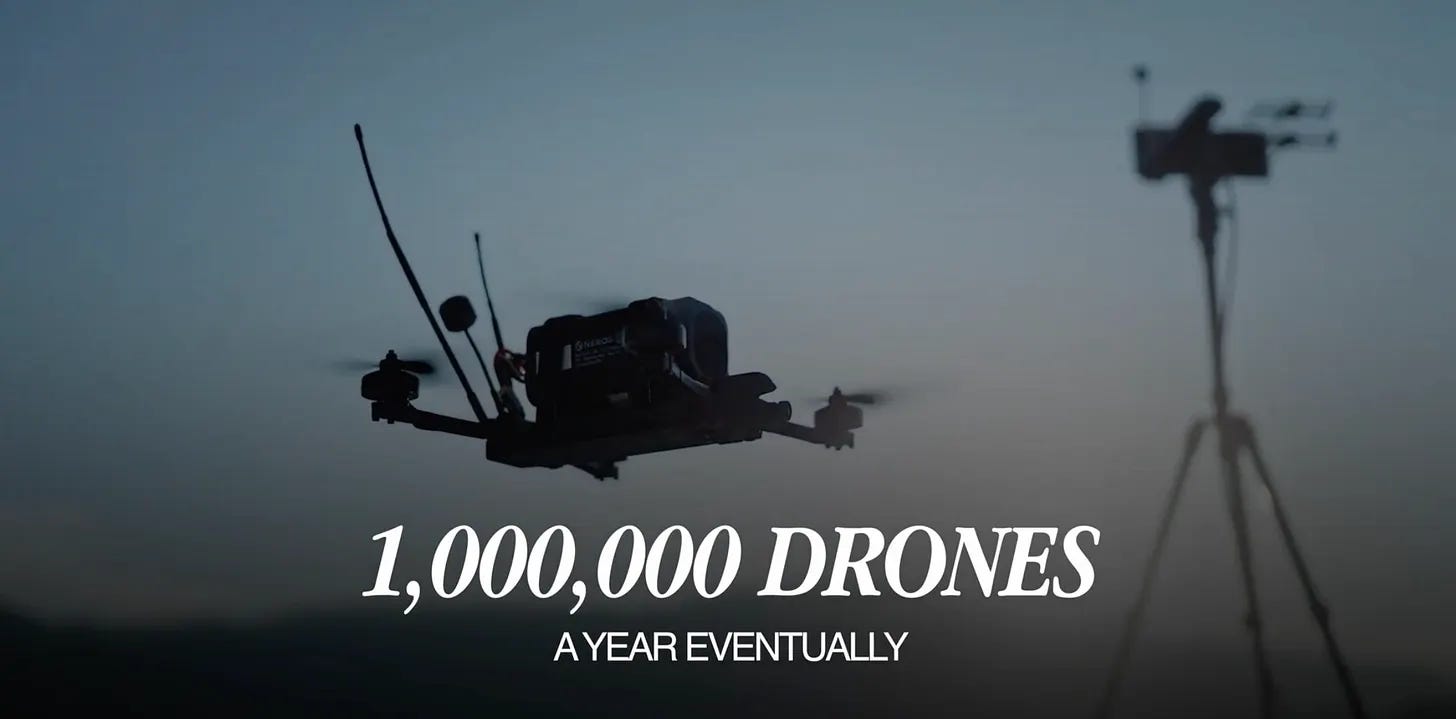
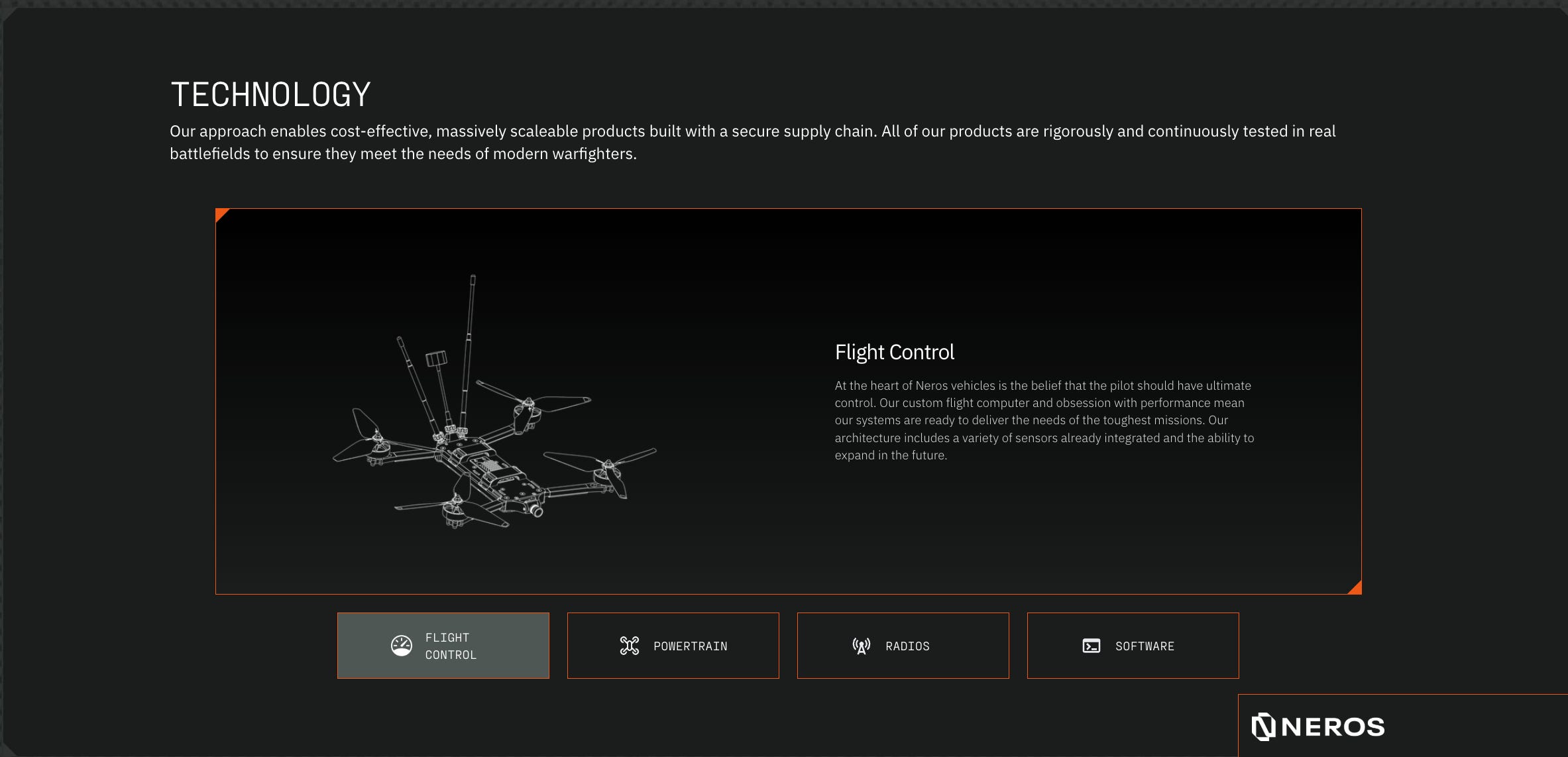
Archer is the modular FPV platform, currently shipping as Block 2 in 5”, 8”, and 10” variants with max payloads of 1.5 lbs, 5.1 lbs, and 7.0 lbs. The 8” carries the longest unloaded range at 22.5 miles. Archer sells starting at $2k and runs to around $5k once peripherals and warheads are added.
Archer AI is the autonomy-enabled variant, launching with terminal guidance and GNSS-denied position hold, estimated at $3k to $6k with warheads and sensors. Terminal guidance addresses the point in the mission where most drones fail. Jamming concentrates over valuable targets, so the signal environment gets exponentially worse as the operator, sitting 10 kilometers back, tries to bring the drone within hundreds of meters of the target.
“Once the pilot has selected the target and the drone has a lock on it, it doesn’t need input anymore. So even if radio comms get cut, it will continue in and hit the target.”
Bandit is the counter-UAS interceptor, built for Class 3 targets like Shahed drones, with an estimated 233 mph top speed, 16,500 ft max altitude, and 12.4 mile engagement range, starting around $5k. Neros intends to deploy Bandit in Ukraine before the end of the year. The company also announced Marksman, an in-house ruggedized handset going to Drone Dominance Gauntlet II this month, and a new generation of the Crossbow ground control station that fits radio and pilot box on a single soldier’s plate carrier at a 50% size reduction while holding 25 km range. Alongside the products, Neros introduced a “Useful Autonomy” framework that measures any autonomy feature against three tests, whether it reduces operator workload, whether it works in actual battlefield conditions, and whether it improves mission success rates.
Multi-product changes the engineering org. Historically Neros ran fewer than 10 responsible engineers across the entire Archer system. New product lines require both platform-level and component-level REs across many projects at once, and the company is hiring across every engineering discipline to fill them.
“It’s way more clear how do you structure all your teams when your whole engineering team is just split by department but working on one product. When you need to support multiple different product lines, it starts to become a little bit fuzzier.”
“De-Chinafy”ing the Supply Chain
Neros was the first company to put an FPV drone on the Blue UAS list, meaning the Department of War can purchase and use it without additional approvals. That required removing Chinese content from the core components. The boards and the chips that populate them are non-Chinese. The motors are made outside China. The magnets are produced outside China, and the material that goes into the magnets is sourced outside China.
“You can look at our boards, you can look at all of the chips that go onto our boards. Those will not have ever touched China.”
The independence has a floor. Printed circuit board manufacturing depends on precursor chemicals that China dominates, which applies to American ITAR-certified board shops producing hardware for programs as sensitive as the F-35. Raw materials and process chemicals sit at the same depth in the stack.
“I would be lying to you if I said nothing in our supply chain relies on China, because the truth of the matter is if you go down far enough, you will find places where China is the main supplier.”
What a single drone company can do is hold the line on the components specific to its own system and generate enough demand to support non-Chinese batteries and non-Chinese thermal cameras. Solving the rest requires a national effort. The broader defense startup ecosystem is working with suppliers that were never set up for volume, scale, or low-cost systems.


How America Fell Behind & What China Gets From Selling to Both Sides
The United States represents 1% of global production of small unmanned aircraft systems. Around 30 years of offshoring consumer electronics manufacturing produced that number. The bill of materials for an FPV drone resembles a laptop or a phone far more closely than a traditional weapons system, so the national security consequence of losing consumer electronics went largely unexamined until drones became central to the battlefield.
“The way America got left behind was not caring about consumer electronics manufacturing being done domestically.”
China produces an estimated tens of millions of drones per year, possibly into the hundreds of millions, and supplies both Ukraine and Russia with drones and components. DJI makes the most commonly used reconnaissance drones on the battlefield, with Mavics and Matrices flying for both sides.
“It’s a morally corrupt approach, although it would also be far worse for Ukraine if they didn’t have access to Chinese components.”
Supplying both sides gives the Chinese industrial base a continuous feedback loop from Ukrainian and Russian FPV companies, with turnaround on requested changes measured in weeks. The accumulated learning from scaled production is the compounding advantage.


Industry Production Claims & What Neros Has Delivered
Neros migrated earlier in 2026 from a 20,000 square foot facility in El Segundo to the 250,000 square foot Torrance factory. Current output is approximately 1,250 drones per week, the highest volume small FPV drone production in America. The company expects to exceed a 100,000 drone per year run rate by the end of 2026 and reach 1,000,000 per year in 2028. A drone is assembled end to end in about 45 minutes, with one coming off the line every 2 minutes. Some competitors spend 12 labor hours per drone, and competitor facilities run under 100,000 square feet.
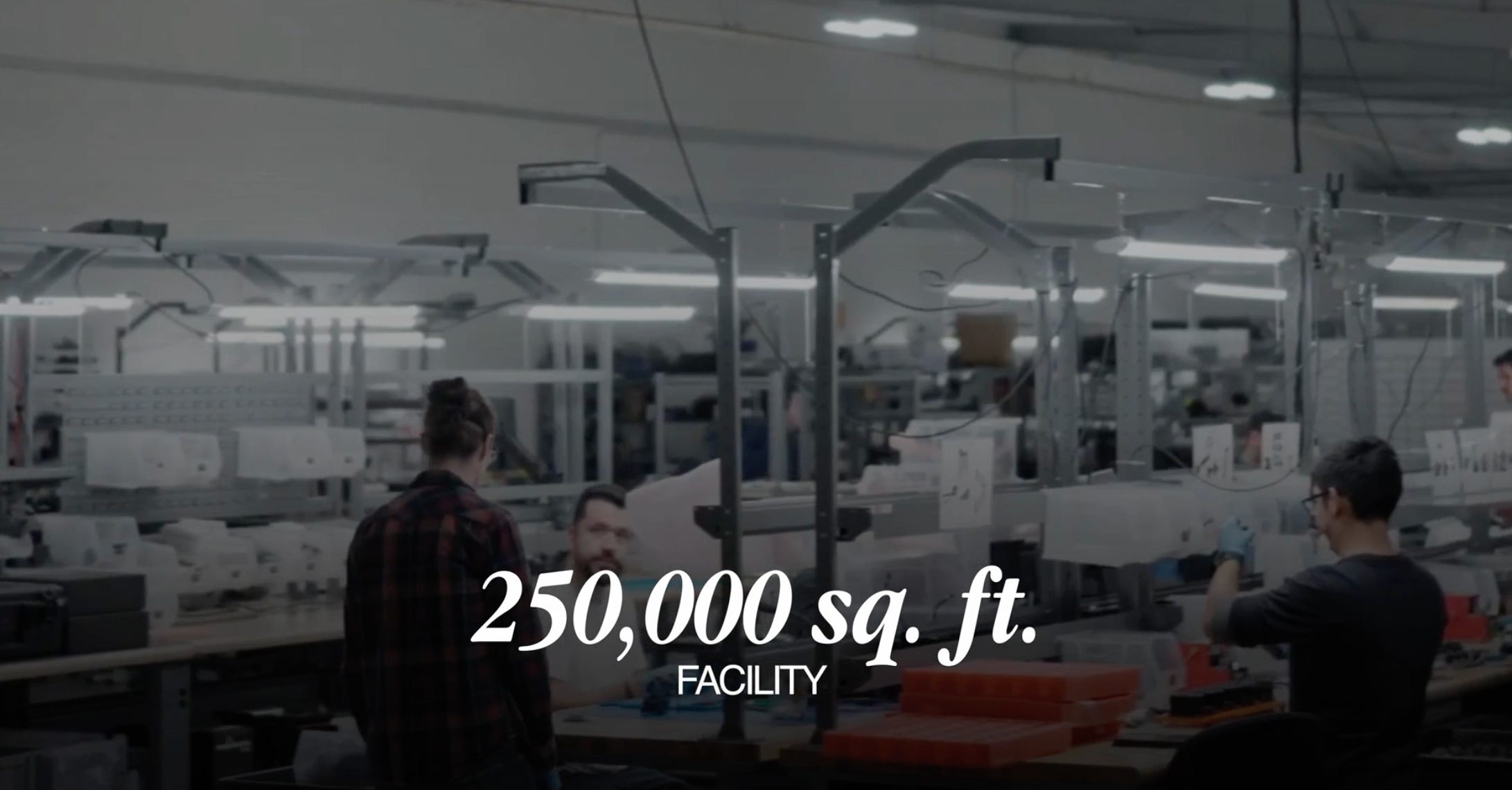
Every drone off the line takes its first flight in an on-site test chamber, and the data feeds future simulators. The flight test team runs experiments at desert test sites 5 or more days per week, which lets an engineer propose a test in the morning and have results that evening. Roughly half of the drones Neros has built are deployed to the military for combat and stockpile use, excluding training and demos.
“To claim a production capacity, in my opinion, you need to have done it many times over.”
At Drone Dominance Gauntlet 1, Neros was the top performing American manufactured drone and the first to fully deliver against Department of War orders. Several competitors have still not completed initial fulfillment months after the competition ended, and Neros received bonus allocations because of those delivery failures. One manufacturer publicly claiming 1 million drones per year is not appearing at Drone Dominance Gauntlet II.
“When we got the order after the gauntlet, we had already built pretty much all of the drones and just shipped them out, and then we were so far ahead of everybody in delivery.”
Headcount went from under 100 employees at the start of 2026 growing to more than 250. The company is filtering for the top 1% of hardware engineers who can carry responsible engineer level ownership of a system or subsystem, a pool Monroe-Anderson describes as very limited globally and heavily competed for among LA hardware companies.

Sovereign Manufacturing & Block 3 Redesign
Allies across Europe, Asia, and the Middle East have shown strong interest in Archer FPV systems and want them produced domestically. Neros has been responding to that demand, and a large share of its own supply chain already comes from allied countries.
“I say we wanna be the Toyota of defense manufacturing, where instead of being like a current prime where we’re very exquisite and siloed, we’re making these very accessible systems and we’re ubiquitous across allies.”
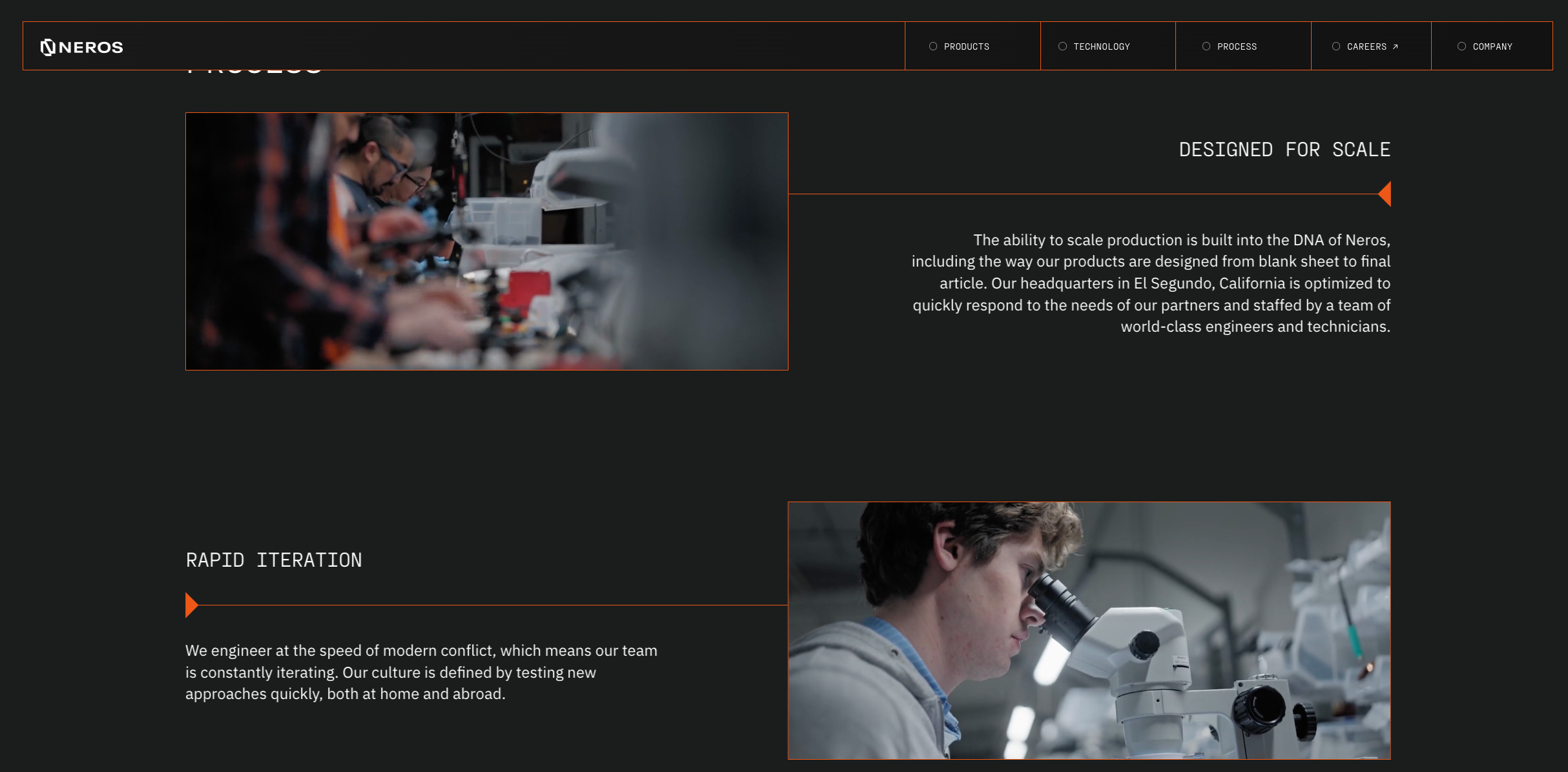
Standing up production abroad has no established playbook. The Torrance factory works partly because engineers sit next to the line, and the production org has recently become less dependent on engineering for daily operations. Replicating it requires someone who holds the full context of how Torrance runs without being the person running it.
“Our factory benefits so much from the engineers sitting right next to the production line, and we have to essentially figure out how to productize the production line itself and have it run without just constant sustaining engineering.”
Scale also constrains iteration speed. Changing a radio design means eating obsolescence cost on roughly 30,000 boards already fabbed and waiting for assembly. Neros moved to a block system to manage that. Small iterations from user feedback roll into Archer Block 2 continuously, while Block 3 proceeds as a full ground-up redesign of the system on a longer timeline. Ukrainian manufacturers iterate extremely fast without the runway for deep technical work on longer horizons, and Block 3 is the hardware that carries Neros to 1,000,000 drones per year by 2028.

Culture & Growing to 250 People
Headcount is growing fast. That growth changed how the team has to operate. Management style, communication flow across the company, maintaining the hiring bar, and screening for culture fit all became deliberate problems over about 6 months. Insider threat protection is also an extremely live consideration at this size & in this sector.
“When you’re under 100 people, you just have a bunch of really smart, high-agency people kind of just working on one thing. Stuff just kind of works.”
Neros is hiring across every engineering discipline, with the sharpest constraint on responsible engineer level talent, meaning engineers who can own a system or subsystem outright. Historically the company ran fewer than 10 REs across the entire Archer platform. Moving to multiple product lines requires both platform-level and component-level REs across many projects simultaneously, which multiplies demand for exactly the people who are hardest to find. Monroe-Anderson describes the global pool of hardware engineers at that level as very limited, and every high-growth LA hardware company is competing for it. The response has been to build a company that top talent wants to join and prove themselves at.
»»» Careers at Neros « « «

High-growth companies across sectors are converging on the same profile, highly capable individual contributors who also make business decisions. While AI is accelerating that concentration in software, with less effect so far in hardware engineering, which still requires much hard-earned skills.
The Torrance building holds the entire company, corporate, engineering, R&D, and production together in one facility, organized into engineering pods for autonomy, firmware, mechanical, and electrical. Colocation is what makes the daily experiment cycle work, where an engineer proposes a test in the morning, loads drones into the flight test van, and has desert results that evening.
The building also has a gym, an outdoor area, and a sauna, which Monroe-Anderson frames as the tradeoff for putting everyone inside a large industrial box and asking them to work very hard.
→ Listen on X, Spotify, YouTube, Apple

The material presented on Molly O’Shea’s website are my opinions only and are provided for informational purposes and should not be construed as investment advice. It is not a recommendation of, or an offer to sell or solicitation of an offer to buy, any particular security, strategy, or investment product. Any analysis or discussion of investments, sectors or the market generally are based on current information, including from public sources, that I consider reliable, but I do not represent that any research or the information provided is accurate or complete, and it should not be relied on as such. My views and opinions expressed in any website content are current at the time of publication and are subject to change. Past performance is not indicative of future results.
Paid Endorsement. Brokerage services by Open to the Public Investing Inc, member FINRA & SIPC. Advisory services by Public Advisors LLC, SEC-registered adviser. Crypto trading provided by Zero Hash LLC, licensed by the NYSDFS. Generated Assets is an interactive analysis tool by Public Advisors. Output is for informational purposes only and is not an investment recommendation or advice. See disclosures at public.com/disclosures/ga. Matched funds must remain in your account for at least 5 years. Match rate and other terms are subject to change at any time.