


Revel Raises $150M at $1B+ to Modernize the Software Layer Behind Hardware Test & Control
Index Ventures leads with participation from Redpoint Ventures, Thrive Capital, Felicis, Abstract Ventures, and Dylan Field
Revel, a unified software platform for hardware test and command and control systems, has raised $150 million in Series B funding at a $1+ billion valuation, just 15 months after founding.
→ Listen on X, Spotify, YouTube, Apple
The round was led by Index Ventures, with significant participation from Redpoint Ventures and returning investors Thrive Capital, Felicis, and Abstract Ventures. Angel participation includes Dylan Field, co founder and CEO of Figma.
Revel is building foundational infrastructure for the next generation of complex, software defined hardware across aerospace, defense, robotics, and advanced energy. Replacing decades-old infrastructure — much of it built in the 1980s and 1990s — with a modern platform that enables engineers to visually configure hardware systems, monitor live telemetry, and issue commands safely in real time.
We cover:
Why Index Ventures led a preemptive $150M Series B
The SpaceX “T-minus 1 minute” moment that shaped Revel’s philosophy
How Revel helped Impulse increase rocket engine testing frequency by 5–10x
The difference between Revel Test and Revel C2 (Command & Control)
Lessons from Elon Musk on pushing engineers beyond perceived limits
Why Dylan Field (Figma) is a key investor & strategic sounding board
Revel is now working with companies like Impulse, Radiant Nuclear, Astro Mechanica, and others building mission-critical infrastructure for the autonomous age.
This is the story of modernizing the software layer behind physical systems — where one character of code can mean total success… or no launch site.
𝐓𝐈𝐌𝐄𝐒𝐓𝐀𝐌𝐏𝐒
(00:00) Scott Morton, Founder & CEO at Revel
(00:40) Raising $150M at a $1.005B valuation in just 15 months
(02:58) What Revel actually builds
(05:23) 10x faster engine testing by replacing legacy systems
(07:26) Designing Falcon 9’s propellant load sequence
(09:12) T-1: When every line of code has to be perfect
(09:54) Building new infrastructure for Starship
(11:48) Biggest lesson from Elon Musk
(13:43) Pushing engineers past their self-imposed limits
(15:43) Scaling Revel without losing speed
(16:52) Revel C2 for command and control
(19:38) Lessons from Figma CEO Dylan Field
(20:55) What the next 12 months look like for Revel
Brought to you by:
Brex—The intelligent finance platform: cards, expenses, travel, bill pay, banking—wrapped into a high-performance stack. Built for scale. Trusted by teams that move fast. visit → brex.com/sourcery

Turing—Turing delivers top-tier talent, data, and tools to help AI labs improve model performance, and enable enterprises to turn those models into powerful, production-ready systems. Visit: turing.com/sourcery
Deel—Deel is the global people platform that helps startups hire, manage, pay, and equip anyone, anywhere. Trusted by more than 35,000 fast-growing companies, Deel is the people platform that just works, so teams can scale without the chaos. Visit: deel.com/sourcery
Public-–Investing platform Public just launched Generated Assets, which lets you turn any idea into an investable index with AI. With Generated Assets, you can build, backtest, refine, and invest in any thesis with AI. Gone are the days of one-size-fits-all ETFs. Try it today: public.com/sourcery
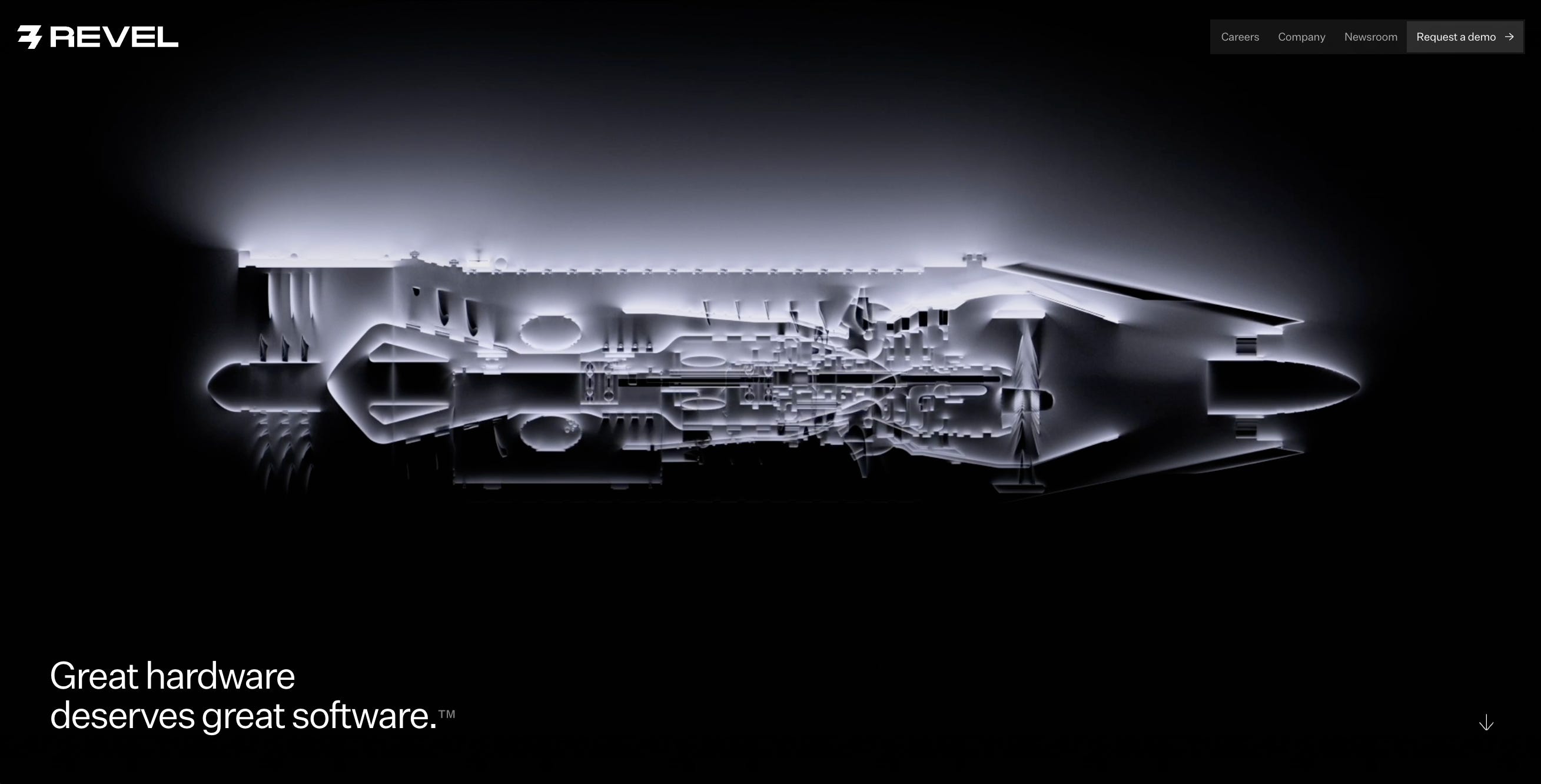
The Problem: Critical Infrastructure Running on Legacy Systems
Modern rockets, propulsion systems, jet engines, small modular reactors, and advanced robotics are increasingly software driven. Yet the tools used to test and command these systems often rely on:
Graphical programming environments developed in the 1980s
Industrial control languages introduced in the early 1990s
Fragmented, in house tooling built team by team
Architectures lacking modern observability and deterministic execution
In high consequence environments, this gap becomes existential. One incorrect line of code can mean catastrophic failure.
Scott Morton, Revel’s founder and CEO, experienced this firsthand during nearly a decade at SpaceX, where he worked on Falcon 9 propellant load systems and early Starship control infrastructure. The stakes were explicit. At T minus one minute, tens of thousands of lines of code execute in sequence, and precision is non negotiable.
Revel’s founding insight emerged from that environment. Engineers operating mission critical systems deserve modern infrastructure purpose built for reliability and scale.
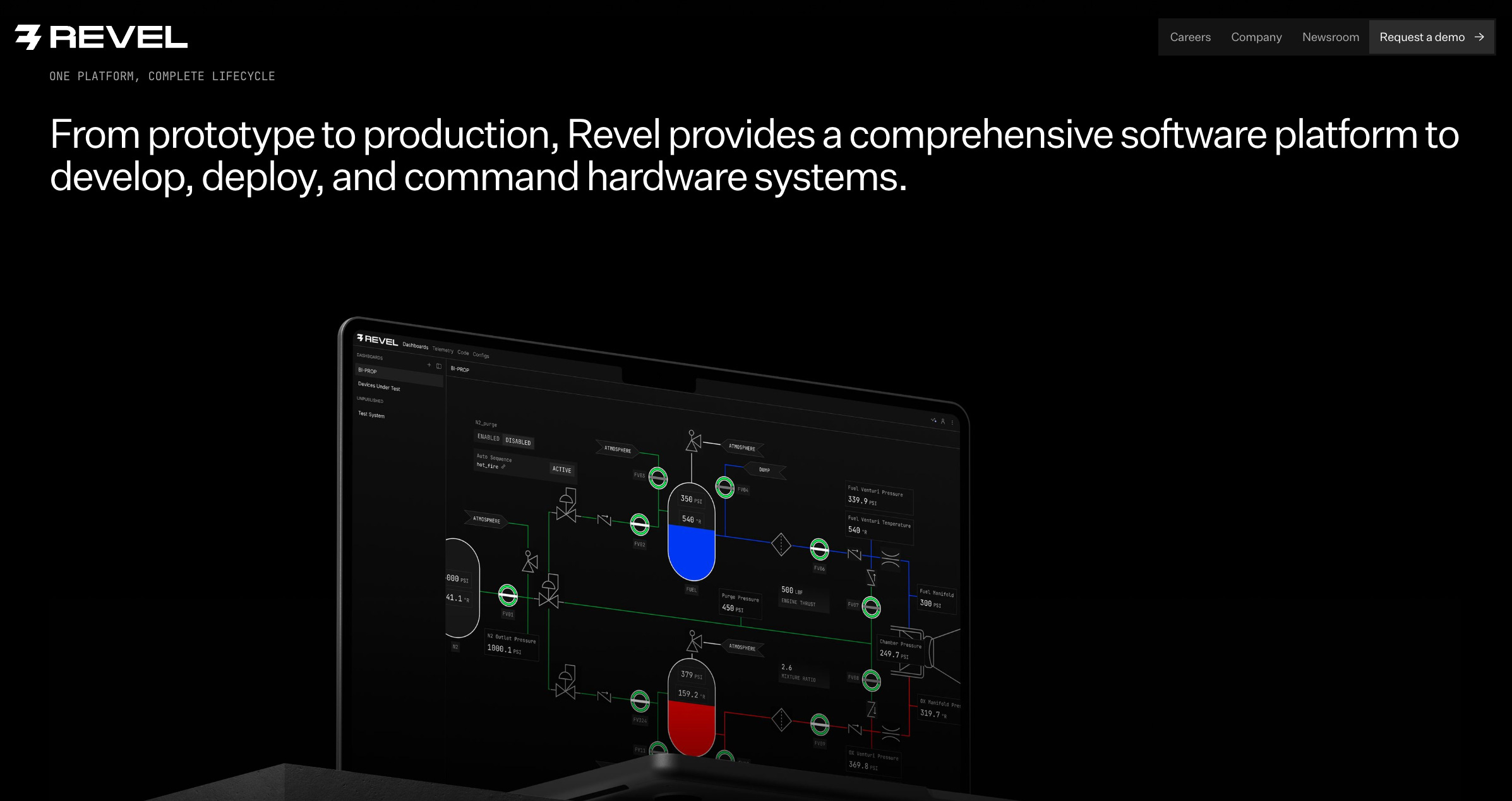
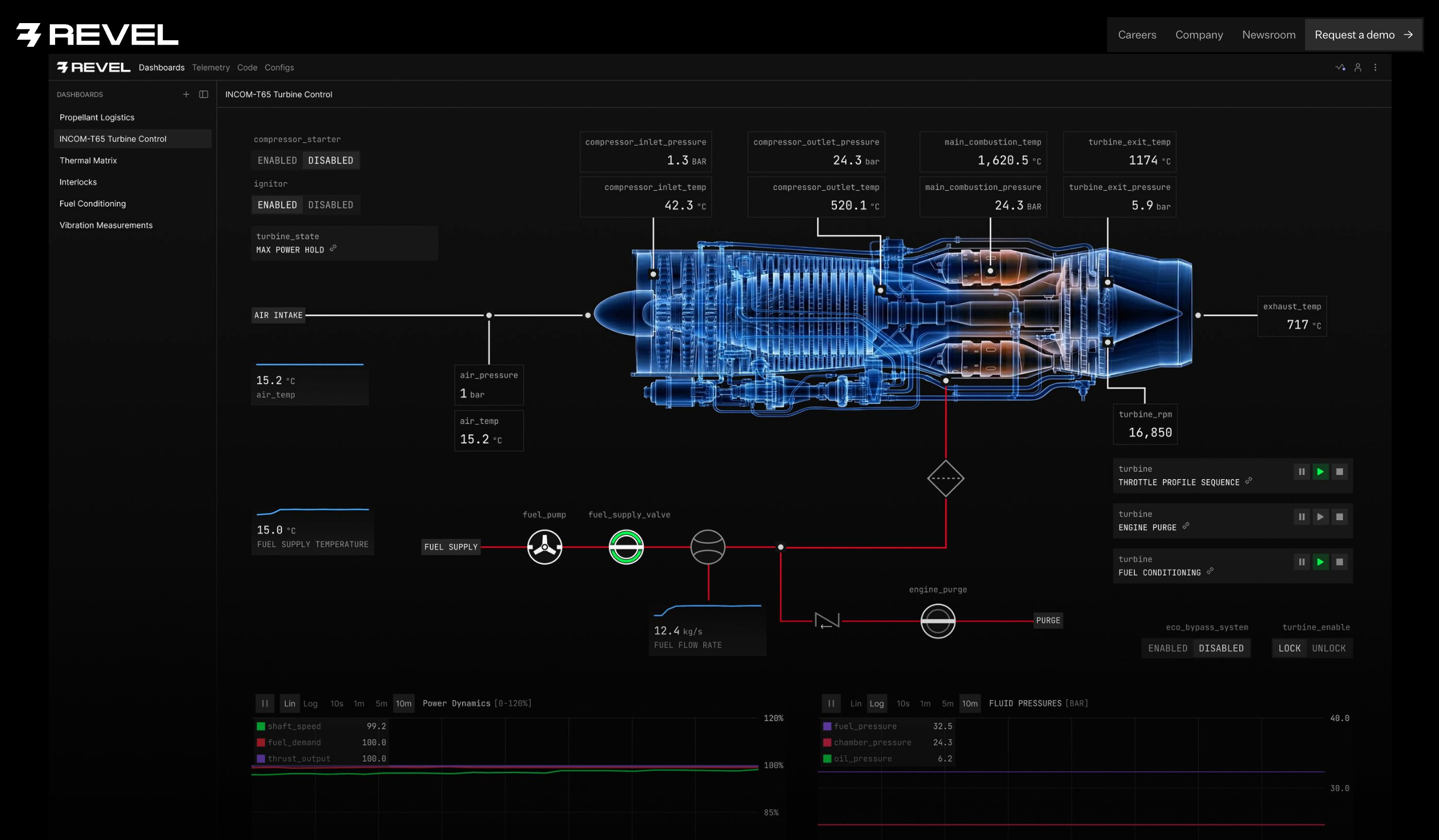
The Product: A Unified Platform for Test and Command and Control
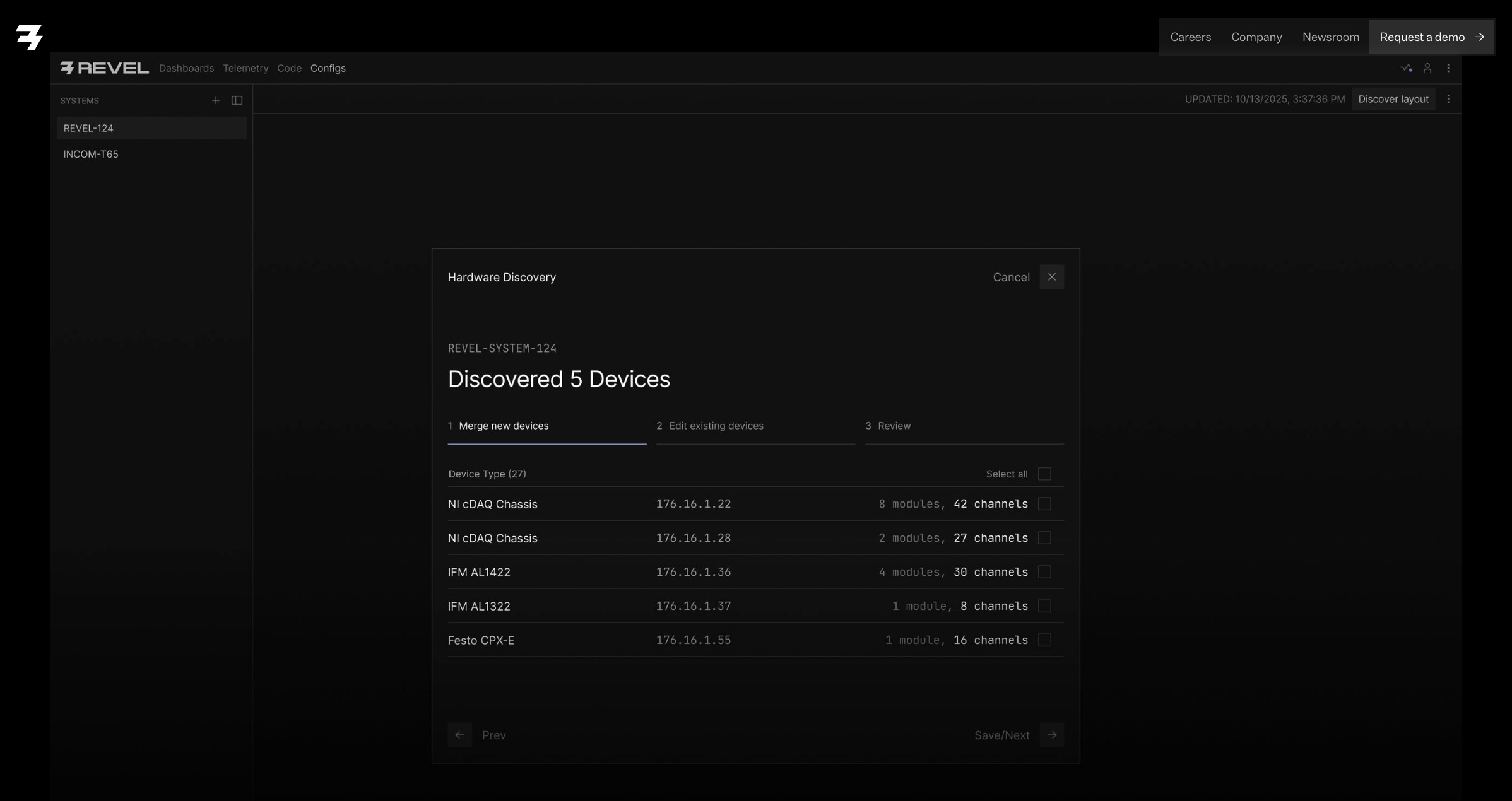
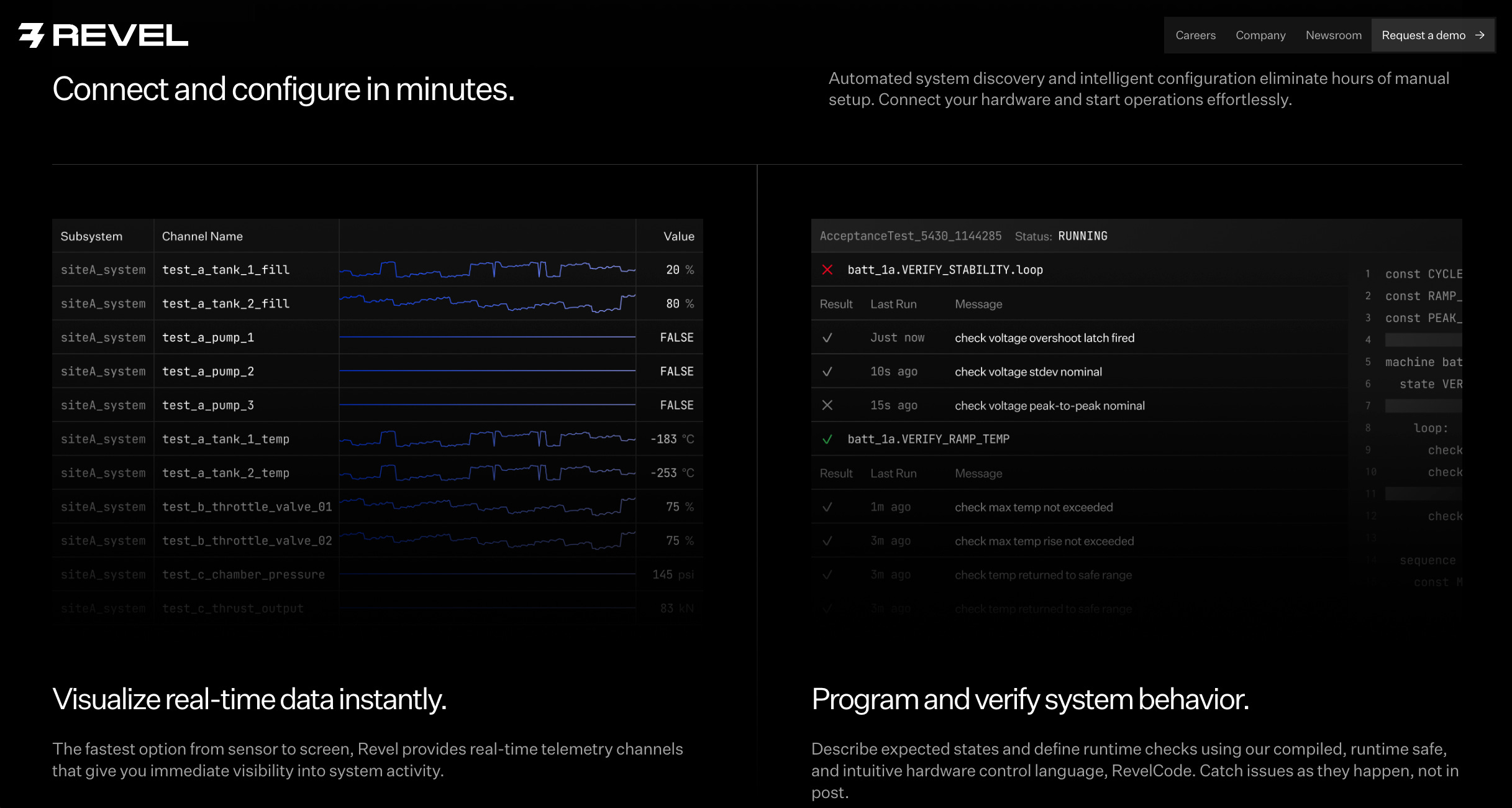
Revel provides a unified software platform that enables teams to:
Visually configure hardware systems
Monitor live telemetry in real time
Issue safe and deterministic commands
Log, replay, and debug execution
Deploy redundant architectures with high availability
The platform is structured across two primary offerings.
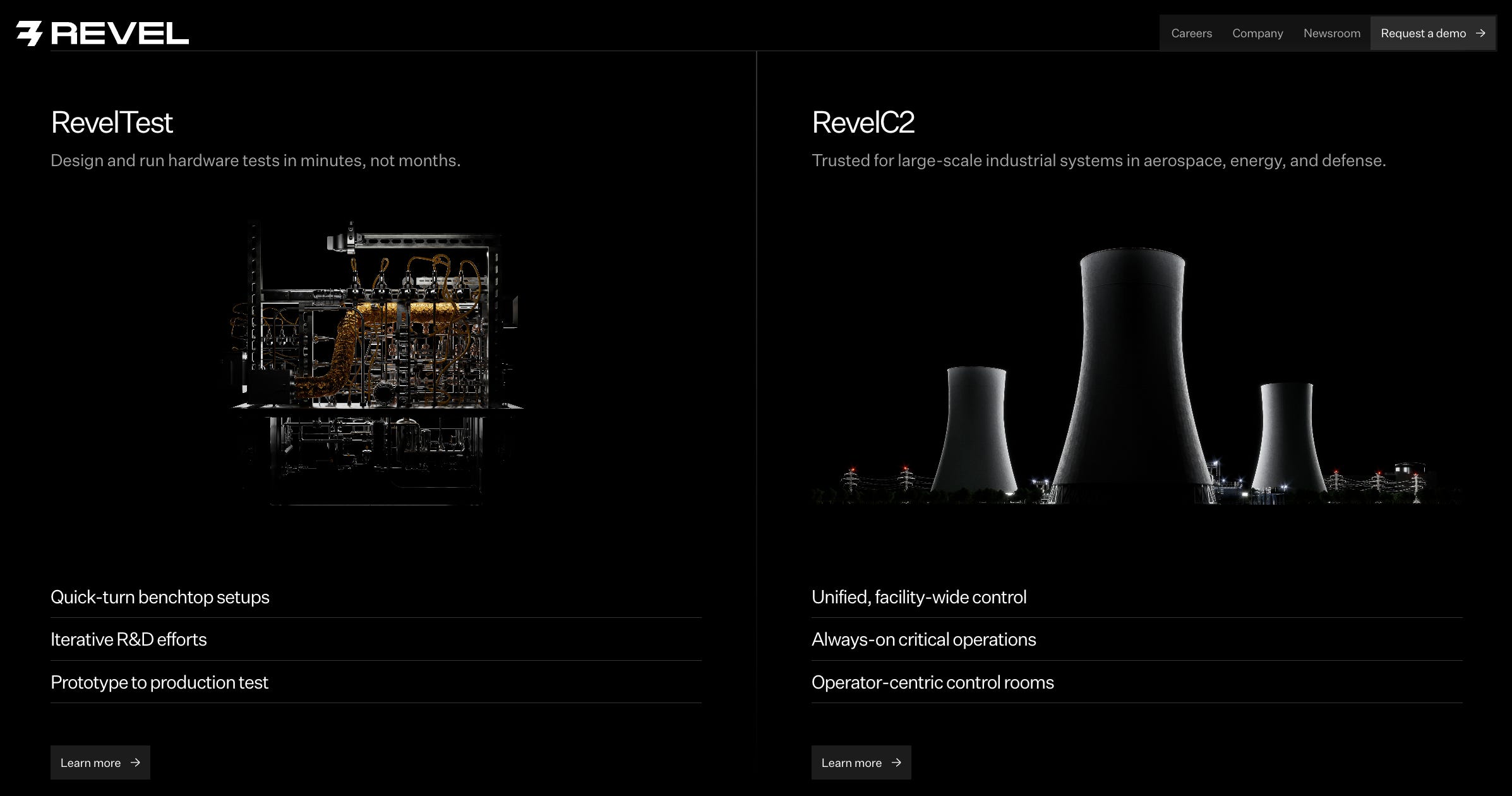
Revel Test
Focused on hardware test systems across aerospace, robotics, automotive, and defense.
Revel C2
Designed for operational environments requiring high availability, redundancy, and safe distributed monitoring, including energy infrastructure and advanced industrial systems.
RevelCode, the company’s programming language, combines Python like ergonomics with deterministic execution and debuggability tailored to safety critical systems.
The core value proposition is structural modernization of a foundational layer.
Early Traction and Measurable Impact
Revel’s early deployments suggest meaningful operational gains.
At Impulse’s rocket engine test site, legacy systems supported testing roughly once every other day. After deployment of Revel, testing frequency increased to multiple times per day, representing a five to ten times improvement in throughput.
Usability is equally important. Intern level engineers have reportedly onboarded and written control software within minutes, reducing reliance on scarce, specialized control systems experts.
The platform has expanded across leading hardware startups including:
Impulse
Radiant
Astro Mechanica
K2 Space
The company reports approximately 1,000 pilots completed to date, with strong conversion rates and high customer satisfaction.
Why This Round Matters
1. High Conviction Capital
The Series B was led preemptively by Index Ventures after product demonstrations, reflecting conviction rather than a prolonged competitive process.
2. Category Creation
Revel is positioning itself as modern infrastructure for physical systems control rather than a narrow developer tool.
3. Structural Tailwinds
Capital expenditure across aerospace, defense, robotics, and energy is accelerating. Hardware systems are becoming more autonomous, more software defined, and more operationally complex. This increases demand for robust control software.
4. Founder Market Fit
Morton’s experience at SpaceX operating high consequence systems is a defining asset. The team includes engineers from SpaceX, Anduril, and Palantir, organizations known for building mission critical systems under real world constraints.
Strategic Insight: Small Teams with Modern Tools
A recurring theme from Morton’s experience during early Starship development in Boca Chica is the leverage created when small teams operate with strong tooling.
Revel’s broader ambition is to extend that leverage across the industrial ecosystem.
Equip small teams building critical hardware with infrastructure that allows them to move at SpaceX level speed without rebuilding the control stack from scratch.
This framing resonates in the current environment, where venture backed hardware companies are scaling rapidly and cannot afford legacy bottlenecks.
Long Term Opportunity
Industrial control and hardware test software represent large but fragmented markets historically dominated by legacy incumbents. As new entrants build autonomous systems across aerospace, defense, advanced manufacturing, nuclear, and robotics, there is growing demand for standardized and modern control infrastructure.
If Revel becomes the default platform for high consequence hardware environments, it could sit at the core of next generation industrial systems.
Future-Forward
Revel’s $150 million Series B at a $1.005 billion valuation is notable not simply for its speed, but for what it signals.
The next wave of industrial innovation will be software defined. Yet much of the foundational tooling that governs physical systems remains decades behind.
Revel is attempting to modernize that layer by replacing legacy control stacks with deterministic, observable, and scalable infrastructure.
If the thesis holds, Revel will not simply be a developer tool company. It will become part of the operating system for the physical world.
The material presented on Molly O’Shea’s website are my opinions only and are provided for informational purposes and should not be construed as investment advice. It is not a recommendation of, or an offer to sell or solicitation of an offer to buy, any particular security, strategy, or investment product. Any analysis or discussion of investments, sectors or the market generally are based on current information, including from public sources, that I consider reliable, but I do not represent that any research or the information provided is accurate or complete, and it should not be relied on as such. My views and opinions expressed in any website content are current at the time of publication and are subject to change. Past performance is not indicative of future results.
Paid Endorsement. Brokerage services by Open to the Public Investing Inc, member FINRA & SIPC. Advisory services by Public Advisors LLC, SEC-registered adviser. Crypto trading provided by Zero Hash LLC, licensed by the NYSDFS. Generated Assets is an interactive analysis tool by Public Advisors. Output is for informational purposes only and is not an investment recommendation or advice. See disclosures at public.com/disclosures/ga. Matched funds must remain in your account for at least 5 years. Match rate and other terms are subject to change at any time.
good morning Molly, I am a founder with a few good innovations that I think will interest you, heuerlabsllc@gmail.com