

Do We Live in a Simulation?
What if AI could predict human behavior before it happens?
I sat down with Joon Sung Park, Co-Founder & CEO of Simile, the $2B AI startup building models of human behavior, backed by Fei-Fei Li, Andrej Karpathy, Greenoaks, & Index Ventures.
→ Listen on X, Spotify, YouTube, Apple
Simile is building digital twins of real people to simulate how individuals, consumers, and entire populations make decisions. Its foundational Stanford research demonstrated 85%+ accuracy in predicting human behavior, and today the company has partnerships providing access to over 40 million real people globally.
Companies including CVS, Wealthfront, Deloitte, and Banco Itaú are already working with Simile to understand their customers, test products, optimize messaging, and simulate decisions before deploying them in the real world.
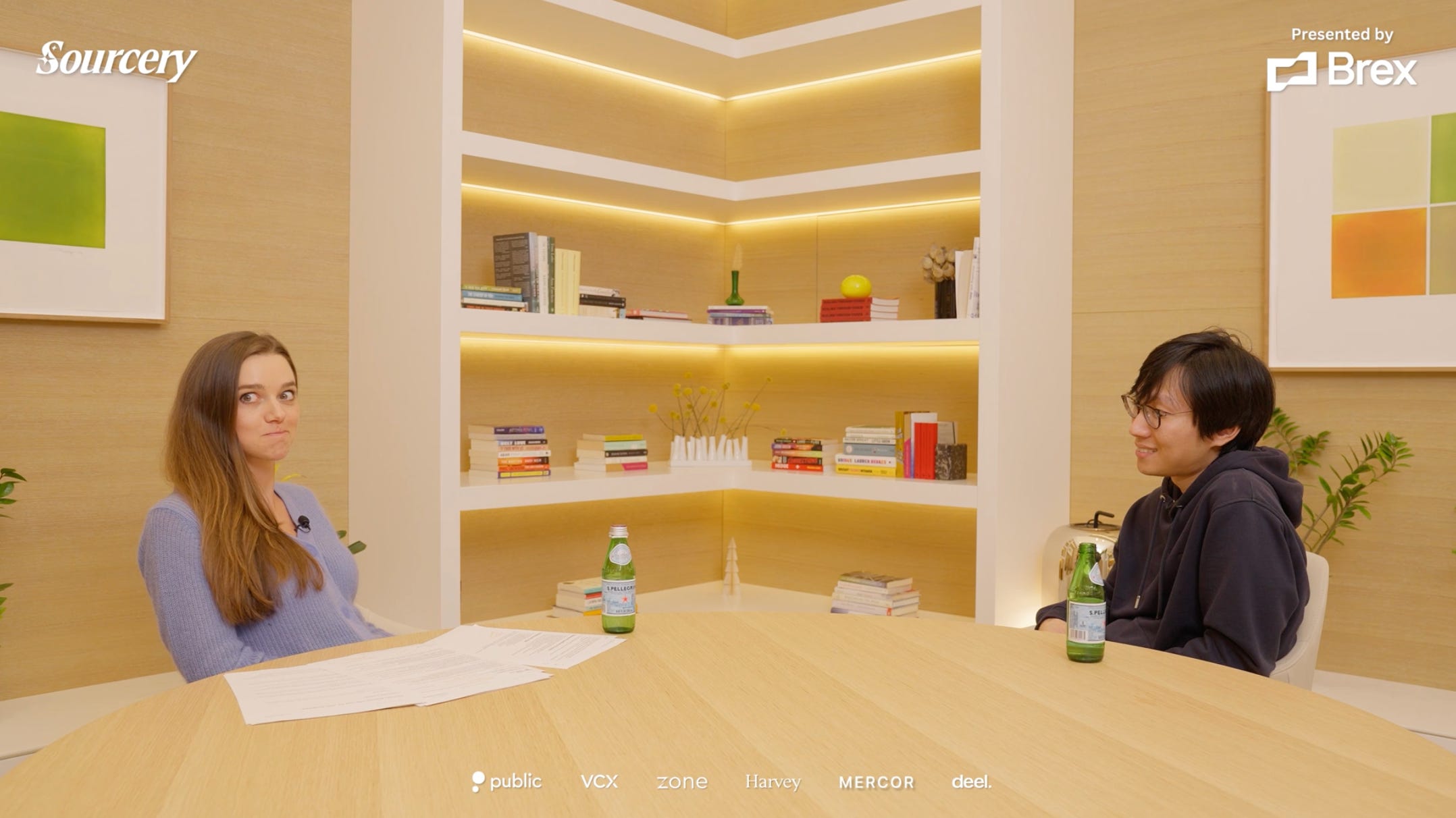
Recorded at Index Ventures in San Francisco, we discuss how Joon’s original Stanford research, Smallville, evolved from 25 autonomous AI agents into a $2B company, why human behavior is more predictable than we think, and how simulations could transform traditional market research, corporate strategy, and decision-making.
We also put Simile to the test. Before our interview, Joon simulated our conversation using AI, and the model correctly anticipated one of my opening questions…
𝐓𝐈𝐌𝐄𝐒𝐓𝐀𝐌𝐏𝐒
(00:00) Joon Sung Park, Co-Founder & CEO at Simile
(00:44) Do we live in a simulation?
(04:01) The AI town that planned its own Valentine’s party
(06:46) Predicting human behavior with 85% accuracy
(11:09) Is human behavior predictable?
(13:40) What really drives human decisions?
(15:45) How Simile simulates customers and markets
(20:05) Why big companies want simulated customers
(21:31) Digital twins and a panel of 40M real people
(22:51) Who actually answers polls?
(24:22) How Simile keeps bad data out
(29:29) What Simile predicted about this episode
(33:34) The EV campaign that looked perfect until it wasn’t
(37:02) Simulating climate change, AGI and UBI
(39:06) What happens when you simulate your interviewer
(40:13) Raising $300M at a $2B valuation
(44:54) Simulation is in its GPT-4 era
(49:43) What the most successful people have in common
(53:58) The “now what?” moment that ends careers
(55:25) The $15B question
Brought to you by:
Brex—The intelligent finance platform: cards, expenses, travel, bill pay, banking—wrapped into a high-performance stack. Built for scale. Trusted by OpenAI, Anthropic, Vercel, Granola, Deepgram, & Sourcery.. teams that move fast AF. visit → brex.com/sourcery

Harvey—The AI platform built for legal work, is helping the best firms and companies close deals faster. More than 200,000 lawyers, 80% of the Am Law 100, and over 20% of the Fortune 500 build with Harvey. Visit: Harvey.ai
Zone—develops next-generation data center campuses, partnering with AI companies, site developers and technology leaders to bring compute online faster and at scale. Visit: zonefrontier.com
Mercor—The human intelligence behind frontier AI. Frontier labs and leading enterprises use Mercor to turn the knowledge of 5M+ experts into the data, evals and benchmarks that make AI better at real work. Visit: http://mercor.com/sourcery
VCX—VCX is the public ticker for private tech, allowing investors of all sizes to invest in venture capital. View The Portfolio at GetVCX.com
Deel—Deel is the global people platform that helps startups hire, manage, pay, and equip anyone, anywhere. Trusted by more than 35,000 fast-growing companies, Deel is the people platform that just works, so teams can scale without the chaos. Visit: deel.com/sourcery
Public—Investing platform Public is the world's first agentic brokerage. You can invest across stocks, options, bonds, crypto, event contracts, & more, then automate anything with AI Agents. Seriously, just tell an Agent what you want—from "Set up a buy-the-close, sell-the-open strategy for me" to "Automatically sweep any cash over $10k from my bank to my brokerage account." Agents can monitor markets, run strategies, & manage your cash 24/7. Get started: public.com/sourcery
Inside Simile, $2B Company Simulating Human Behavior
$300M Total Capital Raised in 5 Months
Simile emerged from stealth with a $100 million Series A on February 12, 2026, led by Index Ventures partner Shardul Shah, with participation from Bain Capital Ventures, Hanabi Capital, A*, and individual investors, including Fei-Fei Li & Andrej Karpathy. The $200M Series B followed on July 30, led by Greenoaks, with Index Ventures, Hanabi, A*, Bain Capital Ventures, CVS Health Ventures & Definition participating. The round valued the company at $2B and brought total funding to $300M+.
“Simile is a company that is creating foundation model of human behavior that basically can take as input a description of a person or a group of people, and then simulate what these people might do in different context.”
The company was co-founded by Joon Sung Park, Michael Bernstein, Percy Liang & Lainie Yallen. Park completed his Stanford PhD advised by Bernstein and Liang and is the first author of the Generative Agents paper. Bernstein, a Stanford human-computer interaction professor, is Chief Product Officer, and Liang, director of Stanford’s Center for Research on Foundation Models, is Chief Scientist.
Clients include CVS Health, Deloitte, Gallup and Wealthfront. The company reported fivefold revenue growth in the 5 months after its Series A.
→ Listen on X, Spotify, YouTube, Apple
Smallville & the First 25 Generative Agents
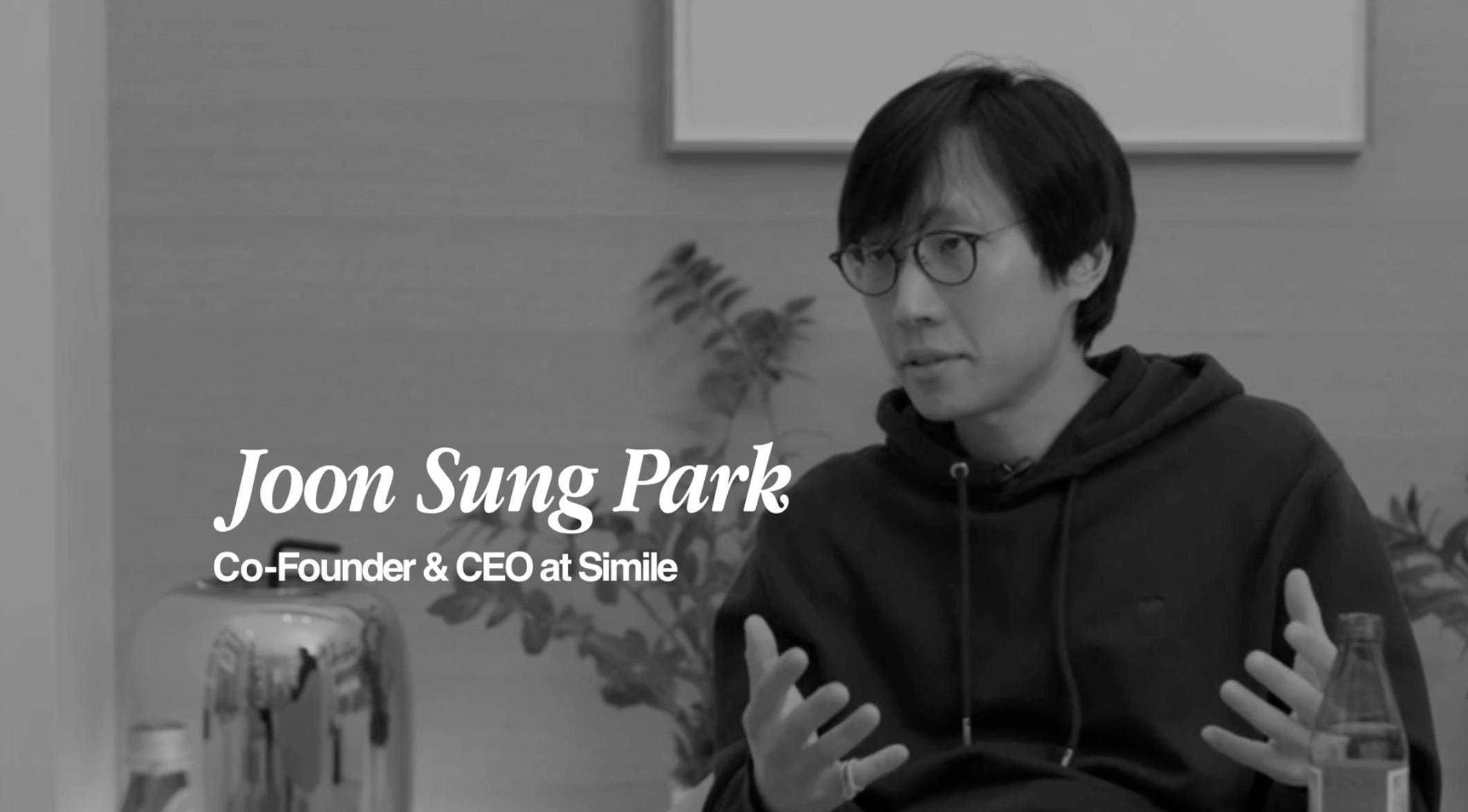
Smallville was a 2022 to 2023 Stanford experiment built on GPT-3 and GPT-3.5. The team populated a game town modeled on titles like Pokémon and The Sims with 25 agents, each with a name, characteristics and a life story. Each agent paired a language model with an architecture for memory, planning and reflection.
“So they would actually wake up in the morning, do their routines, go to work, have relationships. The simulation itself actually takes place the day before Valentine’s Day, so these agents will actually come together to have party.”

One agent organized the party, others asked each other out, and none of the behavior was pre-programmed. The paper introduced 2 concepts Simile still builds on, simulations of people and the core agentic architecture for generative agents.
The first evaluation tested believability. Researchers pulled individual agents out of the town and interviewed them on memory, planning and reflection, asking who they wanted to spend time with and what gift they would buy that person. Human evaluators then compared agent responses against human-authored answers for realism.

1,052 Digital Twins at 85% Accuracy
The follow-up study moved from fictional characters to real people. The architecture simulated the attitudes and behaviors of 1,052 real individuals by applying large language models to qualitative interviews about their lives. An AI interviewer asked participants questions from a semi-structured protocol based on the American Voices Project, covering life stories and views on current social issues.

Participants returned 2 weeks later to complete surveys, personality tests, economic games and behavioral experiments, and their agents predicted each answer. The agents replicated participants’ General Social Survey responses 85% as accurately as participants replicated their own answers 2 weeks later. That figure came from 68.85% agent accuracy divided by 81.25% human self-consistency.
“At the end of 2024, for the first time really in the field, we could actually show that we can predict people’s behavior with 85%-plus accuracy with these agents. That’s ultimately what gave this company foundation for today’s technology.”
The interview-based architecture also reduced accuracy biases across racial and ideological groups compared to agents given only demographic descriptions. The evaluation set included the Big Five personality inventory, prisoner’s dilemma and other economic games, and replications of published and private randomized controlled trials.

Optionality, Opportunity Cost & the Intent Gap
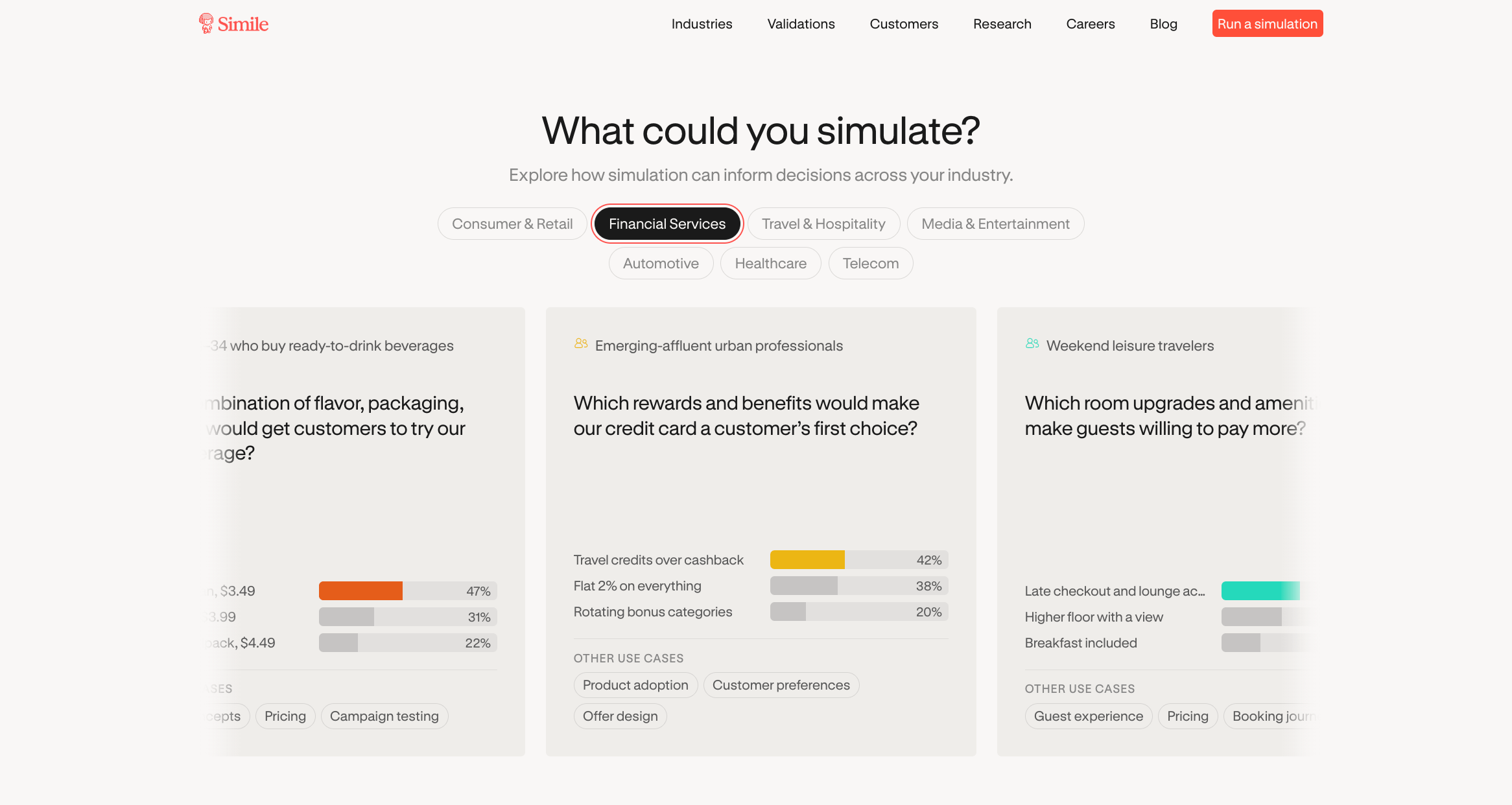
Simile’s modeling work centers on the gap between what people say in surveys and what they do. Some traits, such as risk tolerance, are stable within a person and become predictable once learned. The modeling challenge is translating observed behavior and stated attitudes into those underlying tendencies.
Stated intent and actual behavior follow different curves. Survey answers about going to the gym this week tend to follow a normal distribution. Actual gym attendance follows something closer to an exponential curve with a sharp drop-off, because the activation energy to act is higher than people expect.
“This is where people have this optionality, so now they have to think. They have to think about the opportunity cost of taking that option. So that’s actually what really governs people’s behavior, that, yes, I can go exercise this week, but if I don’t, I can sleep for one more hour, or I can take one more meeting.”
Surveys present a confined set of options in the abstract. Real decisions happen with access to some options and not others, which is why Simile models the surrounding environment, including competing products and alternatives, alongside the people.

40M+ Real People and the Gallup Partnership
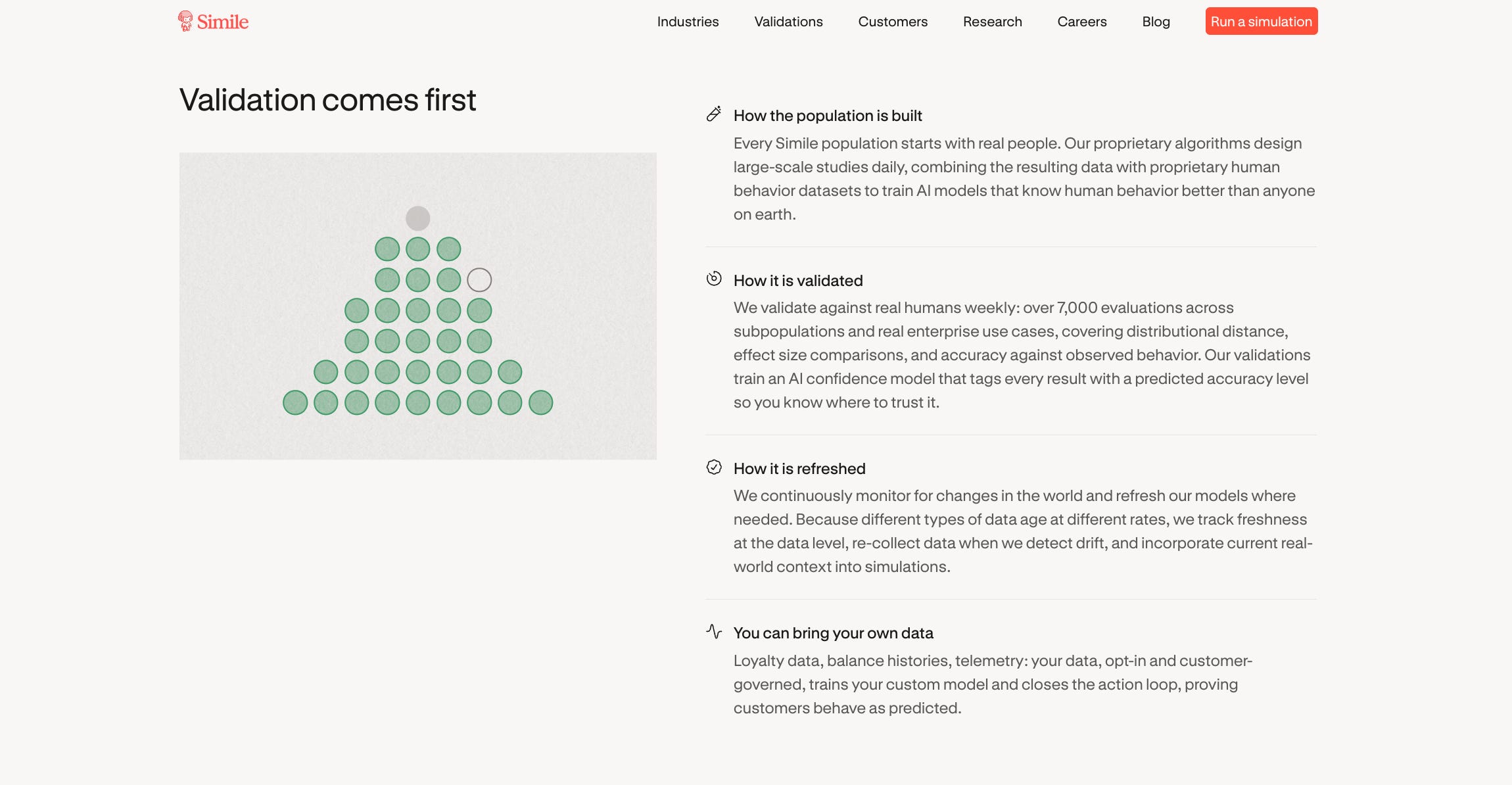
Simile maintains vertical-specific agent banks, simulated panels available to customers on day 1. When a customer needs a population outside those banks, Simile collects new data and trains the model to cover it, with new panel members typically sourced within 24 hours.
“Today, Simile have partnership with over 40 million real people across the panel partnerships that we have. This is across the globe, and at any given moment, we’re talking to tens of thousands, if not hundreds of thousands of real people every single week.”

Gallup is exploring simulated responses through a partnership with Simile and is independently validating the method; the 2 are developing new agent banks across different topic areas. Gallup’s panel includes hundreds of thousands of people the firm has built relationships with over 1 to 2 decades.
Simile controls for panel bias through spacing between survey invitations to reduce fatigue, studies measuring response quality across new and repeat panelists, and attention checks such as simple arithmetic questions. Participants who cannot give informed consent, including minors, are excluded, and every panelist can withdraw consent.

CVS, Deloitte and Wealthfront as Customers
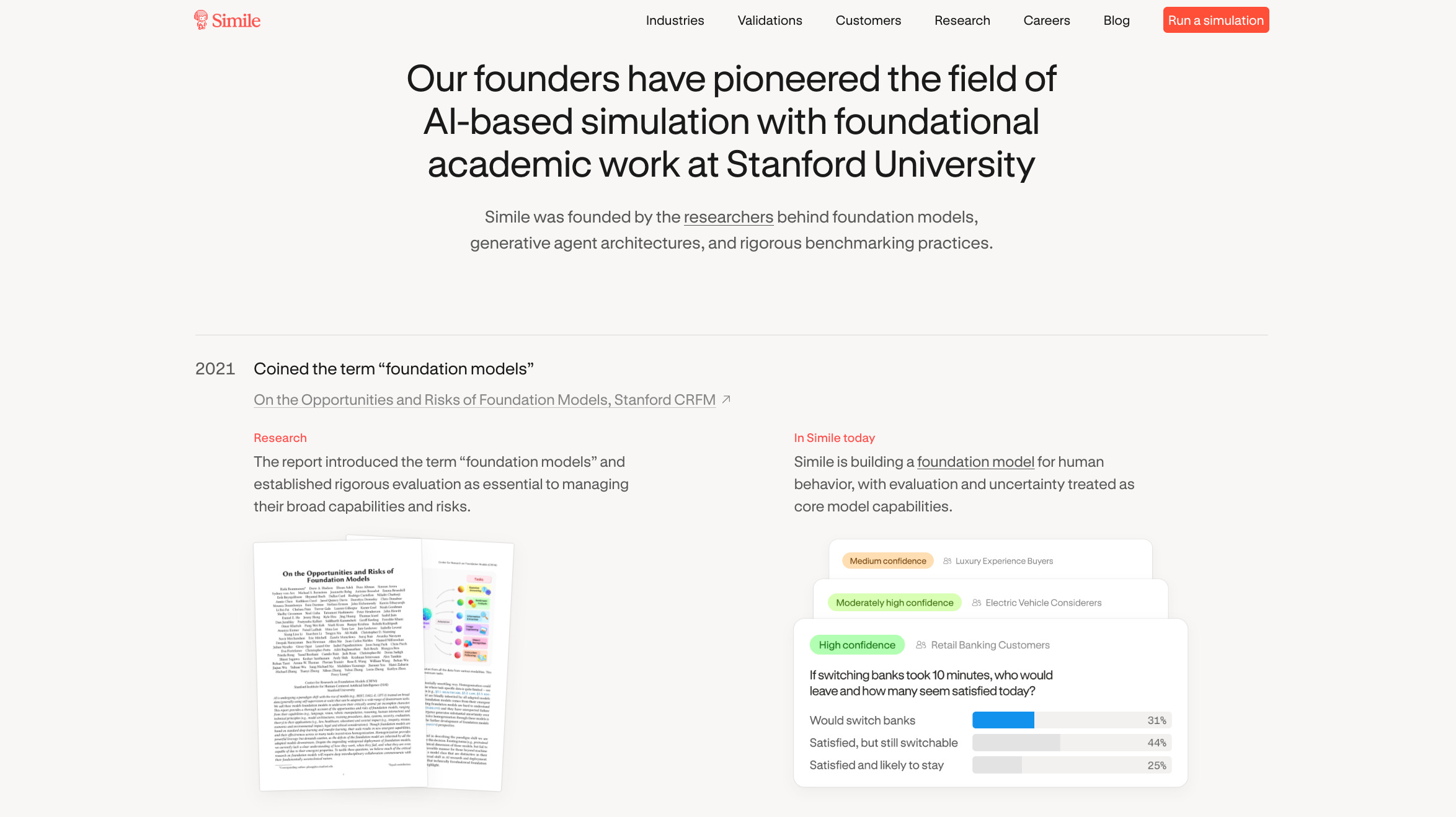
Customers access Simile through a SaaS web interface where they define the population and the questions, with no cap on the number of questions. Common workloads include concept testing, conjoint analysis and MaxDiff analysis.
“The traditional analysis that researchers had to run today, that would’ve taken them sometimes hundreds of thousands of dollars, sometimes millions of dollars over many years, we can run them in simulation basically almost instantly. They are just a query away.”
CVS uses Simile to study consumers, store layout, messaging and decor. In a case study published by Simile, CVS’s agents were built using 2.9 million consented responses from more than 400,000 participants across over 200 behavioral scenarios. CVS uses the simulations to screen research questions, review customer journeys and test approaches to medication adherence before running real-world studies or pilots.
Deloitte uses the platform as a substitute for focus groups, and Wealthfront reported a 15x expansion in qualitative research scope. Banco Itaú in Brazil uses simulations to test policies and messaging.

A Confidence Score on Every Simulation
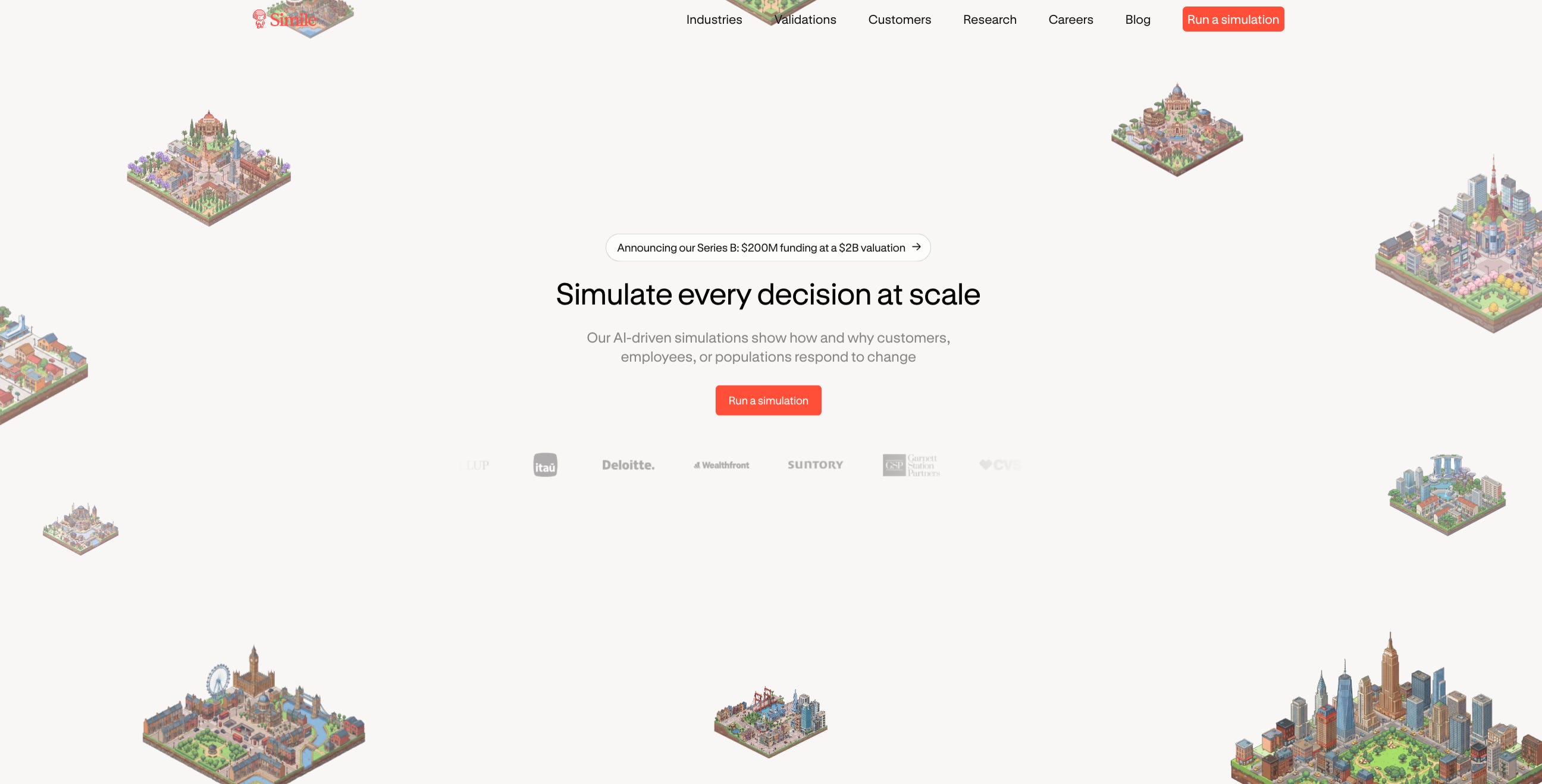
Simile trains a predictive model of accuracy jointly with its core foundation model.
“Its job is to output 0 to 100 range probability on how confident we are in this particular response on the basis of all the data that we use to train our model and the question that we got.”
Park compares the score to a p-value in inferential statistics, where results below 0.05 are the standard threshold for a decision. Simile also runs change management with customers on when to use results, where more data is needed and how to validate outputs.
“If confidence is higher than 90% or usually 85%, our customers have found that to be robust evidence that can actually be used to make very high stake decisions.”
Simile weights its training data toward randomized controlled trials, where a single variable such as a product feature or message changes while the setup holds constant. Customers ask less about forecasts and more about which actions change an outcome, which requires causal data.

100 People, 20% From Stanford Labs
Simile has about 100 employees. Roughly 20% are former lab mates and academic relatives from Liang’s and Bernstein’s groups in Stanford’s computer science department, many of whom went to frontier labs before joining. A small group of methodologists with social science backgrounds works alongside them, and modeling, evals and simulation science make up 20% to 25% of the company.
The engineering organization is led by a head of engineering who joined from DoorDash. Go-to-market and deployment are led by Yallen, and the company runs a forward deployed model with customers, based on the success of forward deployed companies in agentic coding.
“Simulation is basically in its GPT-4, GPT-4.5 era, where the technology’s here to make impact, but this technology is changing and evolving every single month.”
Park expects simulation to reach the maturity of today’s coding agent market in about 1.5 to 2 years.
» » » » Simile is hiring! Check out their open roles « « « «
Climate, UBI & the Next Simulations
Park cites Thomas Schelling, whose segregation model applied simulation to the defining social question of his generation, as a research influence. His candidates for this generation are climate change and the policy response to AGI.
“Climate change is hard, not just because of the physics of it, but because it’s about coordination. There are so many actors with competing incentives who have their own things they’re trying to optimize for.”
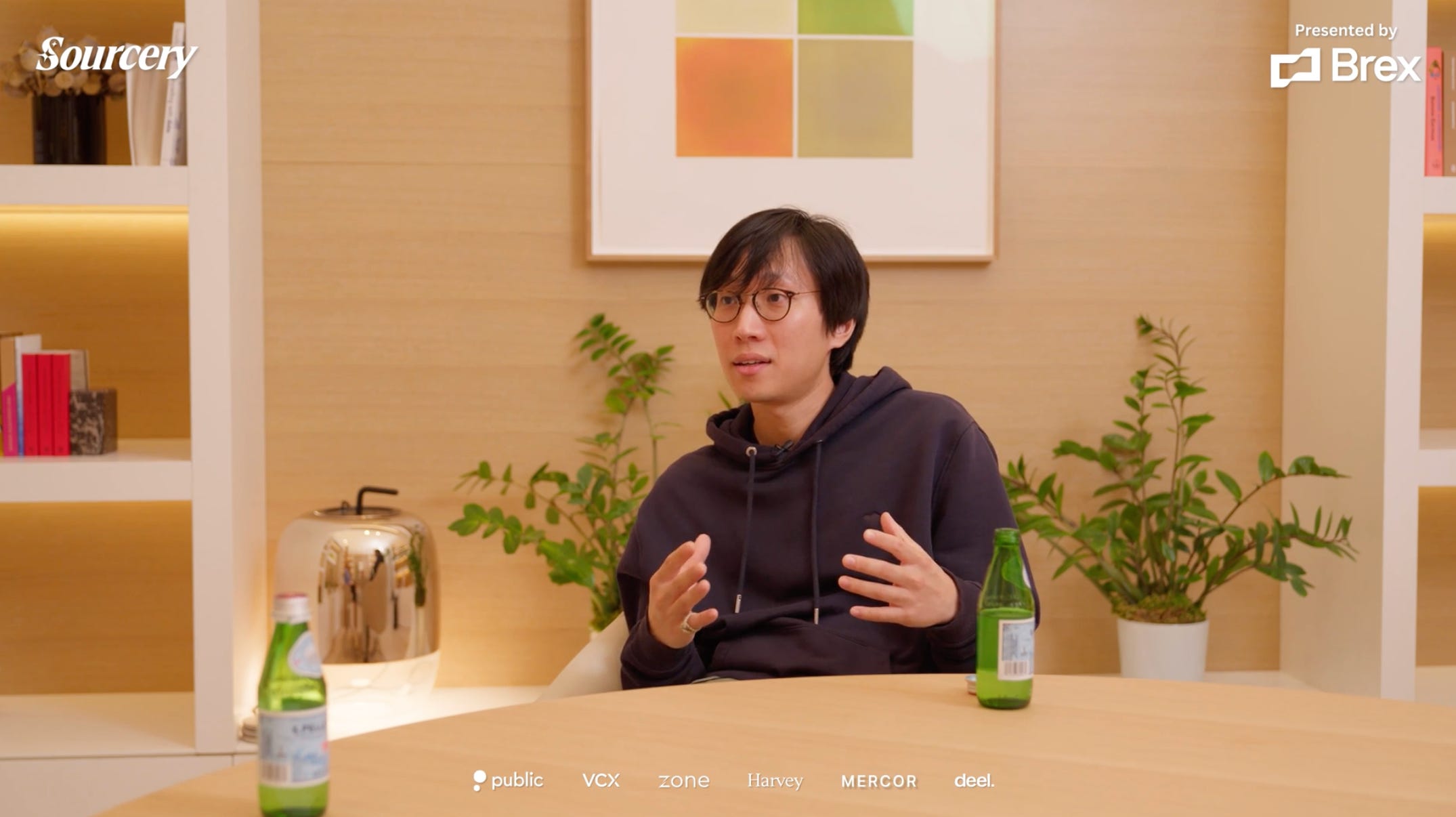
On UBI, simulation could test outcomes in place of a 5-year study. Before this interview, Park ran a simulation of the conversation, and it predicted a question on whether we live in a simulation.
“If I have every right, every reasons to believe that there is an ambitious idea that only Simile can pursue, then we’re going to pursue that.”
→ Listen on X, Spotify, YouTube, Apple
The material presented on Molly O’Shea’s website are my opinions only and are provided for informational purposes and should not be construed as investment advice. It is not a recommendation of, or an offer to sell or solicitation of an offer to buy, any particular security, strategy, or investment product. Any analysis or discussion of investments, sectors or the market generally are based on current information, including from public sources, that I consider reliable, but I do not represent that any research or the information provided is accurate or complete, and it should not be relied on as such. My views and opinions expressed in any website content are current at the time of publication and are subject to change. Past performance is not indicative of future results.
Paid Ad. Agents are an experimental AI tool. Its output may be inaccurate and is not investment advice. Public Holding’s, Inc. makes no guarantees about its accuracy or reliability—verify independently before use. Brokerage accounts & services provided by Open to the Public Investing, Inc. See additional disclosures at: https://public.com/disclosures/agenticdisclosures.