


100 Years of Military History, Explained
Kyle Harrison, GP at Contrary, co-author of The Anduril Thesis, joins Sourcery to unpack the 300-page book he & Sachin Maini just spent two years writing on the most counter-positioned company in defense.
→ Listen on X, Spotify, YouTube, Apple
We go deep on a 100 years of military history — how Robert McNamara strangled America’s industrial golden goose in the 1960s, why cost-plus contracting incentivizes the worst possible outcomes, and how the U.S. ended up building $13 billion programs that turn into trillion-dollar overruns.
Then we map all of it onto Anduril: the Chick-fil-A founding story, why Lattice is the real product (not the drones), how the Sentry Tower beat a Lockheed contract that “defied the laws of physics,” the new $22B IVAS contract, undersea warfare and the cables that move $10T a day, and why ghost sharks are being built in Australia.
Kyle also breaks down Anduril’s funding history (including Contrary’s Series C entry), the talent density problem (only ~40 people in America can actually sell to the government), & the philosophy of conflict deterrence.
If you want to understand why Andúril is named after the Flame of the West, and why that matters for the next decade of geopolitics.. this is the episode.
📕 Get The Anduril Thesis by Kyle Harrison and the Contrary Research team: https://www.amazon.com/Anduril-Thesis-Kyle-Harrison/dp/B0GWLXQ7FC
𝐓𝐈𝐌𝐄𝐒𝐓𝐀𝐌𝐏𝐒
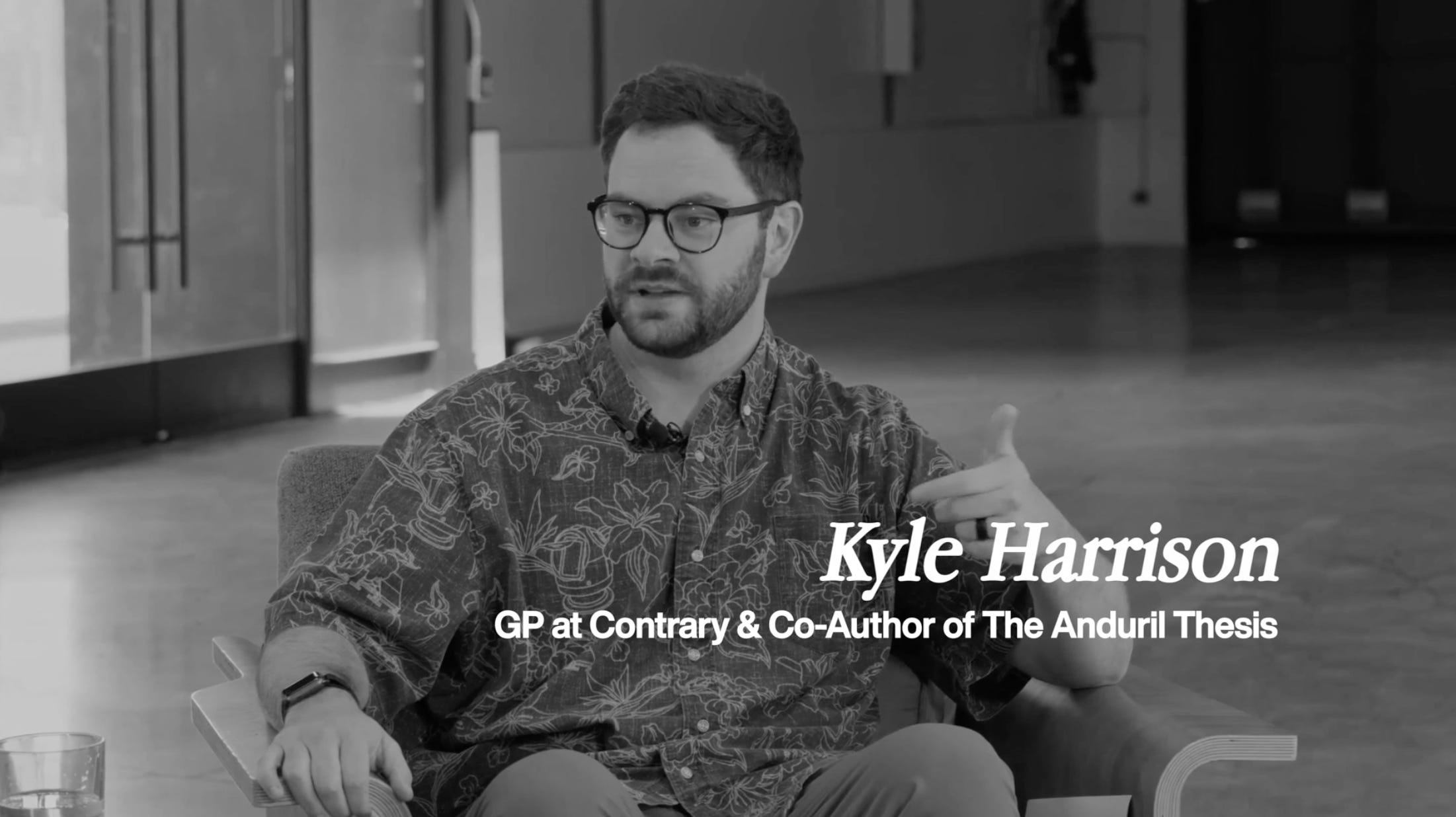
(00:00) Kyle Harrison, GP at Contrary & Co-Author of The Anduril Thesis
(01:22) The Anduril Thesis: A 300 Page Deep Dive
(04:52) How America lost its military edge
(07:33) The book that predicted the mess
(10:36) How bureaucracy broke the US military
(15:39) The ridiculous economics of modern war
(19:25) How Ukraine changed everything
(23:34) The Anduril thesis explained
(30:18) The pitch that changed defense forever
(36:52) Breaking down Anduril's tech stack
(45:26) The $10 trillion undersea threat
(57:43) Why founders need military mavericks
(01:03:53) Inside the new Department of War
(01:10:42) Anduril's unfair talent advantage
(01:21:20) When defense tech was toxic
(01:27:57) Why we must prepare for war
(01:39:27) The venture capital trap
Brought to you by:
Brex—The intelligent finance platform: cards, expenses, travel, bill pay, banking—wrapped into a high-performance stack. Built for scale. Trusted by teams that move fast. visit → brex.com/sourcery

Turing—Turing accelerates superintelligence by helping frontier AI labs improve model capabilities and enabling enterprises to deploy end-to-end AI systems inside mission-critical workflows. Visit: turing.com/sourcery
VCX—VCX is the public ticker for private tech, allowing investors of all sizes to invest in venture capital. View The Portfolio at GetVCX.com
Deel—Deel is the global people platform that helps startups hire, manage, pay, and equip anyone, anywhere. Trusted by more than 35,000 fast-growing companies, Deel is the people platform that just works, so teams can scale without the chaos. Visit: deel.com/sourcery
Public-–Investing platform Public just launched Generated Assets, which lets you turn any idea into an investable index with AI. With Generated Assets, you can build, backtest, refine, and invest in any thesis with AI. Gone are the days of one-size-fits-all ETFs. Try it today: public.com/sourcery
Merge—The leading provider of customer-facing integrations and agentic tools for frontier LLMs, Fortune 500 organizations, and B2B SaaS companies. Visit: https://merge.dev
The Anduril Thesis
Why America Forgot How to Build, & How One Company Is Rewriting the Playbook
A breakdown of our conversation with Kyle Harrison unpacking two years of research into one of the most counter-positioned companies in defense.
→ Listen on X, Spotify, YouTube, Apple
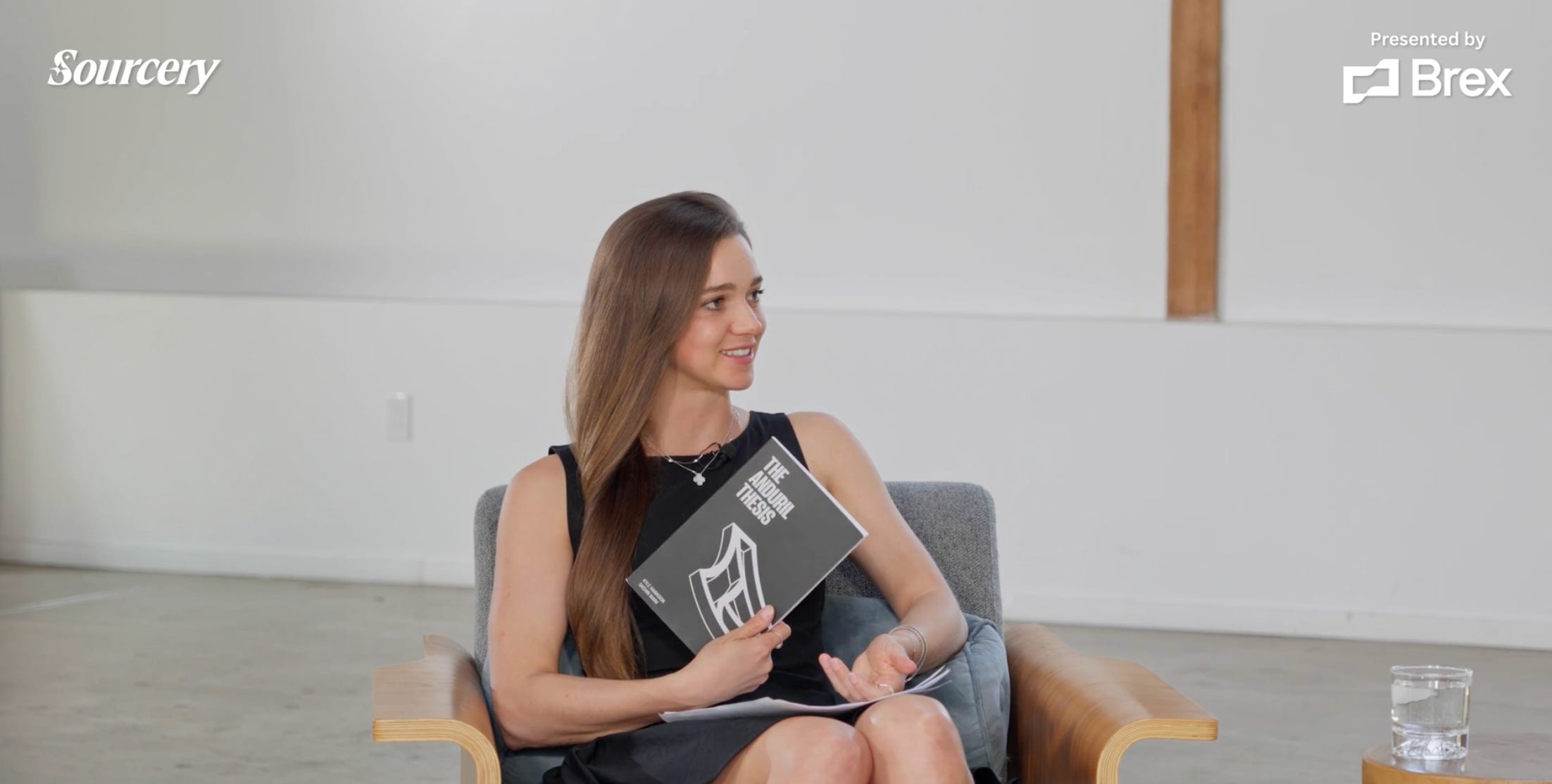
A 300-Page Book Born From a Hundred Years of Context
Kyle Harrison didn’t set out to write a book. Contrary Research, the public-facing arm of Contrary, where Kyle leads research, had been working through deep dives on companies like Stripe, OpenAI, and Databricks. Anduril was supposed to be next on the list. But something kept breaking the format.
“As we dug into it, we realized that in order to understand Anduril as a company, you genuinely have to understand like a hundred years of military history that it is being counter-positioned against.”
That realization turned a long-form research piece into a multi-year project involving a small army of research fellows, dozens of interviews, hundreds of white papers, and roughly 35 drafts. The team leaned heavily on two books in particular: The Kill Chain by Christian Brose (now Anduril’s President and Chief Strategy Officer), referenced more than 150 times, and Skunk Works by Ben Rich. Both lay the groundwork for what Kyle calls the most heartbreaking finding of the project, that America has been ignoring smoke alarms about its own industrial decline for decades.
“It’s just been multiple decades of… constantly tripping over ourselves into both the hubris of thinking that we have officially become the only great power left in the world.”

How America Strangled Its Own Golden Goose
At the end of WWII, the U.S. produced over 40% of global manufacturing capacity. The Department of Defense alone accounted for 36% of global R&D spending in the 1950s and 60s. Then came Robert McNamara.
McNamara, convinced the U.S. was overspending on defense, introduced PPBE, a planning and budgeting system that descended on places like Skunk Works as what Ben Rich described as a plague of auditors and bean counters. Spending dropped briefly. Then Korea and Vietnam happened, and the friction never went away.
“It’s not any one thing. It’s not any one tax. It is a million taxes of friction.”
The result: a defense apparatus that knows how to build big, exquisite, decade-late assets, and almost nothing else. The F-35 program, originally pegged at $13–15B, could ultimately cost up to a trillion dollars. And the cost overruns aren’t even the worst of it.
“It’s actually even worse than just a cost imbalance. You lack the iterative cycle to stay anywhere close to the cutting edge.”
China, meanwhile, has developed what are affectionately called “carrier killers,” $15–20M missiles capable of destroying multi-billion-dollar ships. War games modeling a U.S. vs. China conflict have, since roughly 2015, consistently ended with the U.S. losing. In a large-scale engagement, current estimates suggest the U.S. would run out of munitions in ~11 days, and rebuilding lost naval assets would take 25 years just to return to baseline.. yikes.

The Anduril Thesis: Counter-Positioning Everything
This is where Anduril enters. Kyle frames the company not as a typical tech startup, but as a deliberate inversion of every dysfunction in the existing defense system.
Where the DoD uses cost-plus contracting (which guarantees a percentage on top of whatever a project costs), Anduril uses fixed-cost. Where traditional primes ask the government to fund decades of R&D, Anduril self-funds. Where the Pentagon issues “built to spec” requirements, Anduril builds to mission.
“We absolutely want to listen to our customers because they understand their problem. We don’t necessarily listen to them about what the solution should be.” (Palmer Luckey, quoted by Kyle)
The incentives in cost-plus contracting are perverse by design:
“If the incentive is, no matter what it costs you, I will give you 10% on top of that, 10% of 3 billion is a much bigger number than 10% of 150 million. So as a traditional prime, you are deeply incentivized to reinvent the wheel from scratch every single time.”
The Sentry Tower is the cleanest illustration. A traditional prime had told the government their proposed border surveillance system would cost $5–10B, take 15 years, and probably defy the laws of physics. Anduril built one with off-the-shelf cameras, sensors, and batteries, and sold it first to a private rancher dealing with drug traffickers on his land before scaling to Homeland Security.
Lattice Is the Product (& Everything Else Is a Node)
People talk about Anduril’s drones, submarines, and munitions. Kyle argues they’re missing a very important piece.. Lattice, the underlying AI-driven connector.
“The real core product is… DARPA describes it as mosaic warfare. Chris Brose talks about it as a military internet of things. But basically it very much is this hub-and-spoke model of Lattice as an AI sensor-fusion-driven brain.”
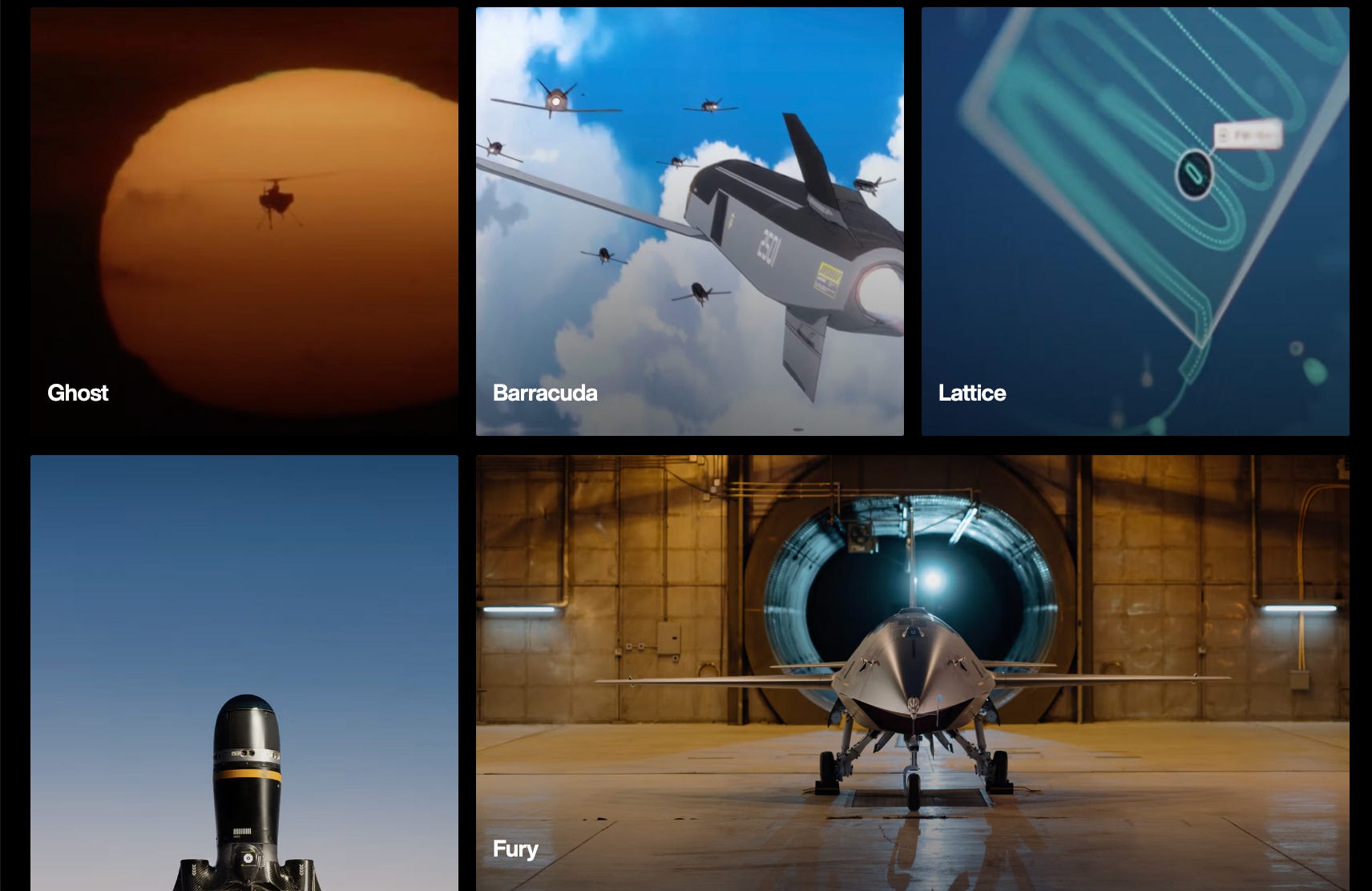
Every Anduril product, Sentry Towers, Ghost drones, Altius loitering munitions, Roadrunner, the Dive line of autonomous undersea vehicles, Copperhead torpedoes, Fury autonomous fighter jets, the new Eagle Eye helmet from the $22B IVAS contract, exists to plug into Lattice. The strategy is to give every domain (air, land, sea, undersea) and every force level a node in the network.
Under-the-Sea
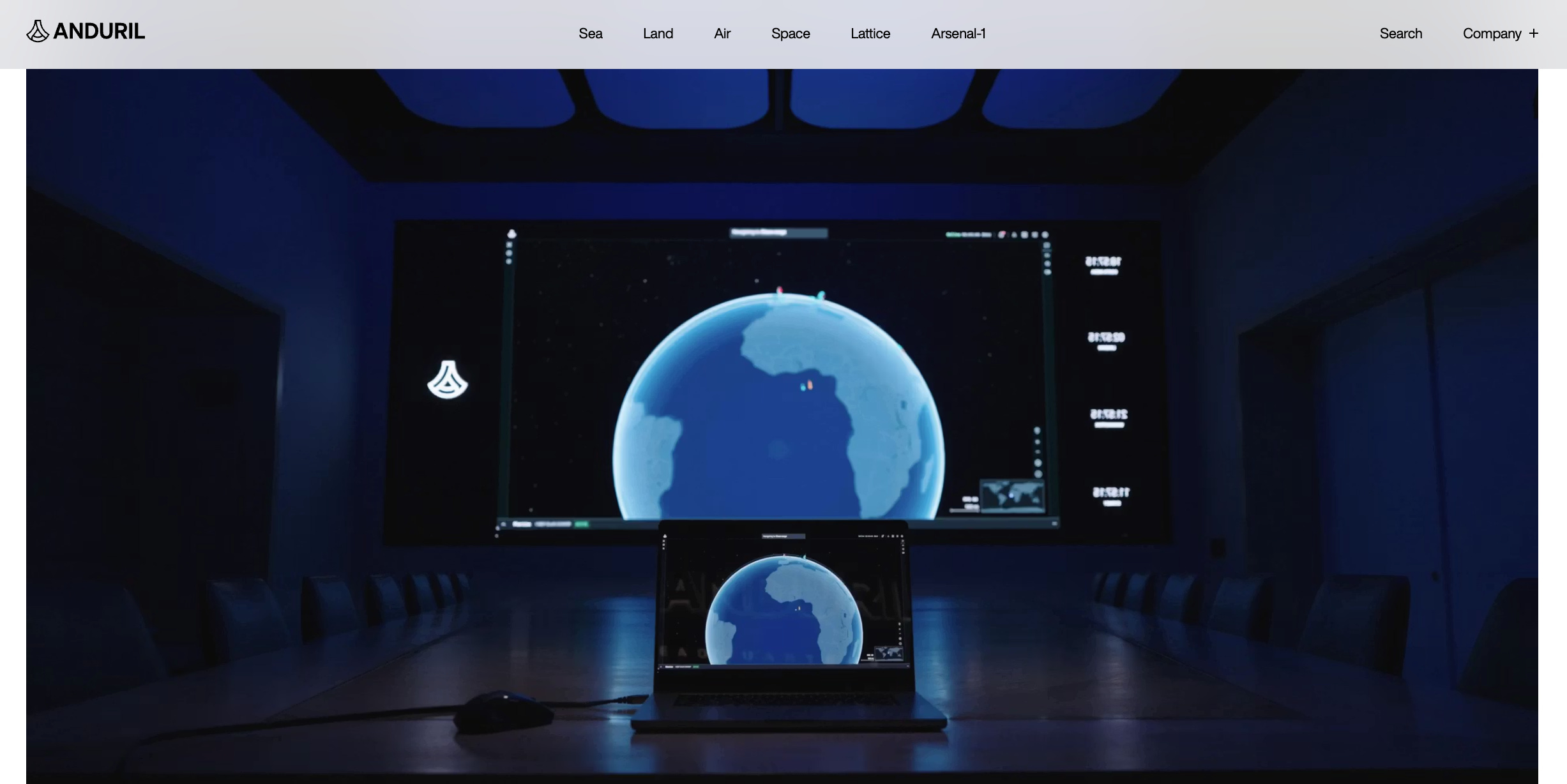
The undersea domain matters more than most people realize. Underwater data cables carry roughly $10 trillion in transactions a day. Many of them run through the Baltics, exposed. Anduril’s Seabed Sentry, Dive-XL, Barracuda, and Copperhead products are being purpose-built for a domain Kyle describes as practically harder to engineer for than space.
And the company keeps calling its shot. The recently announced Hyundai partnership for autonomous surface vehicles was teased at the end of the Copperhead launch video, which itself picked up exactly where the Fury video ended.
“From day one… it was about this software defined, hardware enabled web of products that can all work together.”

Founders, Mavericks, & the Mission Behind the Mission
Kyle keeps coming back to a pattern from defense history: every era of real military innovation pairs a founder-type with a “military maverick” willing to run interference against the bureaucracy. Bernard Schriver had Eisenhower. Skunk Works’ Kelly Johnson had Richard Bissell. William Moffett had Hoover.
What was missing for decades wasn’t the mavericks. There were plenty of admirals and strategists sounding the alarm in the 80s and 90s. What was missing was founder energy and institutional urgency. Anduril brought the first; rising tensions with China and the Russian invasion of Ukraine brought the second.
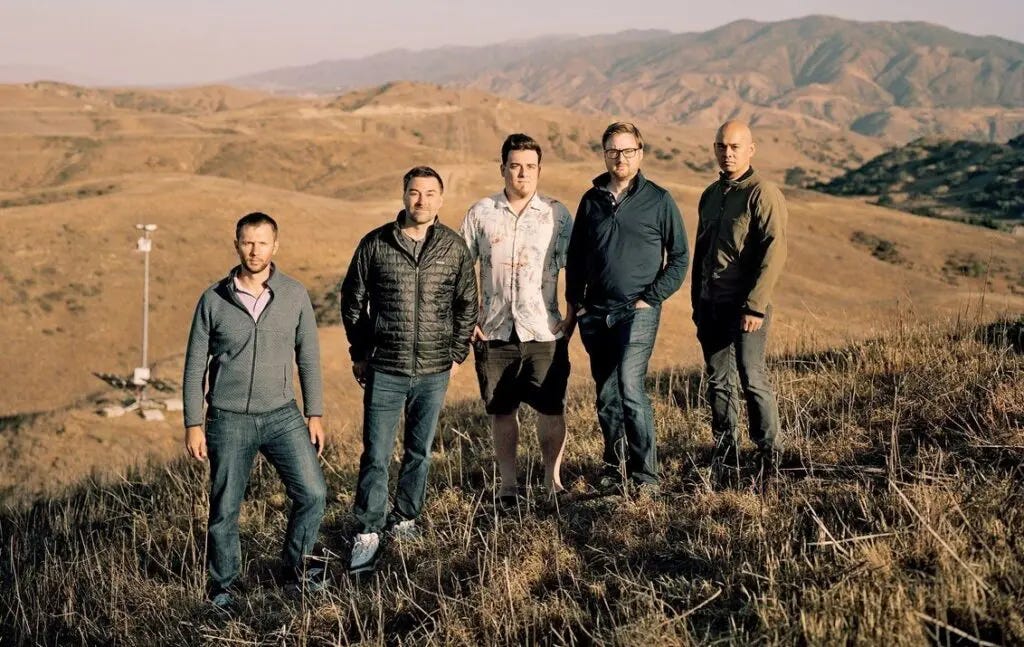
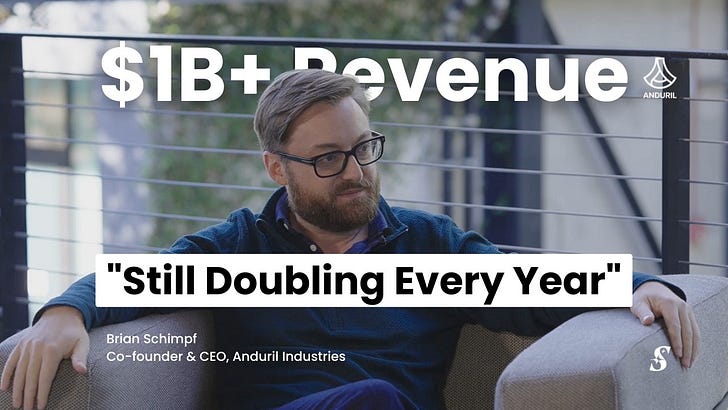
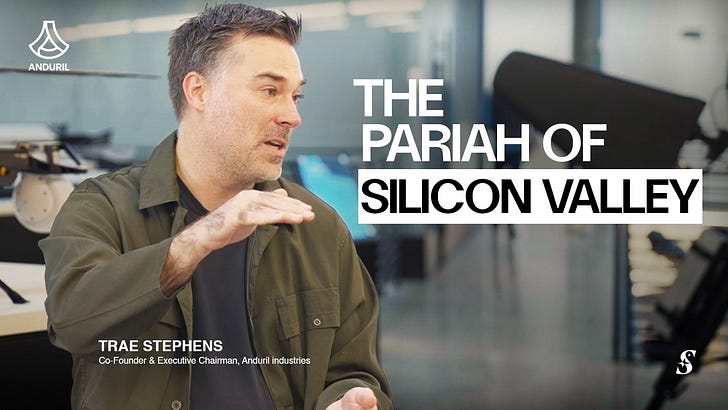
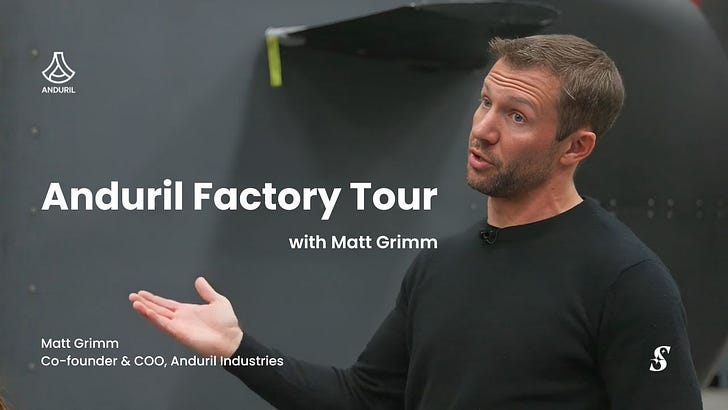
Co-Founders: Matt Grimm, Trae Stephens, Palmer Luckey, Brian Schimpf, Joseph Chen
But Kyle argues the most underappreciated part of the company isn’t its products or its politics. It’s its philosophy.
“If the mission is build cool stuff and blow stuff up, that’s not a mission. That’s a neat trick.”
He went back through every founder interview he could find. The word hope appears 44 times.
“Pacifism really is a privilege of the protected. There is somebody else who is willing to do those things and build those capabilities to protect our right to say, I don’t want to be involved in that.”
The company’s name is taken from Andúril, Flame of the West, the reforged sword in Lord of the Rings. Kyle quotes Faramir, the character Tolkien said he most identified with:
“I don’t love the blade for its brightness or sharpness. I don’t love the arrow for its swiftness or the warrior for his ferocity. I love only that which they defend.”
That’s the thesis underneath the thesis. Anduril’s only purpose isn’t to just win wars. It’s trying to make them defensible & advanced enough not to happen in the first place, & to turn allies like Taiwan into what Palmer Luckey calls “prickly porcupines.”

The Funding Story & Vibe Shift
Anduril’s funding history maps almost exactly onto America’s slow awakening. In 2017, working in defense was deeply unpopular. Engineers ghosted Palmer Luckey when he revealed what he was building, and Elad Gil reportedly received angry messages from friends for leading an early round. Founders Fund and General Catalyst were the early believers. Andreessen came later. Contrary entered at the Series C and has invested in every round since.
Then came what Palmer calls his “I told you so tour.” 2022, the Russian invasion, the post-ZIRP collapse, the public market reset, was a one-two punch followed by a real takeoff. Anduril had been saying since 2017 what Putin had said publicly that same year: whoever controls AI will control the world.
Was the acronym is hiding in plain sight? AI… Anduril Industries.

Hot Take
But Kyle warns that the vibes will swing again, and that’s not just an Anduril problem. It’s a venture problem. Which sets up his closing hot take, delivered against his own self-interest:
“My hottest take is that fewer people should be raising venture capital… There is a huge swath of companies that could be very good companies that are very bad venture-backed businesses.”
He points to a friend running a metal-shelving manufacturer doing $17M in revenue and $3M in profit, growing 3% a year, living a great life. A terrible venture outcome. A wonderful business. The deeper point is that the next phase of American reindustrialization, supply chains, manufacturing, dual-use industrial capacity, won’t all fit through the venture funnel. And it shouldn’t have to.
“Every single time, military superiority is front-run by industrial superiority. We did that in World War II. The problem is now that China is doing that today.”
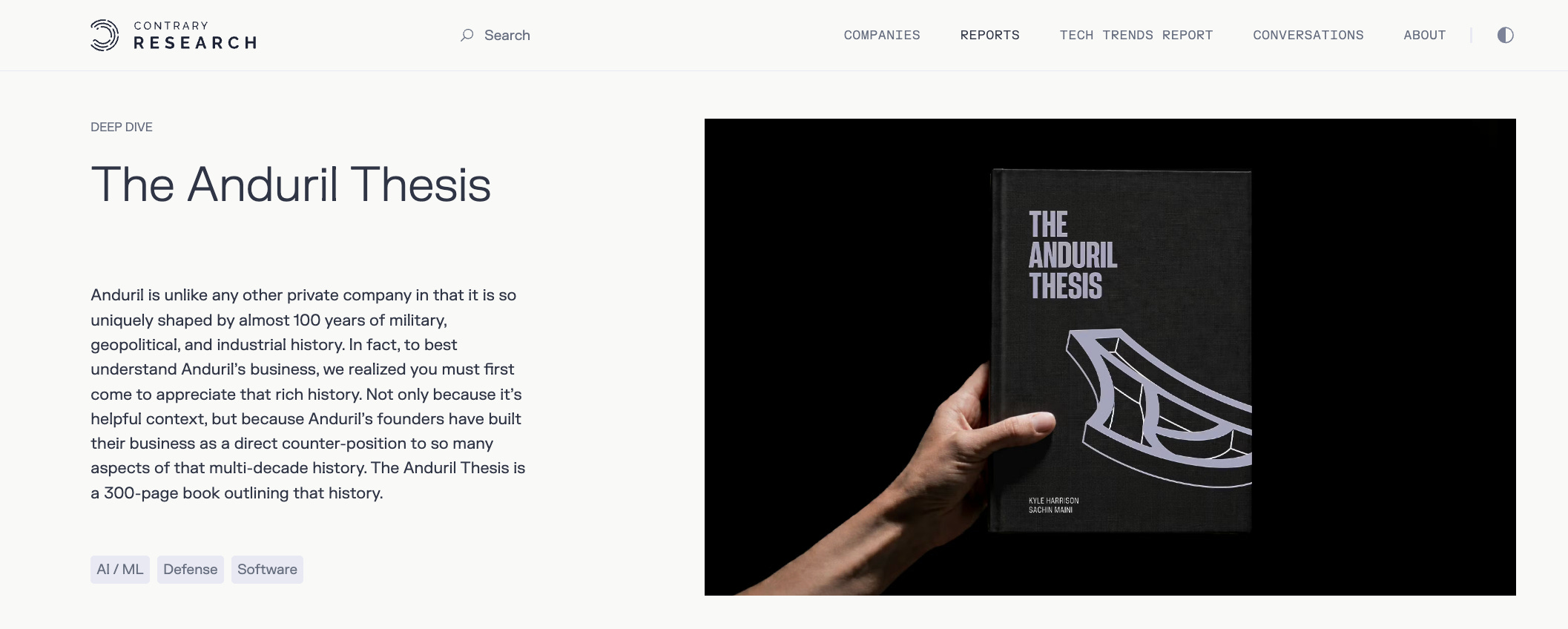
The book is The Anduril Thesis, by Kyle Harrison and the Contrary Research team. If you want to understand the next decade of geopolitics, it’s a useful place to start.
→ Listen on X, Spotify, YouTube, Apple
MORE ANDURIL …
The material presented on Molly O’Shea’s website are my opinions only and are provided for informational purposes and should not be construed as investment advice. It is not a recommendation of, or an offer to sell or solicitation of an offer to buy, any particular security, strategy, or investment product. Any analysis or discussion of investments, sectors or the market generally are based on current information, including from public sources, that I consider reliable, but I do not represent that any research or the information provided is accurate or complete, and it should not be relied on as such. My views and opinions expressed in any website content are current at the time of publication and are subject to change. Past performance is not indicative of future results.
Paid Endorsement. Brokerage services by Open to the Public Investing Inc, member FINRA & SIPC. Advisory services by Public Advisors LLC, SEC-registered adviser. Crypto trading provided by Zero Hash LLC, licensed by the NYSDFS. Generated Assets is an interactive analysis tool by Public Advisors. Output is for informational purposes only and is not an investment recommendation or advice. See disclosures at public.com/disclosures/ga. Matched funds must remain in your account for at least 5 years. Match rate and other terms are subject to change at any time.