


Anthropic, AI Volatility, Next Mag 7
Thomas Laffont, Co-Founder of $70B AUM Coatue, joins Sourcery to break down how AI is reshaping both private & public markets—from Coatue’s investment in Anthropic’s $30B Series G at a $380B Valuation to the growing volatility AI is introducing across SaaS and the broader tech complex.
→ Listen on X, Spotify, YouTube, Apple
Recorded live at the Upfront Summit 2026 in Los Angeles on February 25th, 2026, Laffont shares his take on the Citrini “Global Intelligence Crisis” paper, why boardrooms are rapidly expanding AI spend, and which private companies could emerge as the next “Magnificent 7.”
We discuss:
• Coatue leading Anthropic’s latest funding round (recently hit $19B ARR)
• Why AI coding tools are spreading rapidly inside organizations
• The Citrini paper and how investors should interpret it
• Why SaaS valuations are being repriced
• The “Next Mag 7” candidates in private markets
• Coatue’s philosophy of Big Idea Investing or (“BFI) and risk management

𝐓𝐈𝐌𝐄𝐒𝐓𝐀𝐌𝐏𝐒
(00:00) Thomas Laffont, Co-Founder Coatue Management
(01:18) The rapid rise of Claude Code
(04:15) Anthropic’s revenue growth and trajectory
(05:25) Where capital is flowing: private vs public markets
(08:10) The Citrini paper and AI market volatility
(10:15) Are new Claude releases hurting SaaS companies?
(17:22) Will AI reduce the number of engineers?
(19:38) The ATM analogy for AI and jobs
(21:02) Could autonomous agents automate investing?
(23:18) How Coatue got conviction on Nvidia
(24:18) Why TAM does not matter
(26:43) Running Coatue with his brother Philippe
Brought to you by:
Brex—The intelligent finance platform: cards, expenses, travel, bill pay, banking—wrapped into a high-performance stack. Built for scale. Trusted by teams that move fast. visit → brex.com/sourcery

Turing—Turing delivers top-tier talent, data, and tools to help AI labs improve model performance, and enable enterprises to turn those models into powerful, production-ready systems. Visit: turing.com/sourcery
Deel—Deel is the global people platform that helps startups hire, manage, pay, and equip anyone, anywhere. Trusted by more than 35,000 fast-growing companies, Deel is the people platform that just works, so teams can scale without the chaos. Visit: deel.com/sourcery
Public-–Investing platform Public just launched Generated Assets, which lets you turn any idea into an investable index with AI. With Generated Assets, you can build, backtest, refine, and invest in any thesis with AI. Gone are the days of one-size-fits-all ETFs. Try it today: public.com/sourcery
TL: 5 Key Takeaways
→ Listen on X, Spotify, YouTube, Apple
1. Anthropic’s growth surprised even its investors
Coatue led Anthropic’s latest funding round, but even insiders underestimated how quickly AI coding products like Claude Code would scale. Boardrooms across industries are now rapidly expanding their spending on AI tools.
2. The “Next Magnificent 7” will likely come from private markets
Laffont believes companies like SpaceX, OpenAI, Anthropic, Databricks, and Revolut could become the future equivalents of today’s tech giants, highlighting the growing importance of private market exposure.
3. SaaS valuations are being challenged by AI and slower growth
Traditional SaaS companies once commanded premium multiples due to high growth. As growth slows and AI threatens to rewrite software layers, investors are reassessing the long-term terminal value of many software businesses.
4. AI will likely increase productivity more than eliminate jobs
Instead of shrinking engineering teams, most companies are planning to use AI tools to dramatically expand what their teams can build. Increased productivity could lead to more innovation and larger markets, not fewer engineers.
5. Big idea investing matters more than TAM
Laffont emphasizes that the size of today’s market matters less than how much that market can grow over time. Companies like Uber and Apple massively expanded their markets after launching — which is where the real upside came from.
Investing at Scale: Coatue Across Public + Private Markets

AI Adoption Is Now Showing Up in Boardrooms
One observation Thomas Laffont shared is how quickly AI adoption has moved from experimentation to board-level discussion. Coatue sits at the intersection of public and private technology markets, managing roughly $70B across funds, including about $30B invested on the private side, which gives the firm visibility into operating data across dozens of technology companies.
In recent board meetings across its portfolio, Laffont noted a consistent pattern: management teams are beginning to report AI tool usage and spending as part of regular board updates. That includes companies integrating tools like Claude Code from Anthropic, developer tools like Cursor, and other AI coding or productivity systems.
“I was in a board meeting yesterday… most companies are now reporting back to their boards the adoption of these tools inside of their organizations…
There was a slide in one of the board meetings that said, look, we’re spending $X on this tool, and we think it’s way too low.
We expect the spend to at least 3x next year… when you see the same pattern repeating itself across companies, you know that you’re onto something big.”
This pattern is consistent with what Coatue is seeing across its broader AI exposure. The firm has invested heavily across the stack — including frontier model companies like Anthropic, infrastructure providers such as CoreWeave, and developer tooling platforms like Cursor (Anysphere). Anthropic alone recently raised $30B in funding at a $380B valuation, with Coatue among the lead investors.
Across many enterprises, AI spend appears to be shifting from early pilots toward broader operational deployment.

The New Mag7: Next Generation of Market Leaders May Still Be Private
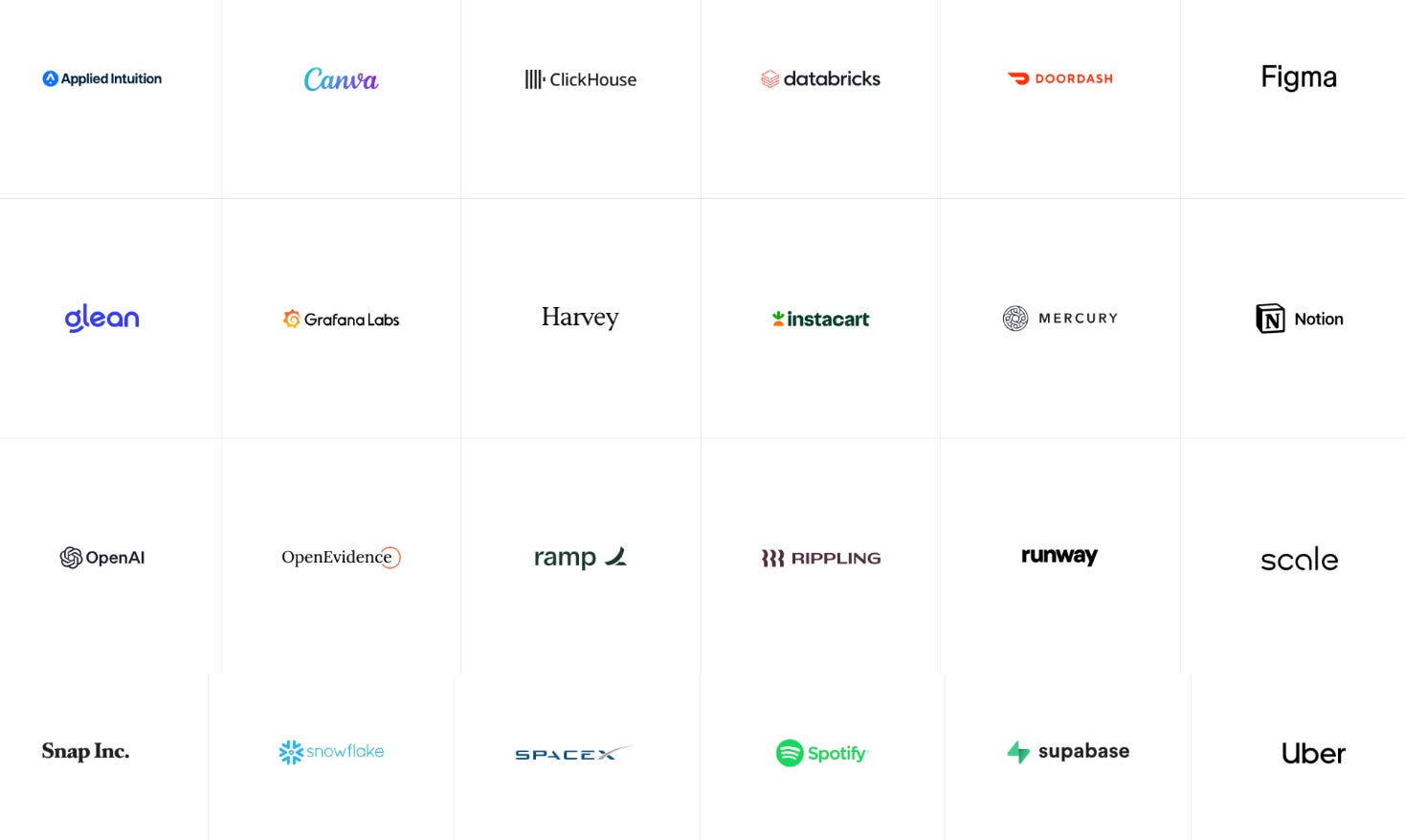
Coatue is unusual among large investment firms because it invests across both public and private technology markets. The firm started as a public equity hedge fund but expanded aggressively into venture and growth investing, building a portfolio that spans companies such as Amazon, Microsoft, Meta, Nvidia, and TSMC on the public side, alongside private companies like OpenAI, SpaceX, Anthropic, Runway, Figma, Harvey, Glean and Databricks.
That positioning shapes how Laffont thinks about where the next generation of market leaders might emerge.
“My default view has always been that the public market is the best kind of valuation mechanism, and it offers transparency, it offers liquidity, it offers opportunity of access… So then that leads you to think, well, what would the next Max seven look like… names like SpaceX… OpenAI and Anthropic and Revolut and Databricks.”
The dynamic he describes reflects a broader shift in the technology ecosystem. Some of the most valuable companies in AI and infrastructure — including OpenAI, Anthropic, and SpaceX — have been able to raise billions & billions of dollars in private markets without going public (See OpenAI’s recent $110B round).
For institutional investors, this raises an important portfolio question: if the next generation of large technology companies remains private longer, access to those markets becomes increasingly important for capturing future index-level returns.
AI Risk, the Citrini Paper, + “Doomerism”

The conversation also touched on the widely circulated Citrini research paper, which sparked debate across the technology and investment community by warning that artificial intelligence could trigger severe economic disruption. Laffont acknowledged reading the report but pushed back on the idea that discussing potential risks should be framed as alarmism.
He argued that raising concerns early is not inherently dangerous and may actually strengthen the ecosystem. In his view, the worst outcome would be a collective blind spot that allows risks to build unnoticed.
“I don’t think that screaming fire in a crowded room is productive or safe. However, I don’t view bringing up these conversations early the same way.”
Instead of dismissing the warnings, Laffont sees value in forcing companies, regulators, and investors to continuously examine how AI could reshape industries. In practice, he believes this scrutiny creates a healthier environment for decision-making.
“If everyone thinks we’re in a bubble, then by definition we’re not in a bubble.”
From an investor’s perspective, volatility driven by AI narratives, whether optimistic or pessimistic, is simply part of the market adapting to a transformative technology. Laffont emphasized that daily questioning and debate are preferable to a scenario where concerns go unexamined until a sudden collapse forces a correction.
Market Volatility Around AI May Be a Useful Signal

AI developments have produced sharp market reactions over the past year. Major model releases, research papers, and product launches frequently lead to rapid re-pricing of entire technology sectors — particularly application software.
Laffont’s perspective is that this kind of volatility may actually be beneficial for the market.
“I would much rather have daily volatility, daily questioning, then no volatility or no questioning, and then like a massive crash like three years later.”
In that sense, he sees the current wave of debate around AI risk not as doomerism, but as a necessary pressure test for the technology sector. The fact that governments, corporations, and investors are already actively thinking about AI’s long-term implications signals a level of awareness that could ultimately reduce systemic risk rather than amplify it.
From Coatue’s vantage point — investing simultaneously in infrastructure providers like CoreWeave, model developers such as Anthropic, and application software companies — the rapid feedback loop may accelerate strategic adaptation across the ecosystem rather than allowing disruption risks to build unnoticed.
Why SaaS Multiples Are Being Re-Evaluated
The conversation also touched on the shifting valuation environment for SaaS companies in public markets. For much of the past decade, SaaS businesses commanded premium valuations because of sustained high growth.
“A lot of SaaS companies were compounding mid 20s to low 30s for a long period of time… what’s happened now is by and large SaaS companies have significantly decelerating… investors are now saying, well hold on, I can own a semi company… growing almost 40%… and it’s trading at a cheaper multiple of GAAP earnings.”
The comparison he references reflects a broader market rotation toward AI infrastructure. Semiconductor and compute-related companies tied to the AI build-out have recently delivered faster growth rates, which affects how public investors compare opportunities across sectors.
For many SaaS companies, the central strategic question now is whether AI can help re-accelerate product adoption and revenue growth, or whether valuations will gradually normalize relative to other technology sectors.

AI May Shift Enterprise Software Toward Selling Outcomes

Another idea Laffont raised is the possibility that AI changes the fundamental business model of enterprise software.
Historically, software platforms were designed to help employees perform their jobs more efficiently. AI agents introduce the possibility that software systems might directly execute some of that work.
“What if they move actually from selling you software… to selling you work… I’m actually selling you the work of an HR professional.”
Under that model, the value proposition shifts from software features to completed outcomes — such as handling payroll inquiries, reimbursements, or internal HR requests.
This concept aligns with the rapid development of agent-based systems emerging across the AI ecosystem, from coding assistants to enterprise automation platforms.
Coatue’s “Big Idea” Framework for Investing

Laffont also described how Coatue evaluates large technology opportunities internally. The firm refers to these internally as “BFIs” — Big F**** Ideas — which reflect long-term structural trends rather than short-term market movements.
“We have a moniker internally… BFI, which… stands for big fucking idea.”
“I personally have a view… the size of the TAM is irrelevant… what I do think is, is that TAM gonna grow… and then I care a lot about additional TAMs.”
Rather than focusing solely on the current size of a market, the framework emphasizes whether a company can expand the market itself and create new adjacent opportunities over time.
Many of Coatue’s largest positions historically reflect this logic. Investments in companies such as Amazon, Nvidia, & Apple benefited from expanding markets like cloud computing, accelerated computing, and mobile ecosystems, that grew far beyond their original addressable markets.
For firms investing across both public and private markets, identifying those structural shifts early remains central to long-term portfolio construction.
ICYMI: Coatue’s CTEK Fund
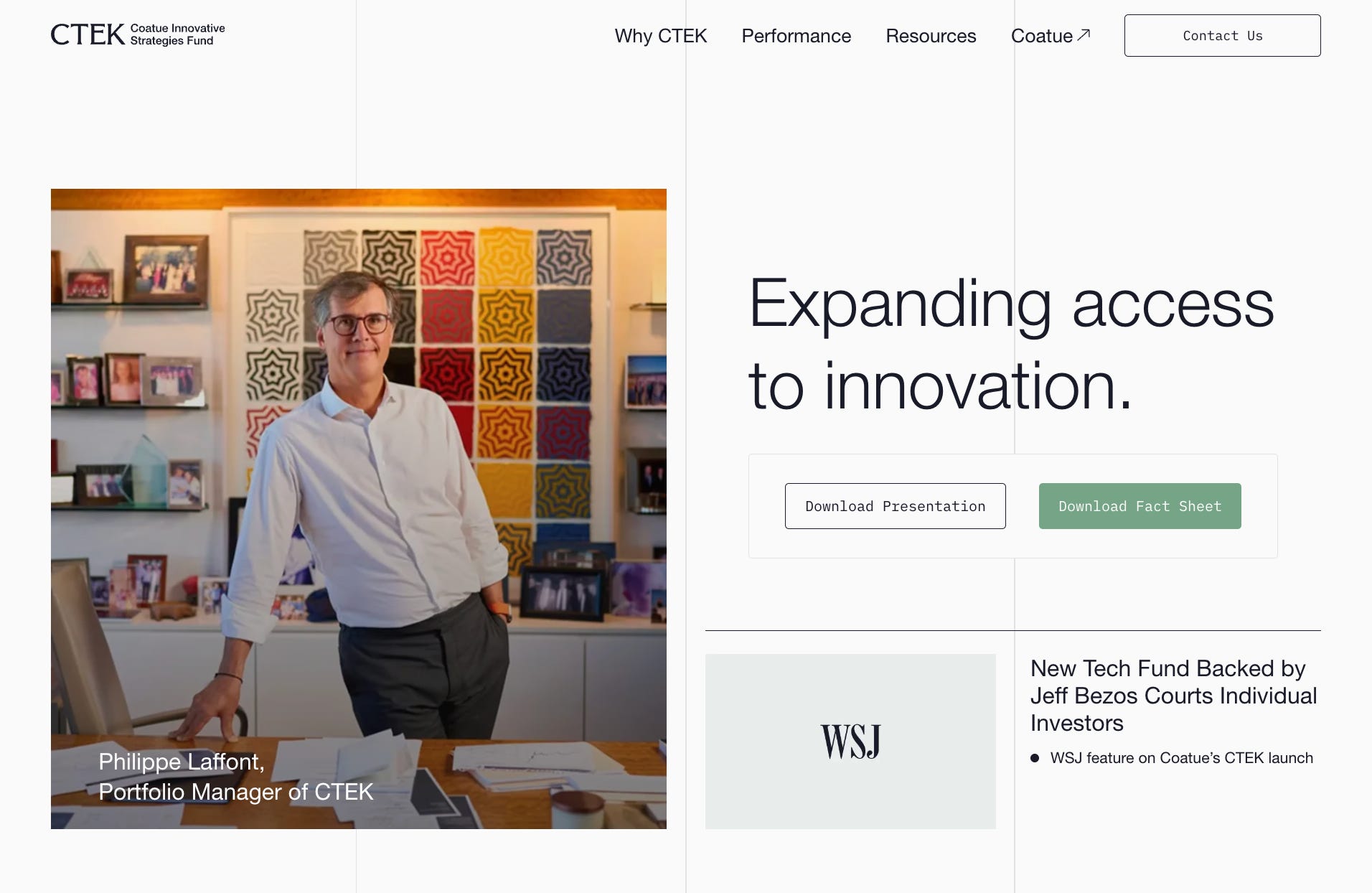
A new addition to Coatue’s strategy is its CTEK fund, a vehicle designed to give investors exposure to the firm’s highest-conviction technology investments across both public and private markets.
CTEK—short for Coatue Technology—reflects the firm’s core philosophy: that the most important technology companies increasingly span the boundary between private and public markets. Rather than treating venture and public equities as separate asset classes, Coatue structures the fund to capture opportunities across the entire lifecycle of a technology company.
The fund holds positions in many of Coatue’s flagship technology investments, including leading companies in AI, software, semiconductors, & internet platforms. By concentrating capital into a portfolio of major technology winners, the strategy is designed to compound alongside the most dominant companies driving the modern technology economy.

This approach aligns with Thomas Laffont’s broader view that innovation cycles are accelerating and that many of the companies shaping the next generation of markets are still private.
Vehicles like CTEK allow Coatue to maintain & offer long-term exposure to these companies as they mature, whether they remain private longer or eventually enter public markets.
In practice, the fund serves as a central access point to Coatue’s technology investing engine, combining the firm’s venture, growth, and public market insights into a single strategy focused on long-term compounding in technology.
→ Listen on X, Spotify, YouTube, Apple

The material presented on Molly O’Shea’s website are my opinions only and are provided for informational purposes and should not be construed as investment advice. It is not a recommendation of, or an offer to sell or solicitation of an offer to buy, any particular security, strategy, or investment product. Any analysis or discussion of investments, sectors or the market generally are based on current information, including from public sources, that I consider reliable, but I do not represent that any research or the information provided is accurate or complete, and it should not be relied on as such. My views and opinions expressed in any website content are current at the time of publication and are subject to change. Past performance is not indicative of future results.
Paid Endorsement. Brokerage services by Open to the Public Investing Inc, member FINRA & SIPC. Advisory services by Public Advisors LLC, SEC-registered adviser. Crypto trading provided by Zero Hash LLC, licensed by the NYSDFS. Generated Assets is an interactive analysis tool by Public Advisors. Output is for informational purposes only and is not an investment recommendation or advice. See disclosures at public.com/disclosures/ga. Matched funds must remain in your account for at least 5 years. Match rate and other terms are subject to change at any time.
Yo phenomenal stuff.
Great listen - enjoyed this on my run this AM