


Michael Mignano
Michael Mignano, Partner at $30B VC firm Lightspeed, & co-founder of Anchor, a podcast creation, hosting, & monetization platform acquired by Spotify in 2019, joins Sourcery to discuss the next era of creation & technology investing.
→ Listen on X, Spotify, YouTube, Apple
In this episode, Michael shares how his background building consumer media products informs the way he invests today, with a focus on AI & creativity-driven companies. We discuss his portfolio, including investments in xAI, Neuralink, Suno, Pika, Granola, & Macroscope, & how he evaluates AI businesses when incumbents can move incredibly quickly.
The conversation digs into what makes AI companies defensible today, investing in competing LLMs (xAI, Anthropic, Mistral, Stability AI, Pika), from retention-driven moats to why ARR metrics can be misleading. Michael shares his reaction to the Sora launch & avatars, and what these changes could mean for creators.
We also touch on evolving early-stage check sizes, megafund investing strategies, lessons from Spotify’s Daniel Ek, his work on Oboe with Anchor Co-Founder Nir Zicherman, & thoughts on 2026’s potential IPO candidates.
Thank you to NYSE for letting us record in your gorgeous IPO library.


𝐓𝐈𝐌𝐄𝐒𝐓𝐀𝐌𝐏𝐒
(00:00) Michael Mignano
(01:06) Anchor’s pivot & podcasting’s breakout moment
(02:32) Spotify’s Talk org: podcasts, video, and live audio
(02:55) Why synchronous (live) formats fail online
(03:27) Joining Lightspeed & portfolio overview
(03:47) Investment thesis: creativity, product taste, founders
(05:24) How xAI & Neuralink fit Lightspeed’s strategy
(06:56) Is OpenAI “Sherlocking” ?
(08:37) Granola & retention as the real AI moat
(09:52) Why ARR can be FAKE in AI startups
(11:20) Seed vs Series A check sizes & AI valuation premiums
(19:34) Sora, avatars, recommendation media, & creator economics
(33:37) Oboe: AI education & human intelligence
(40:01) Lessons from Daniel Ek & Spotify’s long-term strategy
(42:55) IPO predictions & what comes next
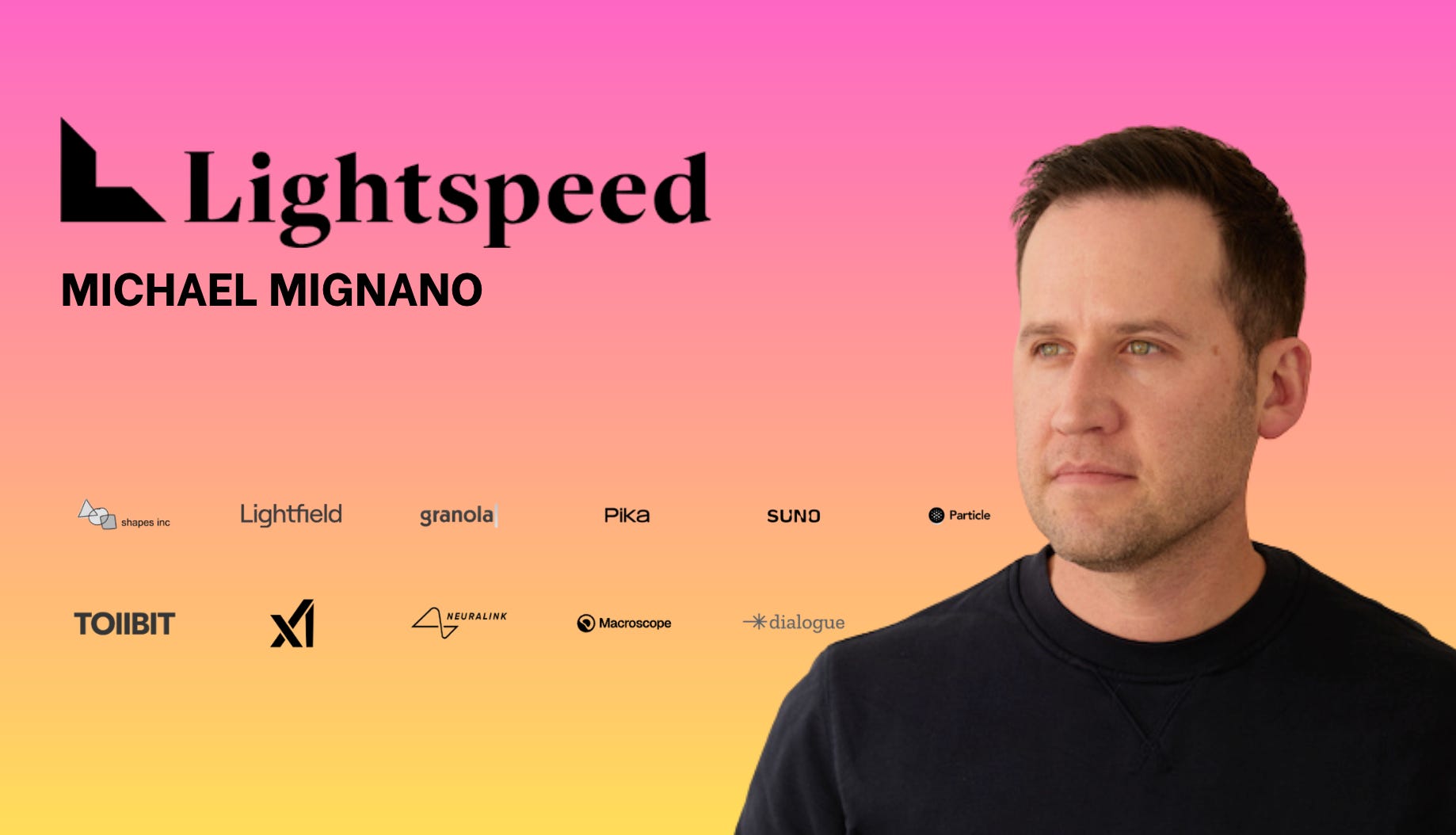
Michael Mignano sits at the intersection of modern media & frontier technology. Now a Partner at Lightspeed Venture Partners (~$30B AUM), Mignano previously co-founded Anchor, the podcast creation, hosting, and monetization platform acquired by Spotify in 2019.
After the acquisition, he went on to lead Spotify’s Talk organization across podcasts, video, and live audio. That experience, scaling a creator platform from niche to global infrastructure, now informs how he evaluates companies building products amid rapid technological change.
One of the more unexpected takeaways from the conversation is the current state of podcasting. Long dismissed as a niche format, podcasting has quietly evolved into something closer to a new form of television: personality-driven, on-demand, and increasingly video-native. Mignano noted that he has consistently underestimated the scale of podcasts, including after leaving Spotify in 2022, only to watch the medium play an outsized role in politics, culture, and long-form media consumption.
In his view, podcasting is still early in its creative evolution, with significant room for experimentation in format, distribution, and production quality.
Check out his new podcast Out of Office here.

A core theme throughout the discussion is that creativity flows directly into business outcomes, and may be one of the last durable advantages left. As AI lowers the cost of execution and compresses the time from idea to product, Mignano argues that what remains scarce is creative judgment: novel business models, differentiated go-to-market strategies, and strong product taste. Creativity, in this sense, is not about aesthetics alone but about making unconventional bets on how markets will evolve and having the conviction to pursue them before the data is obvious.

That perspective shapes how he thinks about real moats in AI. Rather than anchoring on headline revenue or loosely defined ARR, Mignano prioritizes retention, organic adoption, and user behavior that compounds over time. The strongest products, in his view, are those that become more valuable the more they are used.. accumulating context, history, and habit in a way that makes switching increasingly unattractive. In fast-moving markets where incumbents can replicate features quickly, durable user behavior, not surface-level differentiation, is the moat that continually proves to matter.
Mignano’s investment activity reflects that framework across stages. While Lightspeed as a firm makes large platform-level bets from late-stage growth equity to early stage pre-seed, he personally spends much of his time at the seed and inception stages, backing product-oriented founders early. His portfolio includes xAI, Neuralink, Suno, Pika, Granola, and Macroscope, a mix of foundational ambition and application-layer creativity.

Looking ahead, he also pointed to potential IPO candidates, including OpenAI, Discord, and prediction-market platforms, noting the growing gap between public-market demand for AI exposure and the limited number of available assets.

Finally, Mignano credited Daniel Ek with shaping how he thinks about ambition and strategy at scale. From Spotify, he learned that the most enduring companies are built with long time horizons and a willingness to leverage positions of strength into adjacent markets.
Spotify’s move from music into podcasts and audiobooks was not opportunistic, it was strategic, patient, and cumulative. That lesson now carries into Mignano’s investing: build something defensible, then use it as a platform to expand thoughtfully rather than chasing every short-term signal.
Lightspeed’s Strategy Investing Across Multiple LLMs
Michael’s core point is that Lightspeed does not view LLMs as a single competitive category in the way outsiders often do. Instead, the firm treats foundation models as software infrastructure, where different teams can pursue fundamentally different missions, markets, and end users.
As he puts it, Lightspeed took an early internal position that AI and foundation models are more akin to code than to traditional business lines. In that framing, it would be misguided to say one model company is inherently “competitive” with another simply because both train large models, just as it would be incorrect to say two unrelated software companies are competitors because they both write code.
That lens is what allows Lightspeed to back multiple LLM companies, including xAI, Anthropic, Mistral, & Stability AI, without seeing those investments as contradictory.
Michael explains that each of these companies is explicitly pursuing a different strategy:
xAI is oriented toward consumer distribution (via X) and potentially embodied AI and robotics.
Anthropic is focused on enterprise use cases and code-heavy workloads.
Mistral emphasizes European sovereignty and open-source models.

Because the missions, customers, & go-to-market paths differ, Lightspeed views these companies as occupying distinct parts of the AI landscape, even if they share technical similarities.
Finally, Michael emphasizes that value accrues wherever customers are willing to spend money, whether that’s at the model layer or the application layer. From his perspective, the right question is not which LLM will “win”, but which teams can build durable businesses aligned to a clear mission, & that belief underpins Lightspeed’s willingness to invest across multiple foundational AI efforts simultaneously.
Top 5 Quotes / Takeaways
‘The Sora Moment’ & the future of creators
“I think Sora is the next phase. It’s a whole new chapter for the internet. I hate to say it, it’s almost like the end of the creator. If you play this out and think about where this goes, platforms want to amass a huge catalog of content, and then they want to program each piece of content such that when you’re in the platform and you’re swiping, your attention is captured for as long as possible.”
What actually constitutes an AI moat
“What’s really important right now, given how fast OpenAI can move, is getting to a behavior that is sticky and durable extremely early.
The hope is that if you can do that, then even if somebody comes along and builds a better version of your product, you’re not going to switch because it has all of your context and your history.”
Why ARR can be misleading in AI startups
“It doesn’t say anything about the durability or the quality of the revenue. Some of these companies are literally just taking yesterday’s subscription rate and multiplying it by 365.
What I really care about is retention. How often are people coming back? Is it growing organically? That’s what actually matters.”
Creativity as the last durable advantage
“As it becomes easier and easier to make businesses, which it will because of AI, execution gets easier. But I think the thing that will remain rare and special is creativity in business.
Who is coming up with something really new and novel? At the end of the day, maybe the only thing that’s durable at this point is creativity when everything else can be automated.”
Daniel Ek & long-term ambition
“There’s really no ceiling to the ambition. Spotify was built in a world where music was effectively free, and Daniel built something that was better than free.
Then they took that position of strength and laddered into podcasts, and then into audiobooks. They’re thinking five, ten years ahead, and most of us don’t have the attention span to do that.”
Brought to you by:
Brex—The intelligent finance platform: cards, expenses, travel, bill pay, banking—wrapped into a high-performance stack. Built for scale. Trusted by teams that move fast.
Turing—Turing delivers top-tier talent, data, and tools to help AI labs improve model performance, and enable enterprises to turn those models into powerful, production-ready systems. Visit: turing.com/sourcery
Deel—Deel is the global people platform that helps startups hire, manage, pay, and equip anyone, anywhere. Trusted by more than 35,000 fast-growing companies, Deel is the people platform that just works, so teams can scale without the chaos. Visit: deel.com/sourcery
Public—Investing platform Public just launched Generated Assets, which lets you turn any idea into an investable index with AI. Seriously, you can type in anything, from “AI-powered supply-chain companies with positive free cash flow” to “defense tech companies growing revenue over 25% year-over-year.” With Generated Assets, you can build, backtest, refine, and invest in any thesis with AI. Gone are the days of one-size-fits-all ETFs. Try it today: public.com/sourcery
The material presented on Molly O’Shea’s website are my opinions only and are provided for informational purposes and should not be construed as investment advice. It is not a recommendation of, or an offer to sell or solicitation of an offer to buy, any particular security, strategy, or investment product. Any analysis or discussion of investments, sectors or the market generally are based on current information, including from public sources, that I consider reliable, but I do not represent that any research or the information provided is accurate or complete, and it should not be relied on as such. My views and opinions expressed in any website content are current at the time of publication and are subject to change. Past performance is not indicative of future results.
Paid Endorsement. Brokerage services by Open to the Public Investing Inc, member FINRA & SIPC. Advisory services by Public Advisors LLC, SEC-registered adviser. Crypto trading provided by Zero Hash LLC, licensed by the NYSDFS. Generated Assets is an interactive analysis tool by Public Advisors. Output is for informational purposes only and is not an investment recommendation or advice. See disclosures at public.com/disclosures/ga. Matched funds must remain in your account for at least 5 years. Match rate and other terms are subject to change at any time.
curious to see which ones outperform