

Giant Magnifying Glass + Heated Rocks
Most announced data centers will never get built. The ones that do are running on gas generators. And the US grid has no answer for what's coming.
→ Listen on X, Spotify, YouTube, Apple
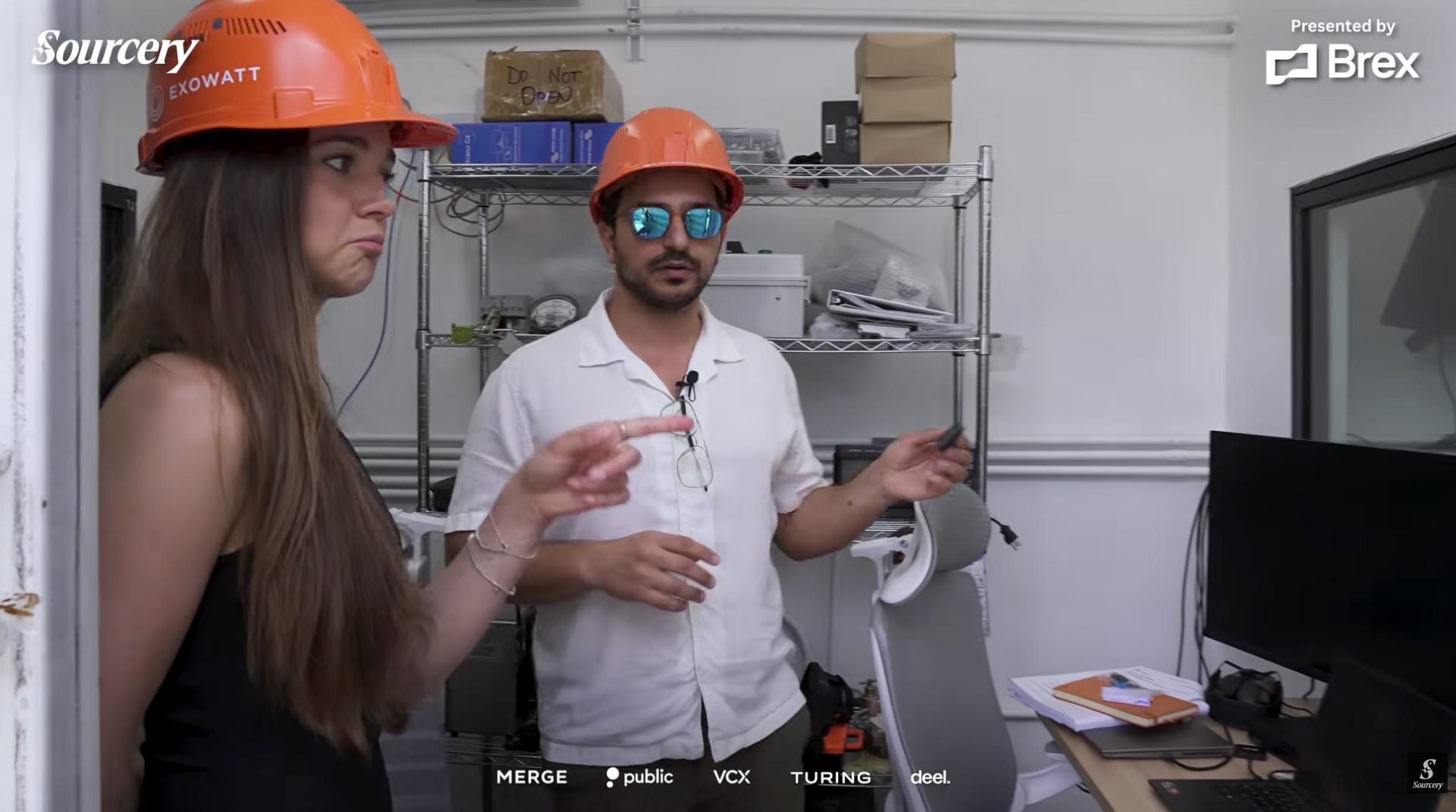
Hannan Happi, CEO & Co-Founder of Exowatt, joins Sourcery for a rare facility tour of their 40,000 sq ft Miami HQ — walking us through the tech, the team, and why the AI power crisis is far worse than the headlines suggest.
Exowatt has raised $140M in total funding from a16z, Atomic, Felicis, Sam Altman, Leonardo DiCaprio, Starwood Capital, Thrive Capital, & more, all betting on a deceptively simple idea: concentrate sunlight with Fresnel lenses, store the heat in rocks at 1,000°C, and dispatch electricity on demand. 24 hours a day, no grid required.
Their P3 system is built from sand, dirt, and steel. Like a large magnified glass and a rock. No lithium. No cobalt. No China. Target cost: 1 cent per kilowatt hour.
In this episode:
→ Why most announced data centers are phantom projects
→ The real bottleneck that replaced GPUs: power & skilled labor
→ How a 200-year-old engine is at the heart of their stack
→ What hyperscalers actually say about sustainability (it's not pretty)
→ Lessons from Tesla on iteration, modularity & vertical integration
→ Why Miami — and why now
With a 90+ GWh demand backlog and commercial deployments live in 2025, this might be the most important energy company you haven't heard of.
Co-Founded in 2023 by Hannan Happi & Atomic CEO Jack Abraham, Exowatt’s mission is to make sustainable renewable energy always available & almost free.

𝐓𝐈𝐌𝐄𝐒𝐓𝐀𝐌𝐏𝐒
(00:00) What is Exowatt? The solar backbone for AI data centers
(01:30) Why the US grid simply cannot handle what's coming
(02:00) Tour begins: Welcome to Lighthouse Miami — 40,000 sq ft facility
(02:45) The P3 explained: three elements, one shipping container
(04:00) The founding story: Atomic venture studio and the modular hypothesis
(05:30) Why solar thermal hasn't followed solar PV's 99.6% cost decline — until now
(07:00) North star: 1 cent per kilowatt hour and where they are today
(11:00) Inside the world's largest solar simulator — the sun, indoors
(13:00) The Fresnel lens up close: a giant magnifying glass for the sun
(15:00) "It's rock science" — the 5-year-old explanation of how it works
(17:30) Domestic raw materials (sand, dirt, steel) as the real competitive moat
(24:30) The phantom data center problem: most announcements won't get built
(26:00) From 100 MW to 10 GW: how data center scale exploded in 3 years
(30:00) Funding breakdown: $140M, a16z, Felicis, Sam Altman, Leonardo DiCaprio
(37:00) Lessons from Tesla: remove parts, iterate fast, build better
Brought to you by:
Brex—The intelligent finance platform: cards, expenses, travel, bill pay, banking—wrapped into a high-performance stack. Built for scale. Trusted by teams that move fast. visit → brex.com/sourcery

Turing—Turing delivers top-tier talent, data, and tools to help AI labs improve model performance, and enable enterprises to turn those models into powerful, production-ready systems. Visit: turing.com/sourcery
VCX—VCX is the public ticker for private tech, allowing investors of all sizes to invest in venture capital. View The Portfolio at GetVCX.com
Deel—Deel is the global people platform that helps startups hire, manage, pay, and equip anyone, anywhere. Trusted by more than 35,000 fast-growing companies, Deel is the people platform that just works, so teams can scale without the chaos. Visit: deel.com/sourcery
Public-–Investing platform Public just launched Generated Assets, which lets you turn any idea into an investable index with AI. With Generated Assets, you can build, backtest, refine, and invest in any thesis with AI. Gone are the days of one-size-fits-all ETFs. Try it today: public.com/sourcery
Merge—The leading provider of customer-facing integrations and agentic tools for frontier LLMs, Fortune 500 organizations, and B2B SaaS companies. Visit: https://merge.dev
The AI Power Crisis Is Bigger Than Anyone Is Admitting
Inside Exowatt’s bet that superheated rocks and a 200-year-old engine can power the next wave of AI infrastructure.
→ Listen on X, Spotify, YouTube, Apple
The Phantom Data Center Bubble
There is a version of the AI infrastructure story that gets told in press releases, keynote slides, and analyst reports. In that version, hyperscalers are constructing a grid of colossal data centers across America, a trillion-dollar buildout that will define the next era of computing. It is a compelling story. The reality on the ground looks considerably different.
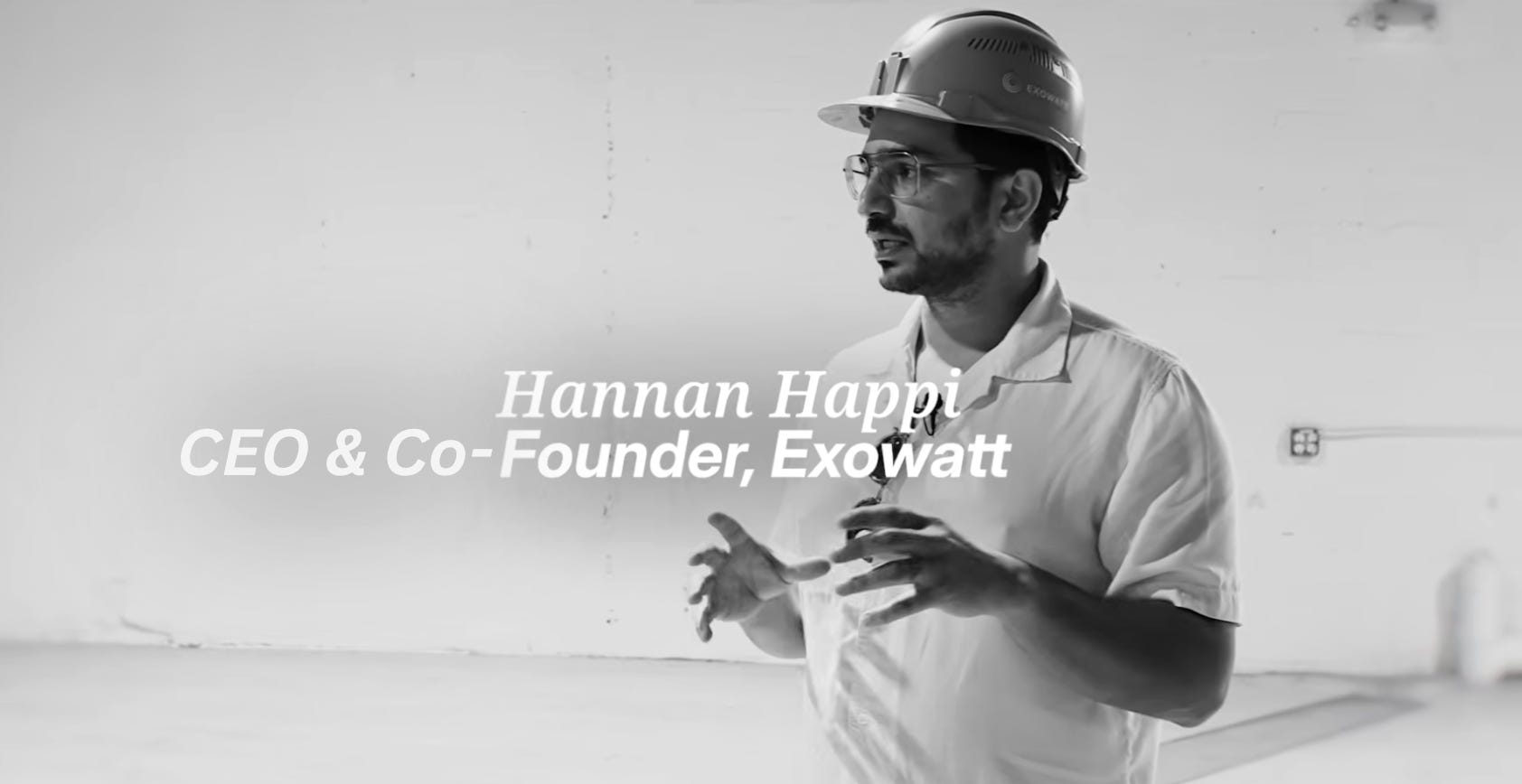
Hannan Happi, CEO and Co-Founder of Exowatt, works directly with the hyperscalers building these facilities. His read is straightforward: a lot of the data centers being talked about will never get built.
“There’s a lot of headlines about data center projects being planned or initiated.. I don’t think all of them are actually happening. So there’s a lot of like phantom data centers that are being announced.”
The evidence for this is not hard to find. Stargate, the $500 billion AI infrastructure initiative announced at the White House in January 2025 by OpenAI, Oracle, and SoftBank, was positioned as the defining infrastructure bet of the AI era. Within six months, Bloomberg reported that the joint venture had not hired any staff and was not actively developing any data centers. The three partners had been arguing over structure, financing, and site selection since the day it was announced. OpenAI, unable to secure financing for its own data centers, eventually returned to Oracle and SoftBank for a restructured two-way deal. The Abilene, Texas expansion, which was meant to grow from 1.2 gigawatts to 2 gigawatts, was subsequently scrapped. OpenAI also paused its Stargate UK project entirely, citing energy costs and regulatory uncertainty.
Microsoft told the market in January 2025 that it would spend $80 billion on AI data centers that year. By March, TD Cowen analysts reported that Microsoft had walked away from more than 2 gigawatts of data center leases across the US and Europe, canceled a $1 billion campus development in Ohio across three sites, and frozen new leasing activity almost entirely. The company maintained it was reallocating rather than retreating, but the gap between the January announcement and the March reality was significant.

This pattern, large announcements followed by quiet pullbacks, is exactly what Happi is describing. Land acquisition, permitting, grid interconnection, financing complexity, and the availability of skilled labor all create friction between a press release and a functioning data center. The gap between announced capacity and operational capacity is measured in years and gigawatts, and it has become one of the more important blind spots in the AI conversation.

The Underlying Demand Is Real. That Is Where Exowatt Comes In.
Calling out the phantom project problem is not the same as saying the demand for AI power is overstated. It is not. The International Energy Agency projects that US data center power consumption is on course to account for almost half of the growth in electricity demand between now and 2030. That is not a bubble. That is a structural shift in how the country uses energy, and it is happening regardless of which specific projects get built on which specific timelines.

The distinction Happi is drawing is between announced capacity and real demand, and Exowatt’s own commercial traction illustrates it clearly. When the P3 launched at RE+ 2024, North America’s largest clean energy conference, the company reported a pipeline of more than 1.2 gigawatts of orders. That grew to 85 gigawatt hours of signed customer demand by the end of 2024, and exceeded 90 gigawatt hours by April 2025. Those are not letters of intent or press release projections. They are contracts from data centers, energy developers, & hyperscalers who need power.. & need it now.
The speed at which that backlog has grown reflects something specific: customers are not evaluating Exowatt as a 10-year bet. They are evaluating it as a solution to an immediate problem. The P3 can be deployed with or without grid interconnection, ships in standard 40-foot containers, requires minimal on-site construction, and can be co-located directly next to a data center facility. For a hyperscaler staring down a five-to-seven year grid interconnection queue, a modular system that generates power on-site from day one is not a nice-to-have. It is the only durable option that fits the timeline.
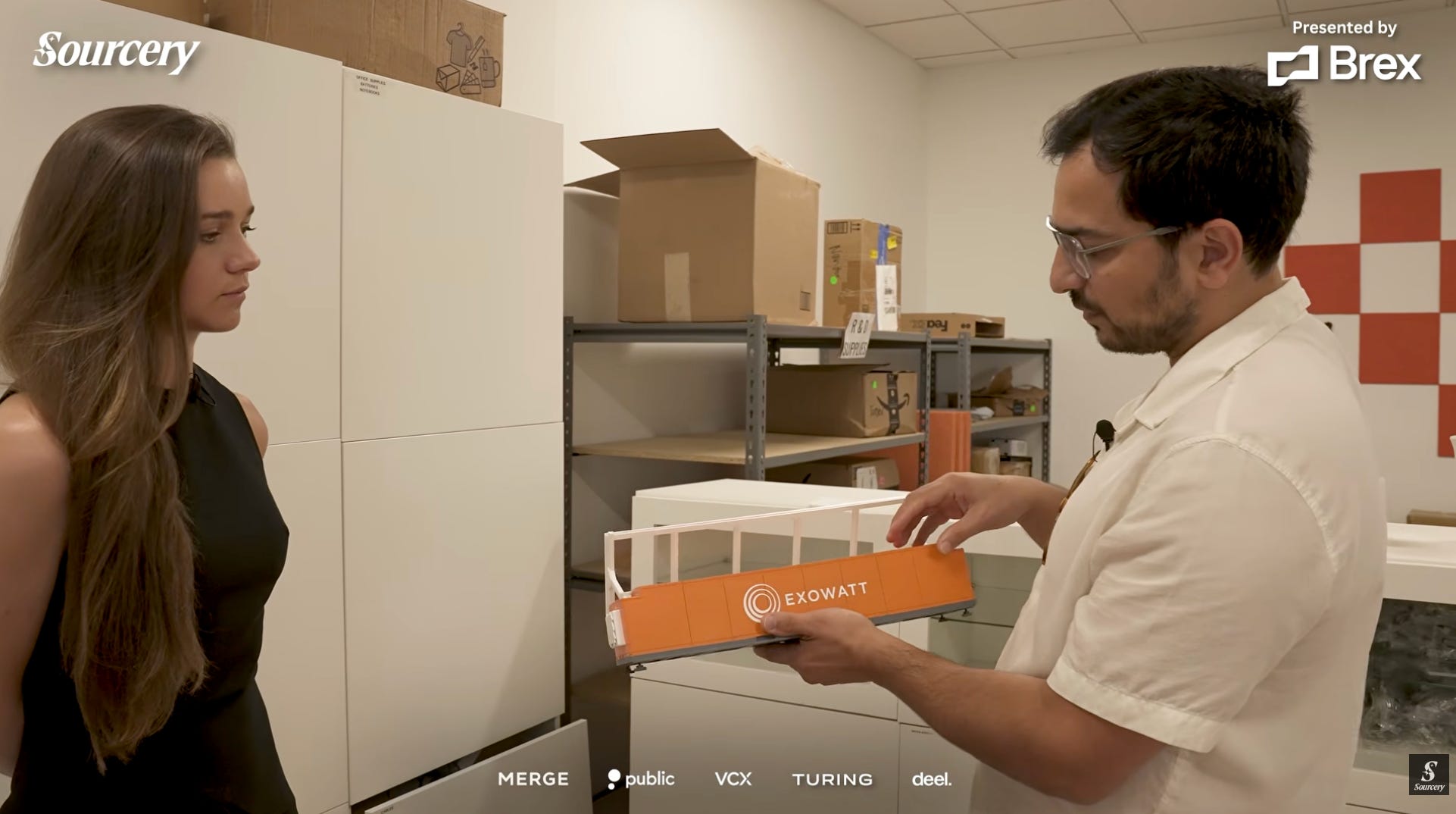
Exowatt has since expanded beyond selling hardware. In January 2026, the company launched ExoRise, a new business arm that delivers fully powered land and energy infrastructure for hyperscale data centers across the US Southwest, covering New Mexico, West Texas, Arizona, and Nevada. The pitch is a turnkey alternative to years of utility bureaucracy: show up, plug in compute, & Exowatt handles everything else.
“Hyperscalers should not have to piece together land, power, & infrastructure on their own,” Happi said at the launch. “ExoRise delivers everything together so customers can focus on compute while we handle the power.”
The demand is real. The grid cannot meet it. And Exowatt is already shipping.

Power Is the Known Bottleneck. Here Is What That Actually Means.
The power constraint in AI infrastructure is no longer a hidden insight. It has been covered extensively, referenced in every major hyperscaler earnings call, and cited as the primary reason behind dozens of infrastructure decisions in the past year. What is less well understood is the specific mechanism by which it constrains the buildout, and why throwing money at it does not solve it quickly.
A single gigawatt data center, the kind that was considered large just three years ago, consumes the equivalent energy of nearly one million US households. Hyperscalers now planning five and ten gigawatt campuses are effectively trying to plug small cities into infrastructure designed for suburbs.
“The grid is just really not built for that,” Happi said. “And what that means is the data centers now have to figure out how to bring their own power online.”
The specific mechanism is the interconnection queue, the process by which new power generation projects formally connect to the US grid. That queue is backed up for years in most markets. A developer who applies today for grid interconnection in a high-demand region can expect to wait five to seven years for approval and connection. No amount of capital accelerates that timeline in any meaningful way because the constraint is regulatory and physical, not financial. Transmission infrastructure capable of serving a ten-gigawatt facility in a rural location does not exist and cannot be built on the timelines hyperscalers need.
The outcome is a shift that would have been considered unusual just two years ago. Data centers are going off-grid. Behind-the-meter power generation, building your own power source on-site rather than drawing from the utility, has moved from an edge case to a near-standard consideration for any large-scale build. The question hyperscalers are now asking is not whether to generate their own power. It is what to generate it from, and how fast they can get it online. The answer most are currently landing on is natural gas, with all of the cost, environmental, and geopolitical consequences that come with it.

Big Tech Quietly Moved On From Clean Energy
For most of the past decade, the major technology companies competed on sustainability as seriously as they competed on product. Net-zero commitments, renewable energy certificates, carbon neutrality pledges. Environmental goals were a fixture of earnings calls and annual reports. That has shifted, and the shift has happened quickly.
Happi describes the current priority order inside hyperscaler conversations plainly. Power availability comes first, at almost any cost and from almost any source. Cost comes second. Environmental considerations, which once sat near the top of the agenda, have fallen considerably down the list, behind reliability, speed of deployment, geopolitical risk, and community impact.
“It used to be one of the objectives,” he said of sustainability. “But it’s now time to power, right? I need power. I don’t care how you make it. Squeeze penguins if you have to, I need the power.”
The result is that natural gas has become the default power source for off-grid data center development. Gas generators are available, scalable, and well-understood. They are also expensive over time, carbon-intensive, and in an environment where energy security has become a national priority, strategically exposed.
The longer-term risk is lock-in. Gas infrastructure built today to power a data center will run for twenty years. The clean energy commitments set aside to enable that build do not go away. They accumulate. The costs associated with emissions, regulatory pressure, and rising energy prices will arrive eventually. The current thinking inside the industry is that speed to deployment outweighs those concerns for now.
Why the Answer Might Be Sand, Dirt, & Rocks
Exowatt’s technology is a direct response to this situation. The Exowatt P3 is a modular, shipping container-sized power generation unit built on straightforward physics and a domestic material supply chain.
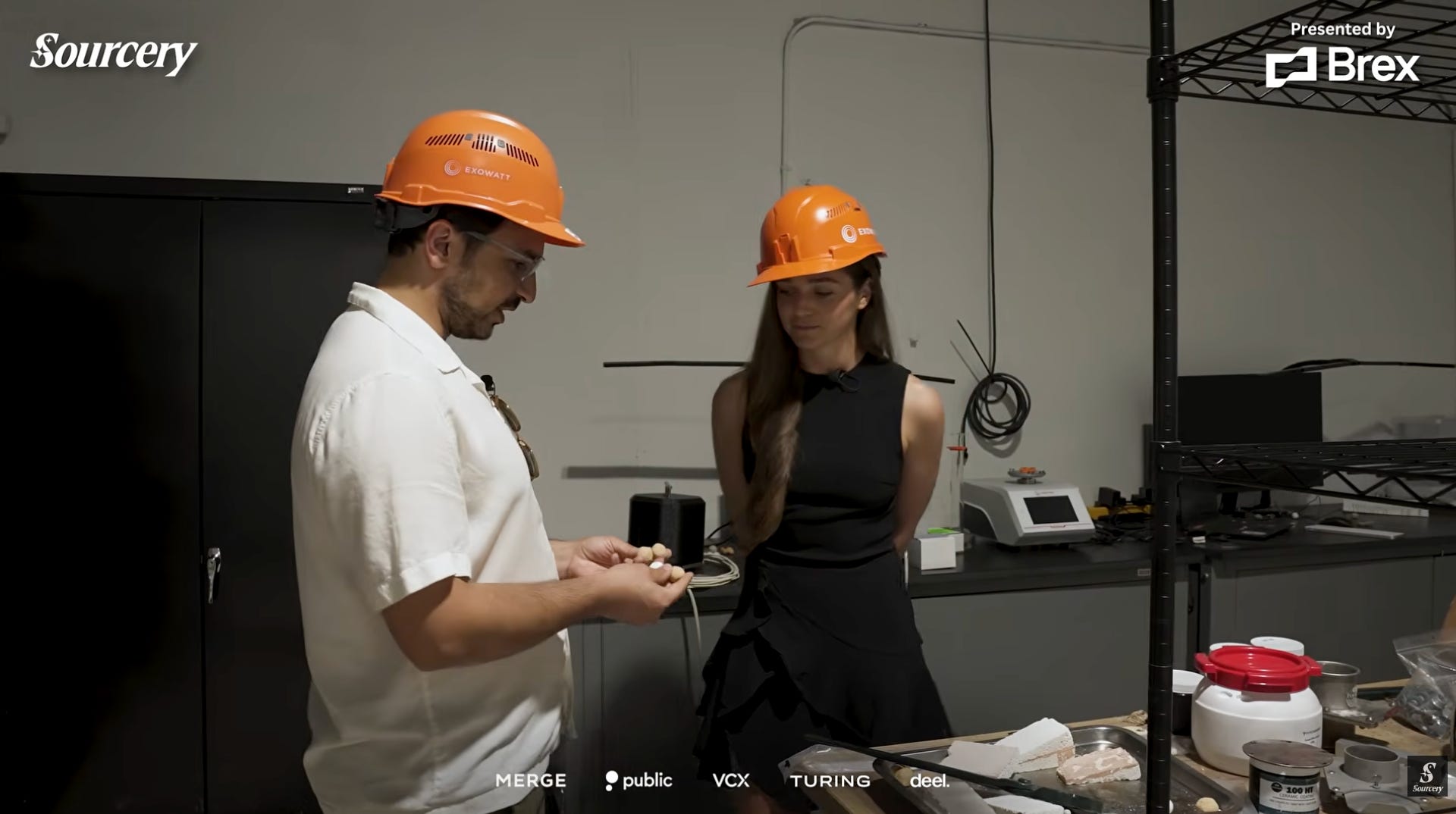
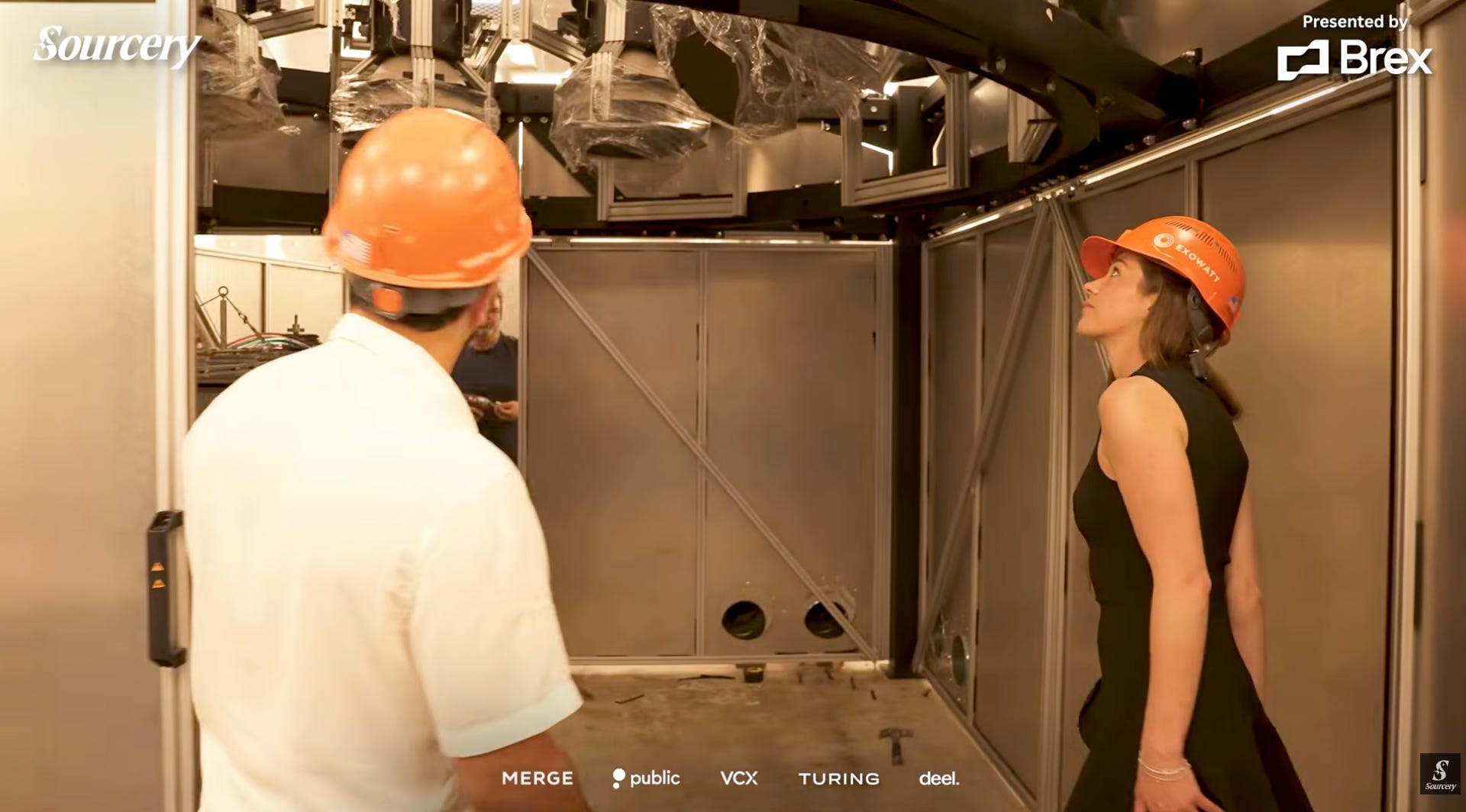
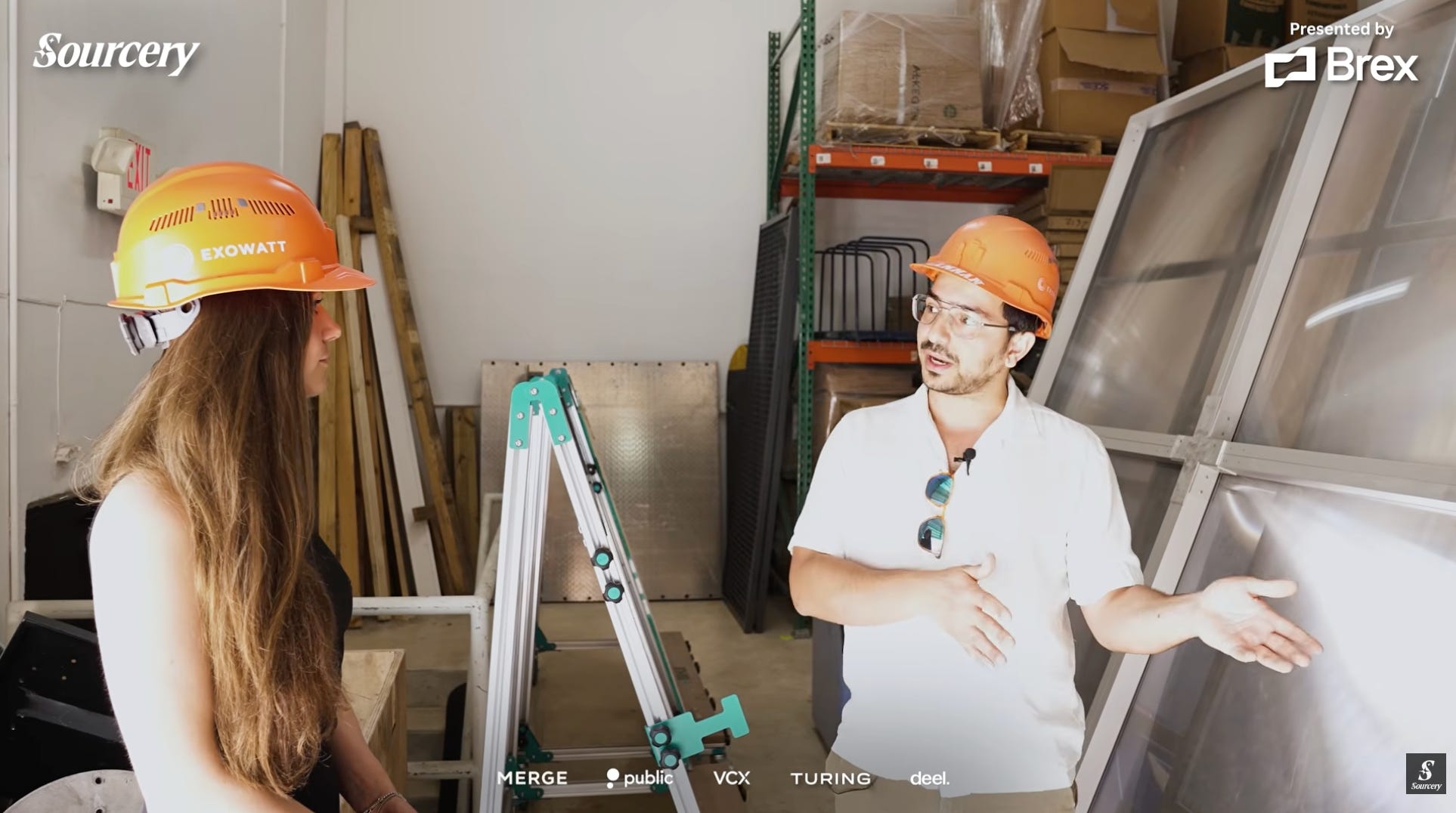
The system works in three stages. A Fresnel lens, the same optical technology used in lighthouses, concentrates incoming solar energy onto a thermal battery made of specialized rocks. Those rocks are heated to between 800 and 1,000 degrees Celsius, storing energy for up to five days without additional solar input. That heat is then moved via a circulating air loop to a Stirling engine, a technology that has been in use for 200 years, which converts the temperature differential into electricity on demand.

None of the individual components are new. Fresnel lenses, thermal storage, and Stirling engines are all well-established technologies. The value is in combining them in a way that is modular, factory-producible, and built entirely from domestic materials: sand, dirt, and steel, with no lithium, cobalt, or rare earth minerals involved.
“The most important thing is at the end of the day the raw materials that we use: sand, dirt & steel,” Happi said. “And so you don’t have to go import something from China.”
Exowatt’s current cost is just under four cents per kilowatt hour (!!). Their long-term target is one cent, which would make it among the cheapest electricity ever produced at commercial scale. Getting there depends on manufacturing volume, which is the core thesis behind how the company was designed.
Economics of Power & Why Exowatt is Ready Now, Not in 10 Years
Hyperscalers signing power contracts today are paying in the range of 20 to 30 cents per kilowatt hour. Commercial grid electricity typically runs between 8 and 15 cents. Residential customers pay 13 to 20 cents. The premium data centers are absorbing reflects a straightforward imbalance: there is not enough power available where they need it, and they will pay whatever it takes to secure what exists.
Natural gas, the current default for off-grid generation, is not cheap either. Once you factor in fuel costs, transportation, generator maintenance, and long-run exposure to gas price volatility and carbon penalties, the economics of running a gigawatt data center on gas for twenty years are significantly worse than the upfront simplicity of the decision implies.
Exowatt’s current cost of just under four cents ($0.04) per kilowatt hour already undercuts the grid price for commercial customers in most US markets. At scale, with the manufacturing learning curve applied, the one cent ($0.01) target would make it cheaper than any grid-connected power source available today. That is the economic destination. The more immediate question is whether the product works on the timeline the market actually needs.
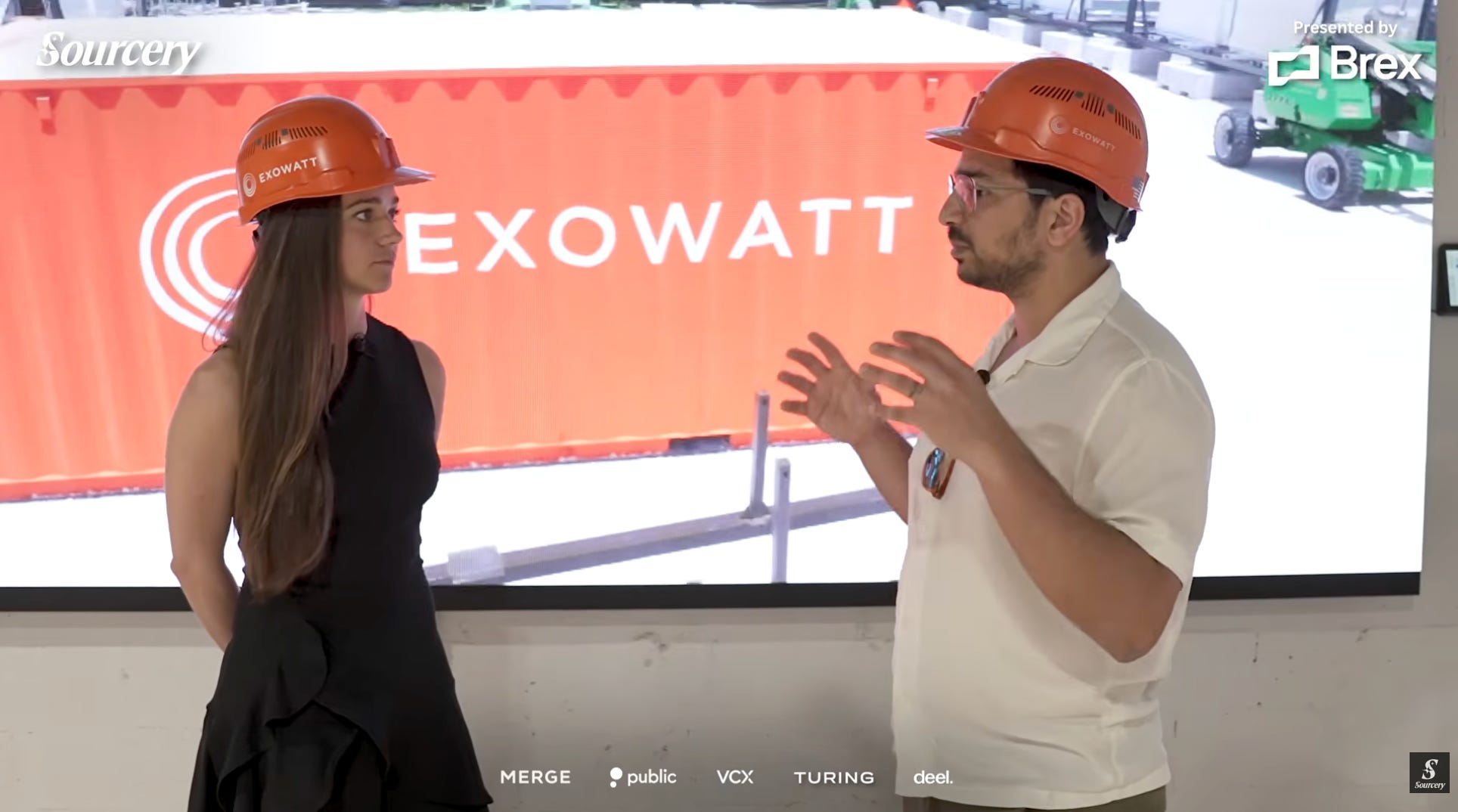
This is where the modular, container-based approach changes the conversation. A traditional utility-scale power project, whether solar farm, gas plant, or nuclear, requires years of permitting, grid interconnection queues of five to seven years in most high-demand markets, and construction timelines that assume a patient developer with a long capital runway. None of those conditions describe the AI infrastructure buildout happening right now.
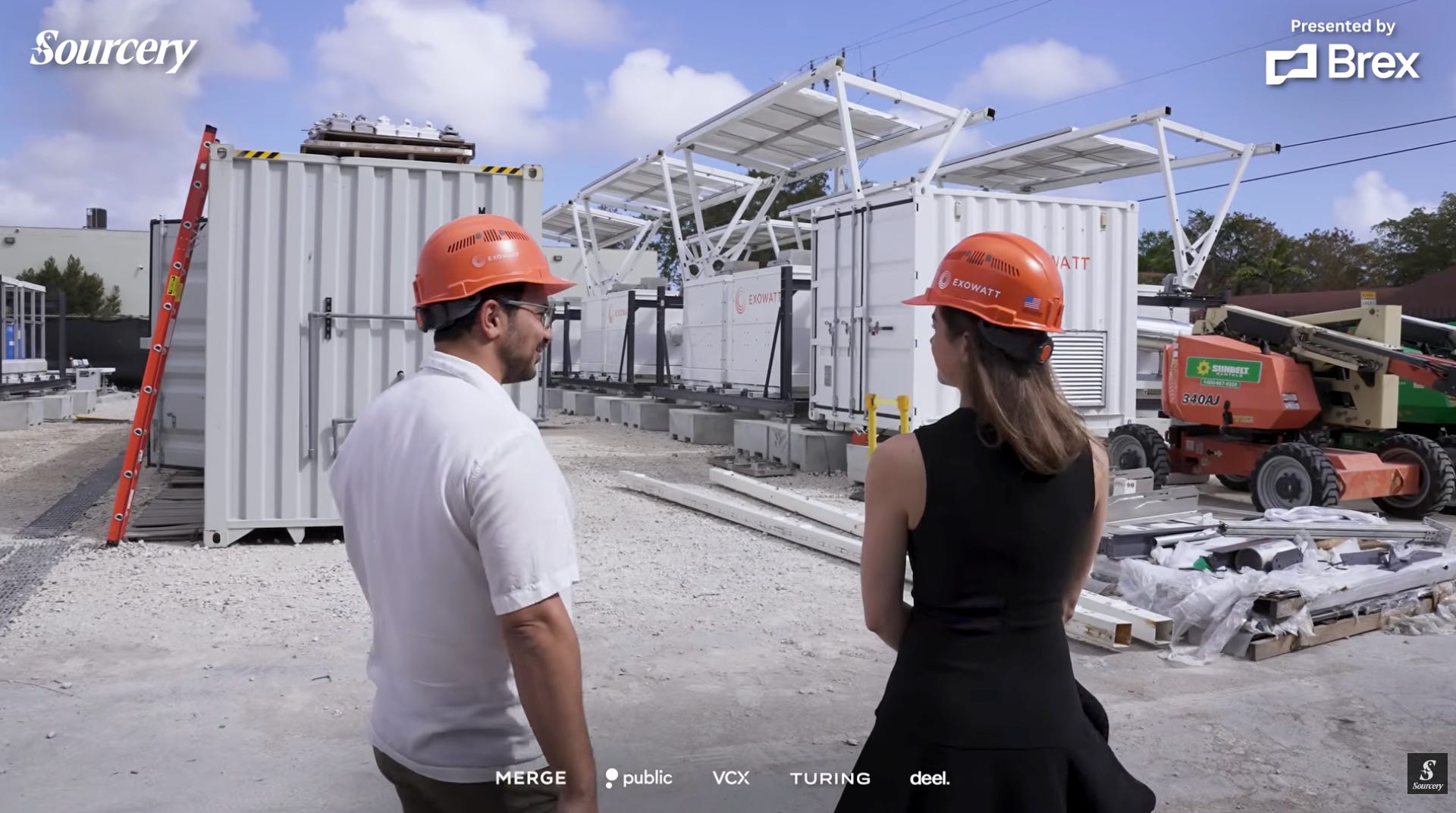
The P3 sidesteps all of it. Because each unit is factory-built and ships in a standard 40-foot container, it can be deployed on-site without grid interconnection. A data center that needs power in 18 months does not need to wait for a utility. It needs land, adequate solar irradiance, and P3 units. The US Southwest, where Exowatt is targeting its ExoRise deployments, has all three in abundance.
The comparison to competing approaches is stark.
Utility grid connection in a constrained market: ~5-7 years.
New gas plant permitted & built from scratch: ~3-5 years
Nuclear small modular reactor, which several hyperscalers have explored as a long-term solution: ~10 years or more
Despite a lot of support, they’re currently in an early, pre-commercial stage
Exowatt’s P3, deployed in modular increments on pre-permitted land: online within the current build cycle
Customers are not just buying the one cent per kilowatt hour target. They are buying the ability to get power online on the timeline that AI actually demands, from a domestic supply chain that does not depend on a utility, a foreign mineral, or a gas contract that locks in costs for two decades.. or pose a major public health hazard.

The Bottleneck After Power: Skilled Labor
The AI infrastructure conversation has worked through a clear sequence of constraints. First it was Nvidia GPUs. Then, as chip availability improved, attention moved to power. Both received significant coverage and drove substantial capital toward solutions.
There is a 3rd bottleneck developing that has received far less attention: skilled labor.
“The biggest kind of challenge for data centers today is there aren’t enough construction workers to build a data center,” Happi said. “You have to import people from other states to a site to build a data center. And being an electrician these days is actually a very high-paying job because there aren’t enough electricians to even twist wires and hook things up.”
Unlike the chip shortage, this one does not respond quickly to capital investment. Training skilled tradespeople takes years, and the industry did not begin investing in that pipeline early enough to meet current demand. The result is a constraint that will slow the buildout well after the power availability problem is addressed.
Exowatt’s modular approach has a practical advantage here. Units assembled in a controlled manufacturing environment and shipped to site require less on-site skilled labor than bespoke, utility-scale power infrastructure. When qualified electricians are the limiting resource, reducing how many hours of their time each megawatt requires is a meaningful efficiency gain.

The Manufacturing Bet Behind the Technology
The core idea behind Exowatt is not any single piece of technology. It is a manufacturing thesis drawn from two reference points: the cost trajectory of solar PV panels over the past fifty years, and the production philosophy Happi observed while working at Tesla.
Solar PV reduced its cost per watt by 99.6% over five decades. That did not happen because of one breakthrough. It happened because manufacturing scale drives learning, learning drives efficiency, efficiency drives lower cost per unit, and lower cost per unit enables more volume. The curve compounds.
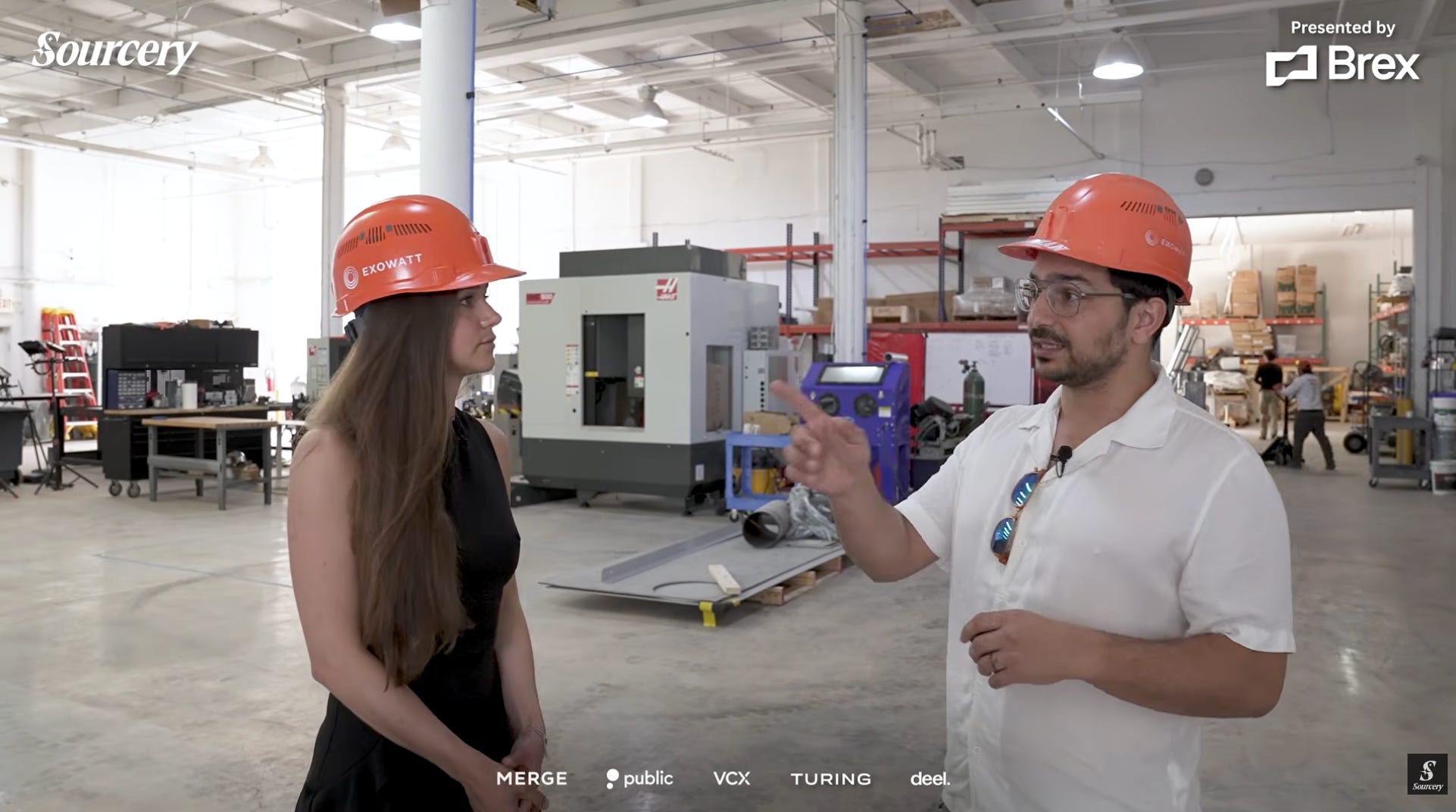
Solar thermal, the technology category Exowatt operates in, has not followed that trajectory. Every solar thermal project built to date has been a large, custom installation. There is no learning curve when every project is built differently. Cost has stayed high because the manufacturing discipline that transformed solar PV was never applied.
Exowatt’s approach is to apply it. Shipping container-sized modules, built in a factory to a consistent specification, create the conditions for that learning curve to develop. Each generation of the P3 informs the next. The one cent per kilowatt hour target is the projected outcome of running that process long enough and at sufficient volume.
“That’s why we chose this modular approach,” Happi said. “Instead of going & building a giant infrastructure project and saying we need ten years and a billion dollars to get to our first demo site, we said: let’s build the smallest thing, learn from that, iterate quickly, & build the next generation, & the next generation.”
Backed by $140 million from a16z, Felicis, Sam Altman, Leonardo DiCaprio, Starwood Capital, Thrive Capital, and others, with a demand backlog exceeding 90 gigawatt hours from data centers and hyperscalers across the US, Exowatt is moving from thesis to deployment. Several commercial projects are going live in 2025. The manufacturing scale that makes the cost curve work is what comes next.

Hannan Happi & What Tesla Taught Him
Before Exowatt, before Atomic, before Miami, & before founding Volansi, Hannan Happi was on the factory floor at Tesla during the launch of the Model S, when the Fremont factory was being stood up from scratch.
“Tesla wasn’t a popular company. I had to fight a lot, uphill, to get there. But it was an amazing, eye-opening experience.”
That experience left a set of convictions that run through everything Exowatt does, and Happi is direct about what they are.
1.) Team >
The team is the primary ingredient. Not the tech, market timing, or capital.
“The lessons learned were to first of all have an amazing, dedicated, mission-focused team. I think that’s the primary ingredient that actually got Tesla through.”
The reason Tesla survived, in Happi’s view, was a group of people willing to absorb a level of pressure that would dissolve a more conventional organization. Exowatt was built with that standard in mind, which is part of why the company chose Miami deliberately rather than defaulting to the Bay Area talent pool, and why the 40,000 square foot facility in Magic City looks more like an aerospace manufacturing floor than a startup office.
2.) Build What People Want
The second lesson Happi traces directly to his time at Tesla and his time at YC: build something people actually want.
“Build a great product that customers really want and enjoy. That’s something I also learned at YC, right from Sam. Build something people want.”
3.) Remove Parts.
The instinct in engineering is to add capability. The discipline that separates companies that scale from companies that stall is the willingness to take things away.
“That constant iteration on: let’s remove parts, let’s make it simpler, let’s scale the manufacturing — that’s the same approach you see at SpaceX or at Tesla. That’s what has led to this.”
Every configuration of the P3 was evaluated against the bill of materials. Every component that could be eliminated was eliminated. The result is a system whose simplicity is what makes it manufacturable at scale.
4.) Short Feedback Loops
Hardware is hard, as Happi puts it, not because the physics are complicated but because iteration cycles are long and expensive if you let them be.
“Hardware is hard. So you want to try to figure out how to create the shortest feedback loops possible & learn from that as fast as possible, & scale that as fast as possible. That’s why we chose this modular approach.”
Exowatt went through more than 50 configurations of the P3 before landing on the version that went to market. The modular approach was not just a product decision. It was a way of compressing the time between building something, learning from it, and building the next version.
5.) Vertical Integration
Or at least the ambition toward it. Happi is candid that Exowatt has not gone as far down that path as Tesla yet.
“Everyone coming out of Tesla is obsessed with vertical integration. You want to build everything in-house. We’ve started working with contract manufacturers because we know we need to scale fast. But Elon really taught us how to vertically integrate everything & build it yourself, build it better, faster, cheaper, & don’t take no for an answer.”
The companies that win in hardware over the long run are the ones that control their own supply chain, their own manufacturing process, and their own cost structure. Every move Exowatt makes toward domestic sourcing and factory production is a step in that direction. The Tesla years gave Happi a clear picture of what that looks like at full maturity. Exowatt is working backward from it.
The Investors & Origin Story Behind It All
Exowatt did not come out of a garage. It came out of Atomic, the San Francisco-based venture studio co-founded by Jack Abraham, who also serves as Exowatt’s Chairman. Atomic’s model is to build companies from the inside, pairing founders with capital, infrastructure, and operational support before a company has a product or a customer. It has produced a number of significant companies including Hims & Hers Health and OpenStore. Happi eventually “moved in as a founder in residence back in 2022 & started working with Jack” ultimately, incubating Exowatt & formally Co-Founding the company with Abraham in 2023.

The founding thesis was not “build a solar company.” It was more specific than that: apply manufacturing discipline to solar thermal in the same way the industry applied it to solar PV, do it at the modular scale, & source domestically. That specificity is part of what attracted the caliber of investors who came in at the seed round.
In April 2024, Exowatt came out of stealth with a $20 million seed round led by Andreessen Horowitz and Atomic, with Sam Altman, CEO of OpenAI, and Leonardo DiCaprio investing as angels. The combination of Altman & DiCaprio in the same cap table is unusual enough to earn attention on its own, but the more meaningful signal was a16z leading the round. Andreessen Horowitz has been one of the more disciplined investors in energy infrastructure, and their conviction at seed reflected a view that the power constraint in AI was not a temporary problem.
The Series A followed in April 2025, a $70 million round led by Felicis and structured as a mix of $35 million in equity and $35 million in debt provided by HSBC Innovation Banking. Additional investors included Starwood Capital, Thrive Capital, 8090 Industries, MCJ Collective, MVP Ventures, GOAT VC, and StepStone Group, with Atomic and a16z both returning. Six months later, Exowatt raised a further $50 million extension led by MVP Ventures and 8090 Industries, bringing total capital raised to $140 million in under two years.
The investor base is worth reading carefully. Starwood Capital is one of the largest real assets managers in the world. Thrive Capital, founded by Josh Kushner, has a track record of backing category-defining companies early. HSBC providing debt at the Series A stage signals that institutional lenders, not just venture capitalists, are taking Exowatt’s revenue prospects seriously. And the fact that both Atomic & a16z came back in subsequent rounds is a solid nod for insider confidence.
What binds all of it together is the founding relationship between Happi & Abraham at Atomic. The venture studio model gave Exowatt something most hardware startups do not have in the early days: time and resources to iterate without the immediate pressure of external market expectations. Happi has described going through more than 50 different design configurations before landing on the P3. That iteration cycle, funded and sheltered inside a studio environment, is what produced a product that was ready for commercial deployment at the moment the market needed it most. The timing was not luck. It was the result of starting early, staying disciplined, and building in a city, Miami, that most of the industry was not paying attention to.
→ Listen on X, Spotify, YouTube, Apple

The material presented on Molly O’Shea’s website are my opinions only and are provided for informational purposes and should not be construed as investment advice. It is not a recommendation of, or an offer to sell or solicitation of an offer to buy, any particular security, strategy, or investment product. Any analysis or discussion of investments, sectors or the market generally are based on current information, including from public sources, that I consider reliable, but I do not represent that any research or the information provided is accurate or complete, and it should not be relied on as such. My views and opinions expressed in any website content are current at the time of publication and are subject to change. Past performance is not indicative of future results.
Paid Endorsement. Brokerage services by Open to the Public Investing Inc, member FINRA & SIPC. Advisory services by Public Advisors LLC, SEC-registered adviser. Crypto trading provided by Zero Hash LLC, licensed by the NYSDFS. Generated Assets is an interactive analysis tool by Public Advisors. Output is for informational purposes only and is not an investment recommendation or advice. See disclosures at public.com/disclosures/ga. Matched funds must remain in your account for at least 5 years. Match rate and other terms are subject to change at any time.
Phenomenal. You literally are the best.