


A Unexpectedly Candid, Philosophical, & Fun Conversation
Bradley Tusk, First Policy Advisor to Travis Kalanick / Uber, Venture Capitalist, Philanthropist, & Author of Obvious in Hindsight, joins Sourcery to discuss what he learned working closely with Travis Kalanick during Uber’s early regulatory battles, & how those experiences shaped his decision to shut down his venture fund & return to an equity-for-services model.
→ Listen on X, Spotify, YouTube, Apple
Bradley explains why Travis was unusually fast, analytical, and willing to challenge institutions, and how that mindset influenced the way Uber approached politics and growth. He also breaks down how the current AI wave is affecting valuations, capital formation, data-center spending, and the broader regulatory environment. The conversation covers the real economics of running a VC fund, why mid-sized funds struggle, how AI is reshaping startup incentives, and what founders should understand about regulation, policy, and long-term strategy.
It’s a practical, grounded discussion from someone who has worked at the intersection of tech & government for over a decade.
P.S. I cut out one of the best sections & shared it below. There are lots of pictures, you’ll like it..
Topics Covered:
Working with Travis Kalanick – early Uber, regulatory battles, “Travis’s Law.”
Why Bradley ended his VC fund – fund economics, incentives, equity-for-services.
AI’s capital cycle – compute demand, data centers, energy, valuation pressure.
Regulation and policy – tech/government dynamics, IP, immigration, debt.
Zero-sum vs abundance – meaning, relationships, work choices, purpose.
Timestamps
(00:00) Bradley Tusk
(01:25) How AI infrastructure spending is being driven by market narratives
(03:10) DeepSeek, inference models, and compute efficiency
(03:55) Where the $2T in AI data-center and energy capital is flowing
(07:10) Nuclear energy and the broader implications of AI’s power demand
(16:30) Zero-sum vs abundance thinking in tech and politics
(17:35) How people find meaning, purpose, and balance in high-pressure work
(27:00) Why Bradley invests heavily in his team and removes non-essential tasks
(32:00) How Bradley’s experience with Travis Kalanick shaped his view of founders
(32:35) “Travis’s Law” and turning users into political advocates
(37:05) Why Bradley decided to stop raising traditional VC funds
(44:30) The economics of mid-sized funds and why they’re so difficult to run
(49:20) How AI valuations differ from non-AI valuations
(54:40) What people misunderstand about Silicon Valley and DC
(59:40) AI, unemployment risk, and why Bradley believes UBI will be necessary
(01:05:50) The biggest lessons Bradley learned from Travis Kalanick
Brought to you by:
Brex—The intelligent finance platform: cards, expenses, travel, bill pay, banking—wrapped into a high-performance stack. Built for scale. Trusted by teams that move fast.
As a Sourcery subscriber you get: 75,000 points after spending $3,000 on Brex card(s), white-glove onboarding, $5,000 in AWS credits, $2,500 in OpenAI credits, & access to $180k+ in SaaS discounts. On top of $500 toward Brex travel, $300 in cashback, plus exclusive perks (like billboards..) visit → brex.com/sourcery

Turing—Turing delivers top-tier talent, data, and tools to help AI labs improve model performance, and enable enterprises to turn those models into powerful, production-ready systems. Visit: turing.com/sourcery
Carta—Carta connects founders, investors, and limited partners through software purpose-built for private capital. Trusted by 2.5M+ equity holders, 65,000+ companies in 160+ countries, Carta’s platform of software & services lays the groundwork so you can build, invest, and scale with confidence. Visit: Carta/Sourcery

Pictured: me holding up my ‘signed edition’ of Bradley’s book “Obvious in Hindsight”
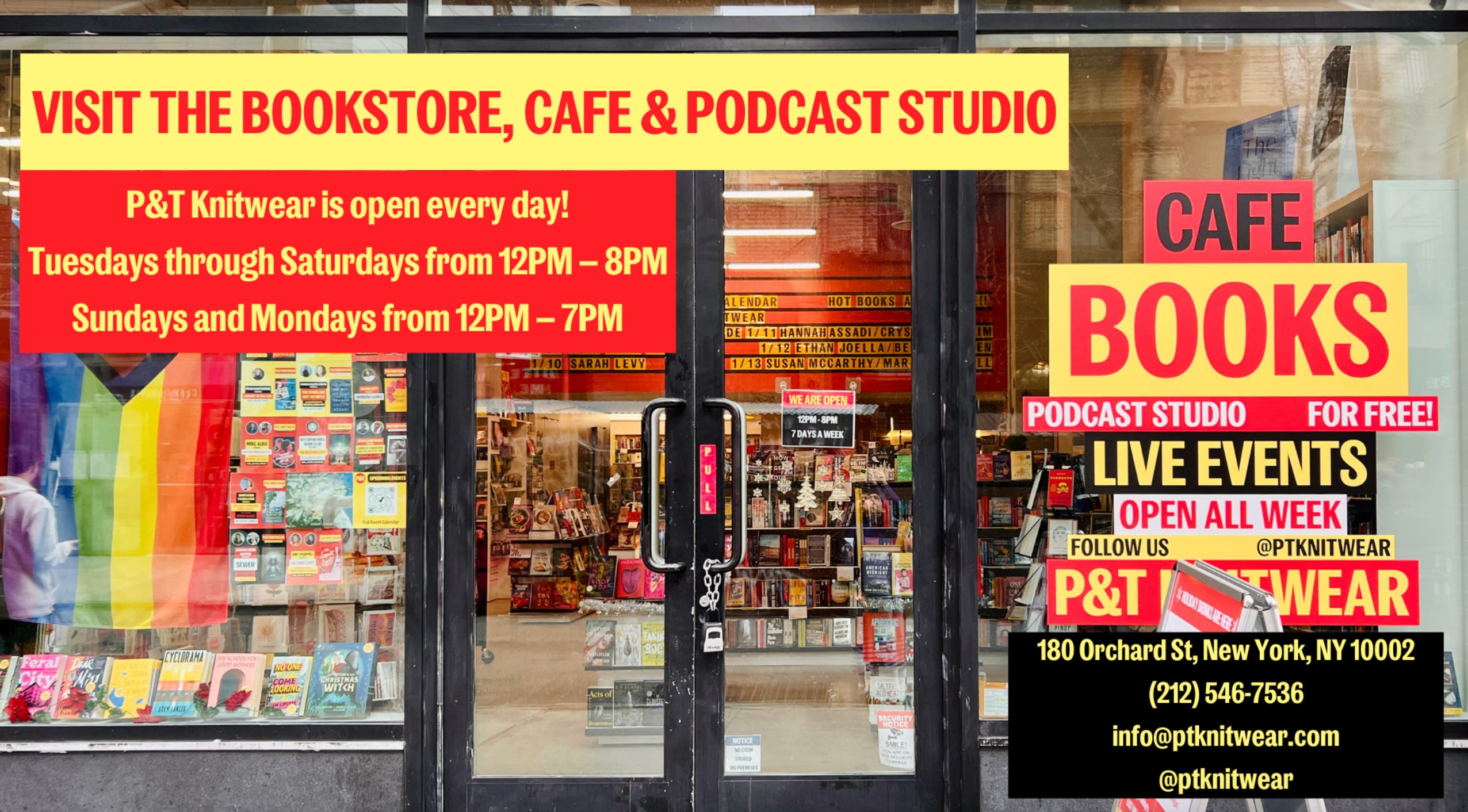
The story of finding abundance with a bookstore: P&T Knitwear, in the Lower East Side.
Bradley Tusk makes the case for the defining question of our time:
“zero-sum vs abundance.”
(in his case: private jets vs passion projects)
It all comes down to 2 proven drivers of human happiness:
1.) Deep, unconditional relationships
2.) Doing things that provide meaning & purpose
Transcript (+clip below):
Bradley: “This is ending up being a far more philosophical podcast than you meant to have, but like arguably I would say the central question of our time is:
zero sum vs abundance.
So there are really 2 fundamental ways to view the world. One would be the everyone’s for themselves, it’s everyone versus everyone, and you just have to get as much as you can in the time that you have without the cost to you being so severe that it outweighs the benefit, right. Which, you know, in some cases means people literally just figure out ways to not get indicted for things or whatever it is, and whoever has the most toys wins, right.
And I think Trump in many ways is the ultimate manifestation of a zero sum mentality, right. You know, he views success and life as: “Who has the most money? Who has the most power? Who has the most influence? Who has the most beautiful woman? Who has the most luxurious airplane? The most gold plating?” Literally whatever it is. He doesn’t ever seem particularly happy to me even though he accumulates more of that at this point combined maybe than anyone, right.
The Abundance Mindset
And the other way would be sort of an abundance mentality, which is we are happier when we are doing things that give us some sense of purpose and meaning.
So, I’ve studied like a ton of happiness science and behavioral economics. Like, I studied behavioral economics when I was in school. And then in my 40s I started studying happiness science, in part because my own life wasn’t that happy at the time and as I was realizing I needed to get a divorce at the same time I was sort of trying to really understand what is it that makes human beings happy.
And there’s really just 2 things, right. It’s relationships where there are people in your life who love and support you unconditionally and you love and support them unconditionally. Doesn’t mean you can’t have disagreements with them or disapprove of something, but fundamentally that’s there. And the things that give you meaning, purpose, right.

The Bookstore Example
So for example, you’ve been to my bookstore.
So I own a bookstore on the Lower East Side of Manhattan. It is a bookstore, it is a podcast studio that anyone in New York can use or anyone wherever can use for free, an event space, and a café. It loses so much money. It is the worst business in all of New York.
However, the way I look at it is I look at how much money do I lose on the bookstore. And it’s, it’s, it’s funny, the other day it came up at lunch with some friends and they like literally gasped. But at the same...
MO: “What is it?”
I mean it’s, I lose around a million bucks a year.
MO: “Oh my gosh.”
Yeah. All in.
But so here’s what I did. I don’t fly private, and yesterday I had a disastrous trip home from San Francisco and probably wish that I hadn’t. But like, mm-hmm, most of the time it’s fine, right. Ninety eight percent of the time, fine.
And I looked at, okay, let’s say that over the course of a year, I travel a lot, right, domestically. If I just flew private instead of flying commercial, what would I spend? And it ended up being about the same amount of money that I lose on the bookstore.
So I was like, okay, this is a great A/B test. Forget about whatever the bookstore does for anybody else. You know, sure, it creates some jobs, people can be... take, put all that aside, right. Just fundamentally, for me, for Bradley, which of these 2 things will make me happier?
P&T Knitwear by Peterson Rich Office


Private Jet vs Bookstore: The A/B Test
Because it’s the ultimate sort of zero sum versus abundance sort of A/B test, right.
So if I spent that money on flying private, what do I get? A little more convenience. Can avoid the TSA line which, with Clear and Pre-Check, is like a minute, right. But sometimes maybe it is 10. And I would find ways to brag to people, sort of like, you know, in a nuanced way, that I flew private, right. And then they probably think I’m a douchebag anyway, right. But nonetheless that’s sort of the upside of flying private.
And the upside of the bookstore: I record my podcast there twice a week. I should plug, it’s called Firewall. If you like this, great podcast, you’ll like that. If you don’t like this, then you’d have to go on without. We have events there all the time. I take meetings there on Fridays usually.
But most of all, do you know what I like about it? People pat me on the head constantly and tell me how wonderful I am because I own a money losing indie bookstore in New York City. And people like bookstores. And I get a lot of validation and affirmation.
So the meaning and purpose I got from the bookstore, not because it does anything for anyone else but simply because if you just said, “Which of these 2 things will make me feel better, people admiring me and praising me because I flew private or people admiring me and praising me because I own a money losing bookstore?”
It is like the ROI is significantly greater on the bookstore, right. Just from a pure selfish standpoint.
The Formula for Happiness
So I would argue that for happiness generation, the 2 things that are proven to be the most effective are:
cultivating and really investing in relationships with people who you really care about and really care about you,
and the things that give you purpose.
So like, for example, I keep a running list of the 50 people at any given moment who kind of matter to me the most. And it evolves a little bit over time. And then usually once a week on the weekend I’ll just run through it. I’ll be like, “Okay, I haven’t talked to so and so in a week or 2 weeks or 3 weeks,” whatever. And I’ll text or I’ll call.
And you know what, no one has ever texted back saying, “Why are you bothering me?” It’s always like, “Hey, great to hear from you.”
And then you have a pleasant exchange that might lead to some sort of plan or it might just be a nice check in or whatever it is, but either way.
And then I try to really look at, look, I am lucky to be at a point in life where I have enough money to do what I want to do, but I also choose not to do certain... I don’t have a big house in the Hamptons, right. I don’t have a plane or boat or anything like that because I invest in stuff that I care about instead.
And I truly believe that I have figured out kind of the formula in many ways to happiness because I effectively just prioritize relationships and purpose ahead of everything else. I still make money. I still need to make money to do the things that I care about, and to further them. But, and I also just like making money and I like being in business, but nonetheless I truly believe that if you can adopt that mentality, your odds of long term sustained happiness are significantly greater.
Applying This to Society
And I think whether or not humanity realizes that, especially in the first world where you don’t have to worry about, you know, again, some people do, but the vast majority of Americans don’t have to worry about, you know, being homeless or don’t have to worry about not having any access to healthcare of any kind, right. At least there’s an emergency room or something.
Assuming that you have the very basics covered, at that point it becomes really a question of maximizing happiness. It becomes a math question. And that ultimately gets to zero sum versus abundance.
And I really think that it is, both on an individual level, the most important question that we can answer for ourselves. And on a societal level, if we want to sort of bring ourselves to extinction in the next 50 or 100 years, zero sum is a great way to do that. If we want to see our children’s children’s children’s children live and thrive, then it’s got to be an abundance approach.
And ultimately to me, that’s what life comes down to.”
Abundance Clip:
P&T Knitwear, as described by Peterson Rich Office (the designers)

“At a time when there are a record number of empty storefronts in Manhattan, P&T Knitwear is designed to be a place of dynamic activity and events, activating Orchard Street and the wider Lower East Side with a new type of space for learning, dialogue, and exchange of ideas.
At its core, P&T is a bookstore. It will display roughly 10,000 volumes, making it the largest independent bookstore in the area. However, the store will also be home to a series of civic spaces, designed to encourage public discourse.
A lecture space with raked seating is set up for readings and symposia. When there are no events, the built-in seating will provide a place to sit, read, and talk. A full service cafe will serve coffee and light foods, further encouraging visitors to stay for a while. A children’s reading space beside the cafe, outfitted with soft seating and custom carpets will serve small children and young adults, providing space for families.
Finally a podcast studio, fit out with the technical and acoustic infrastructure for professional recording is at the front of the store, facing the street through storefront glass, reminiscent of the historic East Village Radio window which once lived a block away, this space will make a public-facing event out of podcast recording and conversations. The podcast studio is available for any number of the public to use, free of charge.
This mix of civic and commercial program will make P&T a place of intellectual activity, day and night, a new focus for intellectual dialogue on the Lower East Side.”
Check out the full coverage from their website: https://www.petersonrichoffice.com/project/p-t-knitwear-bookstore