


Time to Sell Now?
Elad Gil says Most AI Companies Should Sell Now
In the next 12–18 months, many AI companies could hit the highest valuation they’ll ever see.
→ Listen on X, Spotify, YouTube, Apple
A year after our last interview, I sat down with Elad Gil, an investor in SpaceX, OpenAI, Anthropic, Anduril, Perplexity, Harvey, Stripe, Waymo, Long Lake, deel, Cognition & many more, to discuss how radically the AI market has changed, what he got right (& wrong), & where he’s investing next.
With early-stage AI valuations up 10X, Elad explains why investors are treating every company like the next Anthropic, why founders should evaluate acquisition opportunities every six months, & where he still sees opportunities to build massive businesses.
We also cover:
› Elon Musk & the possibility of $100T companies
› The biggest untapped investment opportunities in AI
› Recursive self-improvement & what the frontier labs are seeing
› How to identify generational founders
And somehow, AI psychosis, microplastics, Botox, vaping & OF..
Elad is hiring!!!
𝐓𝐈𝐌𝐄𝐒𝐓𝐀𝐌𝐏𝐒
(00:00) Elad Gil, Founder of Gil Capital
(00:50) Why every diagnosis chart is up and to the right
(06:42) Two companies, zero to $1 trillion
(09:38) Is $1 trillion the new benchmark?
(12:51) 3 people, an idea and a $200M valuation
(15:27) Can SpaceX hit $100 trillion?
(18:19) Beyond the hyperscaler
(19:49) The AI bets that haven't happened yet
(24:07) How Elad spots AI tastemakers
(28:32) How chatbots are rewiring us
(32:20) Reading founders' faces with AI
(35:55) What Elad would do with five years left
(39:10) Are microplastics actually bad for you?
(46:39) How defense stopped being a vice
(49:09) When AI models build themselves
(51:39) Why most AI companies should sell now
(54:23) How to know it's time to sell
(57:56) Why AI talent keeps switching sides
(1:01:48) The founder traits behind Cursor and Cognition
(1:07:29) Why Andreessen and Altman last across cycles
(1:08:57) The next 12 months of AI

Brought to you by:
Brex—The intelligent finance platform: cards, expenses, travel, bill pay, banking—wrapped into a high-performance stack. Built for scale. Trusted by OpenAI, Anthropic, Vercel, Granola, Deepgram, & Sourcery.. teams that move fast AF. visit → brex.com/sourcery

Harvey—The AI platform built for legal work, is helping the best firms and companies close deals faster. More than 200,000 lawyers, 80% of the Am Law 100, and over 20% of the Fortune 500 build with Harvey. Visit: Harvey.ai
Zone—develops next-generation data center campuses, partnering with AI companies, site developers and technology leaders to bring compute online faster and at scale. Visit: zonefrontier.com
Mercor—The human intelligence behind frontier AI. Frontier labs and leading enterprises use Mercor to turn the knowledge of 5M+ experts into the data, evals and benchmarks that make AI better at real work. Visit: http://mercor.com/sourcery
VCX—VCX is the public ticker for private tech, allowing investors of all sizes to invest in venture capital. View The Portfolio at GetVCX.com
Deel—Deel is the global people platform that helps startups hire, manage, pay, and equip anyone, anywhere. Trusted by more than 35,000 fast-growing companies, Deel is the people platform that just works, so teams can scale without the chaos. Visit: deel.com/sourcery
Public—Investing platform Public is the world's first agentic brokerage. You can invest across stocks, options, bonds, crypto, event contracts, & more, then automate anything with AI Agents. Seriously, just tell an Agent what you want—from "Set up a buy-the-close, sell-the-open strategy for me" to "Automatically sweep any cash over $10k from my bank to my brokerage account." Agents can monitor markets, run strategies, & manage your cash 24/7. Get started: public.com/sourcery
Elad Gil on the 12 to 18 Month Window to Sell Your AI Company
Elad Gil joined me for a second annual Sourcery conversation. He covered how Anthropic became a trillion-dollar business in 5 years, seed valuations, how far AI can scale against US GDP, the open categories on his 2021 AI map, recursive self-improvement (‘RSI’), & the case for AI founders to consider selling within the next 12 to 18 months.
→ Listen on X, Spotify, YouTube, Apple
The Multi-Stage Firm Behind OpenAI, Anthropic & Stripe
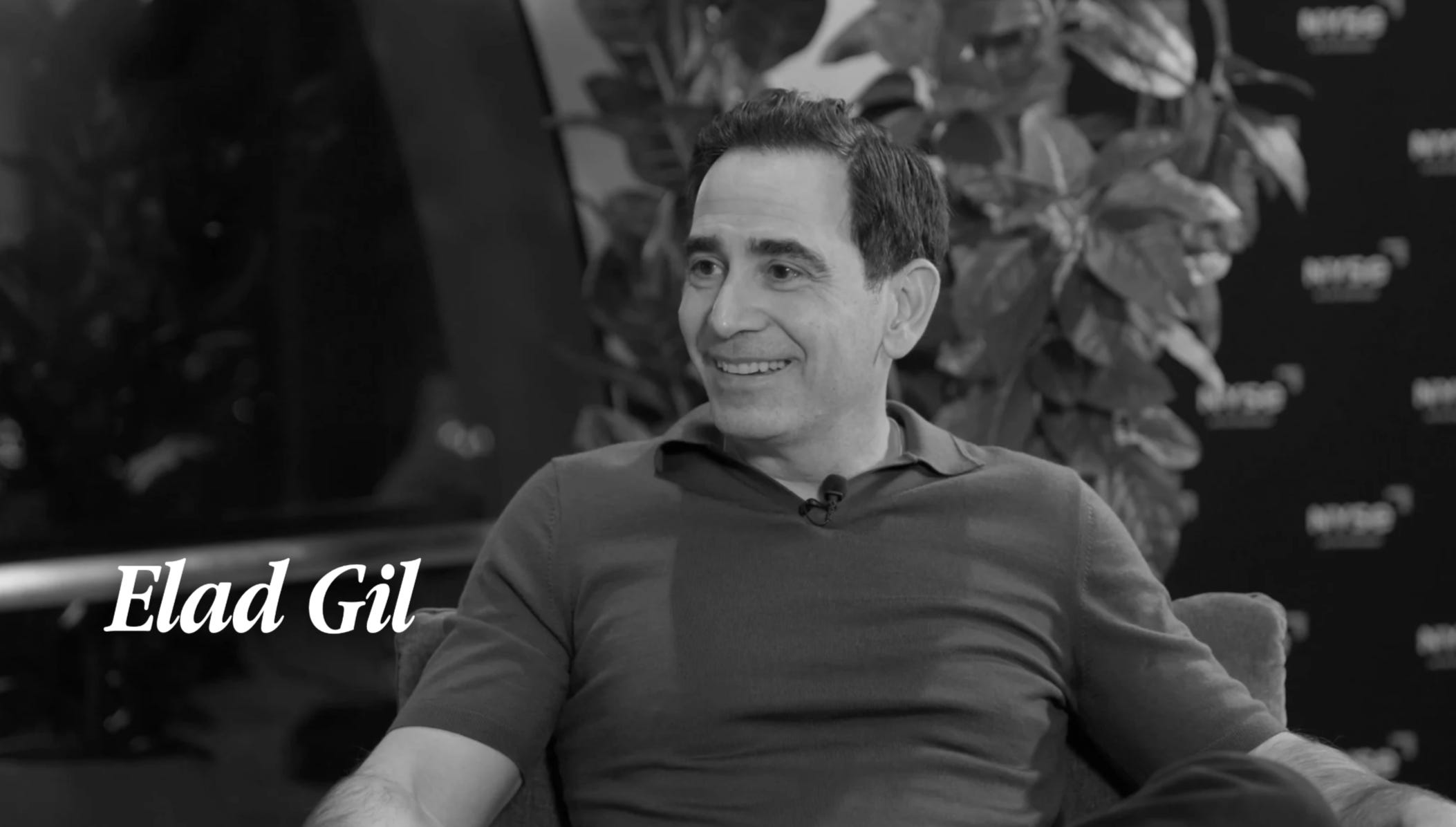
Elad Gil runs Gil&Co / Gil Capital, a multi-stage investment firm. Past investments include Airbnb, Anduril, Anthropic, Applied Intuition, Base Power, Brex, Coinbase, Cognition, Decagon, Deel, Figma, Flexport, GitLab, Gusto, Instacart, Long Lake, Navan, Notion, OpenAI, Opendoor, PagerDuty, Perplexity, Pinterest, Rippling, Samsara, Scale AI, SpaceX, Square, Stripe and Waymo.
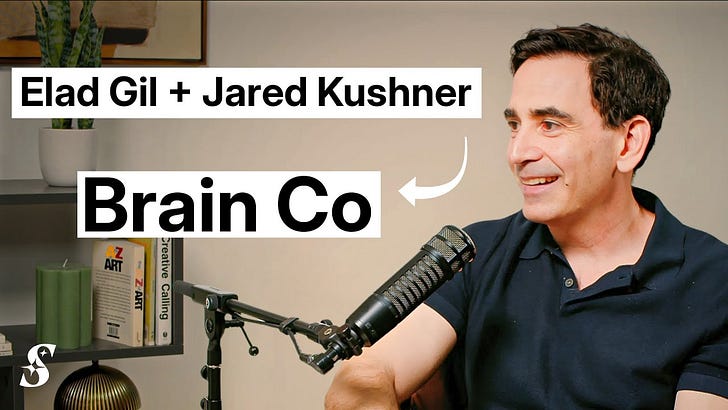
In AI, Gil invested early in or led rounds for Abridge, Anthropic, Braintrust, Brain Co, Cerebras, Character.ai, Cognition, Decagon, Harvey, Long Lake, Mistral, OpenAI, Perplexity and Waymo. He incubated Braintrust, an AI evaluation company, and Brain Co, which builds an AI platform for the world’s largest institutions. He also hosts the AI podcast No Priors.
Gil started Mixer Labs, which Twitter acquired, and Color Health. He served as a VP at Twitter, worked on AI and mobile at Google, and ran AI-focused product orgs at both companies. He wrote High Growth Handbook, a guide for companies after product market fit. In longevity, he is involved with BioAge and NewLimit.

Gil&Co is hiring!!! The firm added several people earlier this year and is preparing its next wave of hires. Gil is looking for people who pursue excellence and are pragmatic about the 80% that gets work done well, who cover a lot of ground, go deep on subjects, and like working on a team.
“We are looking for people who are highly technical, who want to do a mix of really deep thinking about technology, but also commerciality, investment, the business side.”

Anthropic Became a $1T Business in 5 Years
Anthropic was founded in 2021 and is now a trillion-dollar business. OpenAI’s most recent private round values it at $1.25T.
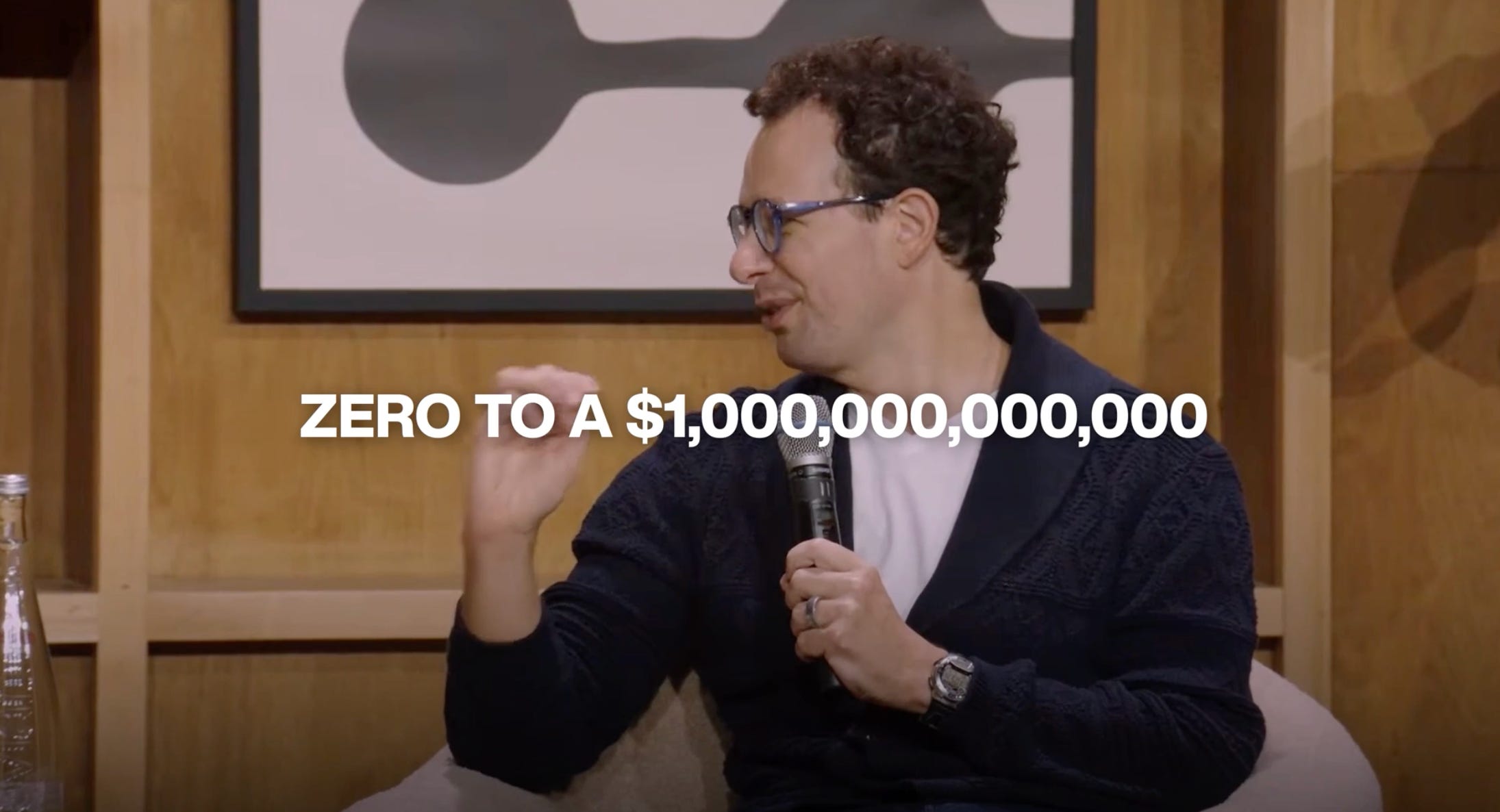
“Over the last 4 or 5 years, we’ve seen 2 companies go from zero to a trillion dollars of market cap from nothing.”
Gil estimates that each year in AI now covers 3 to 5 years of a normal technology cycle. A year earlier, an MIT report estimated that 90% of AI was useless, and articles at the time argued that AI investment lacked ROI. Gil compares the current period to punctuated equilibrium in evolutionary theory, where a burst of new species is followed by consolidation.
“The labs are, say, 6 to 9 months ahead of the average engineer here because they have internal models they’re using, and they’re seeing all sorts of behavior that we’re not seeing yet.”
Gil points to the Claude model released less than a year ago as the start of the coding shift in earnest. It led to the current wave of coding tools and agentic workflows. Inside the labs, agentic swarms now collaborate on software and research.

Seed Rounds Now Price at $100M to $200M
When Gil invested in Perplexity and Harvey in 2022, a typical pre-seed round was $1M at a $10M valuation, or $2M at $20M at the high end. Founders now raise $10M to $20M at $100M to $200M valuations, often with a simultaneous oversubscribed tranche that values the company near $500M.
“They’re raising $10 million, $20 million at $100 to $200 million valuation with 3 people and an idea.”
Gil’s rule of thumb is that high-margin software eventually trades at about 10X revenue. On that basis, a $500M company needs at least $50M of revenue growing at a strong rate, and every $1B of market cap implies $50M to $100M of fast-growing revenue.
“If you have 4-month-old companies raising at a billion dollars, the expectations on those things are extremely high.”
Those valuations work only if a meaningful share of the companies become $100B or trillion-dollar businesses. Around 2011, the largest companies in the world, including ExxonMobil and Apple, were each worth under $500B.
Biology & Materials Need Closed Loops Before They Scale
Many companies in large markets are priced as if they will grow at Anthropic’s pace. Gil separates market size from speed of adoption. Code can be written, tested and fed back into a model within a closed digital loop. Biology and materials science still depend on lab experiments to generate data and confirm predictions.
“Those things are just definitionally going to take longer until you can move everything in silico.”
Gil sees biology as possibly near the point where enough data could bootstrap rapid drug discovery on the biopharmaceutical side. He also expects AI to take over much of semiconductor design, firmware and kernel writing. That would shorten chip design cycles and speed migration onto new chipsets.

A $100T Company Needs $10T of Revenue
At 10X revenue, a $100T market cap requires at least $10T of high-margin revenue. US GDP is in the tens of trillions. Gil can see companies reaching $10T to $20T within a decade or more, depending on how much labor AI models take over or expand.
“$100 trillion of market cap would be like at least $10 trillion of revenue with a high margin.”
Gil’s team estimated that $100B of revenue each at OpenAI and Anthropic would equal roughly 0.5% of US GDP. Adding model spend across inference clouds and the AWS, Azure and GCP hyperscalers brings AI to an estimated 0.5% to 1% of GDP. Data center build-outs now drive a large share of GDP growth, which is a separate measure from AI’s share of total GDP.
Trillion-dollar companies now span semiconductors, NVIDIA, Meta, Google and Eli Lilly, with JPMorgan Chase near $800B to $1T. Gil attributes the expansion to GDP growth, post-COVID inflation, and internet and mobile distribution that reaches billions of users at once.

Cyber, Sales & Accounting Are Still Open on the 2021 Map
Around 2021, Gil’s team mapped the AI stack across data centers and chips, foundation models, infrastructure, and B2B and B2C applications. The resulting investments include OpenAI, a later position in Anthropic, Braintrust as an incubation, Harvey in legal, Cognition in code and Decagon in customer support.
Several categories on the map still lack a breakout AI company, including security, sales enablement, and financial tooling and accounting. The map also anticipated AI-driven roll-ups of services businesses. Gil backed Long Lake, which completed its acquisition of Amex GBT in an all-cash transaction valuing the company at approximately $6.3 billion, and Ithaca.
“One of the biggest mistakes I ever made was assuming that everything’s a monopoly & everything is a single player.”
Gil expects many AI markets to end up as oligopolies, as payments & pharma have, where 3 or 4 providers typically sell the same class of drug. In a compute-constrained environment, no lab can build a training cluster large enough to pull away from the others.

80% to 90% of Lab Code Is Now Written by AI
Inside the model companies, AI now generates 80% to 90% of the code base, and AI suggests a growing share of research experiments. Recursive self-improvement, where each model helps build the next, is one of the long-discussed paths to superintelligence described in Nick Bostrom’s work.
“The strong form of RSI is eventually the models are just building themselves.”
For core research at a lab, most of the cost is now compute. A few hundred researchers produce about 80% of the best ideas. Gil expects compute to go both to those researchers and to AI systems that perform at an equivalent level, with more experiments designed by AI or by AI working alongside people.

The 12 to 18 Month Exit Window
In April, Gil wrote that “founders running successful AI companies should all take a cold, hard look at exiting in the next 12-18 months, which may be a value-maximizing moment for outcomes”. Gil credits Ben Horowitz with the practice of holding one pre-planned board meeting a year on selling the company. For AI companies, Gil puts the right cadence at every 6 months or faster.
“It’s purely your fiduciary duty to ask, ‘Is this the moment in time that maximizes our outcome? And if so, should we sell?’”
Roughly 2,000 companies went public across the 1990s and 2000, and about 2 dozen internet companies from that period remain. Gil saw the same pattern in his own 2020 and 2021 portfolio. Companies that turned down acquisition offers worth hundreds of millions of dollars are now selling at fire-sale prices or shutting down. A handful of companies should never sell. Meta turned down a $1B offer from Yahoo, and Google offered itself to Excite for under $1M in 1999, a deal Excite passed on (!!).
The triggers Gil lists for a sale are:
› A valuation that prices in years of future growth
› A large competitor entering the market
› Founder burnout or conflict between founders
› Access to a buyer’s distribution to billions of users
Common mistakes include picking the highest headline offer over a smaller one from a fast-growing acquirer whose stock could 10X, and leaving before stock vests. Acquired founders with long runs include John Hanke, who joined Google through the Keyhole acquisition and ran Google Maps, and Andy Rubin of Android.


Founders Who Ship Weekly Prototypes
Gil describes 2021 and 2022 as a period when AI founder quality rose after the zero interest rate era. The current market mixes serious builders with opportunistic founders drawn by recent billion-dollar exits. One founder who left xAI told Gil he had underestimated how hard it is to run his own company.
The traits Gil looks for are:
› Competitiveness
› Work ethic
› Sales ability across recruiting, fundraising and first customers
› Concision and technical depth
› Root-cause thinking and product strength
› A strong bias to ship
› Good taste in people
He cites the Cursor, Cognition and Perplexity teams as deep product thinkers.
“If somebody shows up with something built, even if it was just in a week, it’s usually a better sign than somebody who’s just talking about it very articulately.”
When Gil first worked with Aravind Srinivas, Perplexity was a single founder who arrived at each meeting, every 1 to 2 weeks, with a working prototype of whatever they had discussed the week before.
Gil is also studying why some operators last across multiple cycles, including Marc Andreessen from Netscape to a16z, Sam Altman from Loopt to YC to OpenAI, and Patrick Collison with Stripe and the Arc Institute.
→ Listen on X, Spotify, YouTube, Apple
Watch our other episodes!
→ Listen on X, Spotify, YouTube, Apple
→ Listen on X, Spotify, YouTube, Apple
The material presented on Molly O’Shea’s website are my opinions only and are provided for informational purposes and should not be construed as investment advice. It is not a recommendation of, or an offer to sell or solicitation of an offer to buy, any particular security, strategy, or investment product. Any analysis or discussion of investments, sectors or the market generally are based on current information, including from public sources, that I consider reliable, but I do not represent that any research or the information provided is accurate or complete, and it should not be relied on as such. My views and opinions expressed in any website content are current at the time of publication and are subject to change. Past performance is not indicative of future results.
Paid Ad. Agents are an experimental AI tool. Its output may be inaccurate and is not investment advice. Public Holding’s, Inc. makes no guarantees about its accuracy or reliability—verify independently before use. Brokerage accounts & services provided by Open to the Public Investing, Inc. See additional disclosures at: https://public.com/disclosures/agenticdisclosures.