

AI Agents Could Drive 10,000x More Web Activity
Former Twitter CEO & CTO Parag Agrawal predicts AI agents could drive another 5,000–10,000x increase in web usage, fundamentally transforming how the internet operates and makes money.
→ Listen on X, Spotify, YouTube, Apple
Now Founder & CEO of $2 Billion Parallel Web Systems, Parag is building the search infrastructure for an internet where AI agents, not humans, become the primary users. Parallel has raised $230M in total funding from funds like Index Ventures, Kleiner Perkins & Khosla Ventures, building AI-native search infrastructure for customers like: Harvey, Lovable, Granola, Replit, LangChain, Profound, Modal, Notion & Browserbase.
Recorded at Index Ventures in San Francisco (Index co-led the $100M Series A), we discuss the massive GPU demand behind AI search, why traditional advertising and subscription models could break, and how Parallel is developing a new way to compensate content owners as agents replace human browsing.
Parag also explains why the web will shift from reactive to proactive, how he’s scaled Parallel from 30 to 120 employees this year, and lessons from his 11 years at Twitter as engineer, CTO, and CEO.

𝐓𝐈𝐌𝐄𝐒𝐓𝐀𝐌𝐏𝐒
(00:00) Parag Agrawal, Founder & CEO at Parallel
(01:03) What is Parallel AI?
(05:28) Bots took over the web & it’s only the start
(07:22) Will people stick with AI agents?
(11:55) Why models will get bigger, smarter and cheaper
(14:47) Where AI startups actually find GPUs
(19:43) Is 10x a year the new normal?
(21:59) Searching the web faster than you can blink
(26:02) AI that knows what you need before you do
(26:57) Agents are breaking the web’s business model
(31:08) Good bots vs bad bots
(33:45) Agents and the cyber arms race
(37:19) The web’s biggest problem with agents
(42:04) Why great models still give bad answers
(45:13) Parallel built a website for robots?
(47:56) Proactive agents and the future of search
(51:30) The person who drives Parag’s ambition
(55:50) Why feeling insecure is a superpower
Brought to you by:
Brex—The intelligent finance platform: cards, expenses, travel, bill pay, banking—wrapped into a high-performance stack. Built for scale. Trusted by OpenAI, Anthropic, Vercel, Granola, Deepgram, & Sourcery.. teams that move fast AF. visit → brex.com/sourcery

Harvey—The AI platform built for legal work, is helping the best firms and companies close deals faster. More than 200,000 lawyers, 80% of the Am Law 100, and over 20% of the Fortune 500 build with Harvey. Visit: Harvey.ai
Zone—develops next-generation data center campuses, partnering with AI companies, site developers and technology leaders to bring compute online faster and at scale. Visit: zonefrontier.com
Mercor—The human intelligence behind frontier AI. Frontier labs and leading enterprises use Mercor to turn the knowledge of 5M+ experts into the data, evals and benchmarks that make AI better at real work. Visit: http://mercor.com/sourcery
VCX—VCX is the public ticker for private tech, allowing investors of all sizes to invest in venture capital. View The Portfolio at GetVCX.com
Deel—Deel is the global people platform that helps startups hire, manage, pay, and equip anyone, anywhere. Trusted by more than 35,000 fast-growing companies, Deel is the people platform that just works, so teams can scale without the chaos. Visit: deel.com/sourcery
Public—Investing platform Public is the world's first agentic brokerage. You can invest across stocks, options, bonds, crypto, event contracts, & more, then automate anything with AI Agents. Seriously, just tell an Agent what you want—from "Set up a buy-the-close, sell-the-open strategy for me" to "Automatically sweep any cash over $10k from my bank to my brokerage account." Agents can monitor markets, run strategies, & manage your cash 24/7. Get started: public.com/sourcery
Ex-Twitter CEO Parag Agrawal Is Now Building a $2 Billion Web for Agents
Parallel Web Systems Now Powers Search for Browserbase
Parag Agrawal is the Founder and CEO of Parallel Web Systems, which builds web search and research APIs for AI agents. He spent 11 years at Twitter as an engineer, CTO, and CEO. Parallel was founded in 2023 and has raised $230M, most recently a $100M Series B at a $2B valuation in April 2026. Index Ventures co-led the $100M Series A in November 2025 and participated in the Series B. The interview was recorded at Index Ventures’ office in San Francisco.
On the day of recording, Parallel became the default search provider for the Browserbase Search API and Browserbase Agents. Browserbase supplies cloud browsers that agents use to log in, fill out forms, and complete transactions. Parallel supplies the search step that comes before the browser session.
“We now power search in Browserbase, and if you think about every AI agent that people use, what are they doing? They are looking at your internal information, they’re looking at web information.”
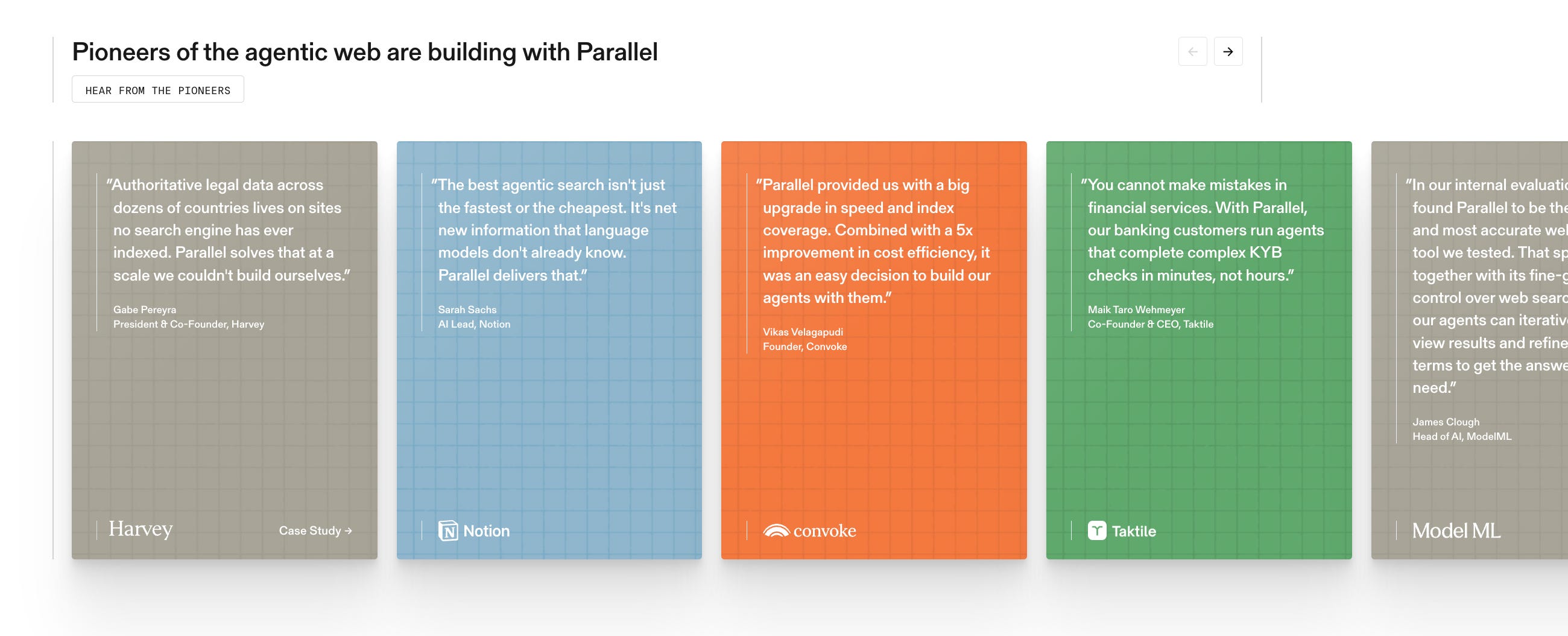
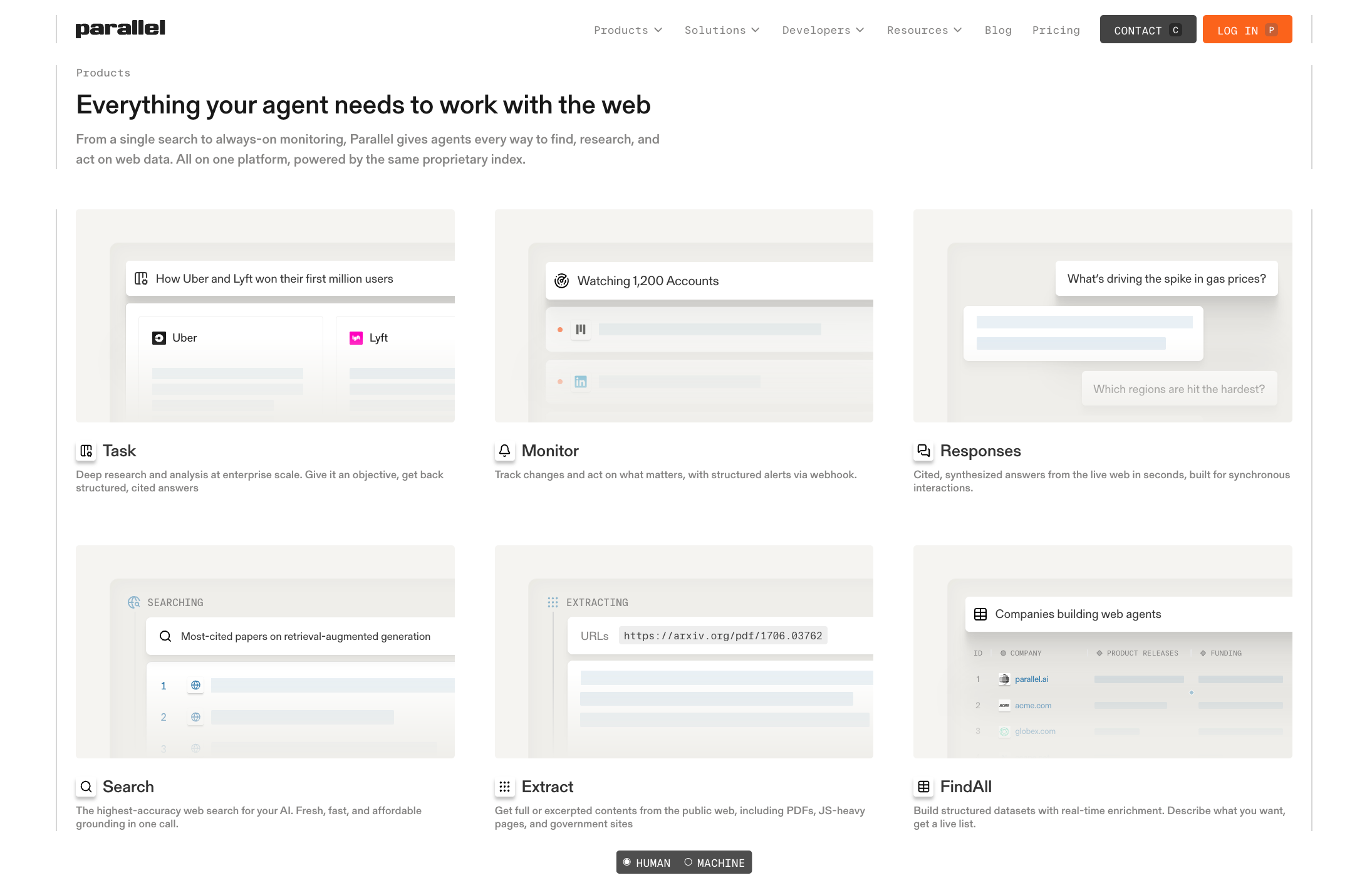
More than 100,000 developers build on Parallel, including teams at Harvey, Notion, Replit, & Rogo. The product suite covers search, extraction, deep research, entity discovery, and continuous monitoring, running on Parallel’s own web-scale index.
→ Listen on X, Spotify, YouTube, Apple

Agents Use the Web at 10% to 20% of Human Levels
Agrawal’s original pitch deck projected that agents would use the web 1,000x more than humans. The deck included a section titled “Are we too early?” He now puts the 1,000x figure on the low end.
An average person runs roughly 10 Google searches a day. The agents Agrawal personally tracks run several thousand per day, putting his own usage near 1,000x. Across the broader market, he estimates agent web usage at a fraction of human levels once crawling for pre-training is separated from agents doing real work.
“My best estimation right now of where we are is agents are using the web 10 to 20% of humans. Which is to say if my 1,000x number is right, we have from here at least 5,000x or 10,000x growth left.”
Agrawal expects the rest of the world to reach his level of usage over the next few years.


1 to 2 GPUs on Search for Every 10 on Inference
Google serves an estimated 10B searches a day on infrastructure built over decades. Agrawal does not expect anyone to build 1,000x that footprint to serve 1,000x the queries. Parallel distills ranking intelligence into progressively smaller models and runs search indexes on GPUs.
“Historically, search was done on CPUs. Memory and CPU bound. Now you get to architect and re-architect search for a price performance band that the world never needed until today.”
The core assumption behind Parallel’s business is a fixed ratio between inference and search compute, holding for both workplace and consumer agents.
“For every 10 GPUs the world spends on model inference, we’ll spend 1 to 2 on web search. That’s the business I’m in.”

GPU Sourcing Runs on Location, Timing, & iMessage
Parallel rents GPUs and has run multiple GPU acquisition fire drills over the last 3 months, calling every hyperscaler and neocloud. The company has not turned away a customer for lack of capacity.
Each request specifies GPU count, acceptable chip types, timing, physical location, and commitment duration. Location is often the binding constraint.
“Sometimes we need GPUs within 5 milliseconds of where our large web index is sitting.”
Agrawal describes the market as functional but inefficient, with much of the early negotiation happening informally.
“You’re figuring out availability on iMessage, and then the finance person calls the finance person, and the paperwork gets done.”


Headcount Grew From 30 to 120 as Enterprises Bought Search Alongside Tokens
Parallel benchmarks its own growth against inference growth for knowledge work and consumer agents, using 10x per year as the working target. Agrawal notes that each prior estimate he made in this market came in too low.
The team grew from about 30 people at the start of the year to roughly 120, driven by a go-to-market team built over the last 3 to 6 months. Parallel had no GTM function at the beginning of the year. Large enterprises increasing their token spend are now buying web search alongside it.
Customers arrive at 3 points. Some find that the search bundled with their model limits output quality, which is how Parallel began working with AI legal, finance, and science companies. Others adopt multiple proprietary or open weight models and need search that works across all of them. A third group runs scaled workloads and wants to reduce end-to-end cost.
“Because our search is so high signal and token efficient, the models do half the number of searches, use up far fewer tokens, end-to-end are cheaper, faster.”
Voice Agents Push Web Search to 150 Milliseconds
Early customers such as Harvey and Notion were building agents for high-stakes work, which pushed Parallel’s systems on quality. Voice agents added a latency requirement. Users briefly accepted voice agents that paused to look something up, and that tolerance lasted about 3 months.
Human web search operated as a 600 to 700 millisecond product end to end. Voice agents require far less.
“Now you gotta be able to search the web in 150 or 200 milliseconds.”
“So now you have to push yourself on the quality dimension, on the cost dimension, and the latency dimension, and you gotta crush all three.”
Agrawal points to ChatGPT, which ran without web search for roughly its first 8 to 9 months. He estimates that turning web search off today would leave 90% of queries unsatisfactory.


Parallel Pays Content Owners Each Time an Agent Reads Their Page
The open web has been monetized through subscriptions, advertising, affiliate links, and transactions, all of which depend on humans clicking from page to page. When agents do the browsing, purchases remain and attention-based revenue disappears.
“If agents are doing this, the buying action still remains. Every other action breaks. So you can’t monetize attention anymore. So ads business model, per seat subscription business models, these things are not durable.”
Parallel has built a model that prices each agent read and pays the content owner, and it is signing partnerships with publishers. Agrawal compares the system to AdSense. The goal is to give content owners a reason to keep their pages open to agents instead of blocking them.
“We built a system which runs a model, not surprising, to compute how much to pay each content owner every time an agent reads their content.”
Agent Identity, Bot Detection, & Defense in Layers
Agrawal separates automated traffic into 3 categories, crawlers, agents acting on behalf of a person or business, and malicious bots. He prefers the word agent for the second group. Bot detection vendors are growing because incentives between agents and websites have not been aligned, which leaves consumer agents like Instinct and Muse blocked from sites their users can access. If those agents declared themselves today, more sites would block them.
His experience with crypto spam and state-sponsored influence campaigns at Twitter informs his view on security. The hardest cases are the ones that cannot be distinguished from real users.
“It is almost impossible to take it to zero. You have to contain it because it is a knife fight, and the tactics change.”
Malicious content on the web can flow directly into an agent’s context through injection attacks. Models have improved on this over the last 2 years, and Parallel filters at its own layer before content reaches the model. Agrawal expects a cyber event of consequence every few weeks, with agents used heavily on both attack and defense.
“This whole world will rely on defense in many, many layers.”


Proactive Agents and a Web That Moves From Pull to Push
Consumer agents including Instinct, Muse, and Dot are always on but still mostly reactive. Agrawal expects the next generation to act on a user’s explicit and implicit needs without being asked. Earlier attempts at proactive products such as Google Alerts and Google Now did not work, and lower costs of intelligence now make the model viable.
“I’ve been out there saying the web will go from pull to push.”
The web contains roughly a trillion pages, many changing daily and most of it junk, and agent-generated SEO content is accelerating the rate of change. Parallel is building systems to prioritize compute toward changes that require action.
“No matter how cheap you make compute, we have not enough compute to compute everything.”
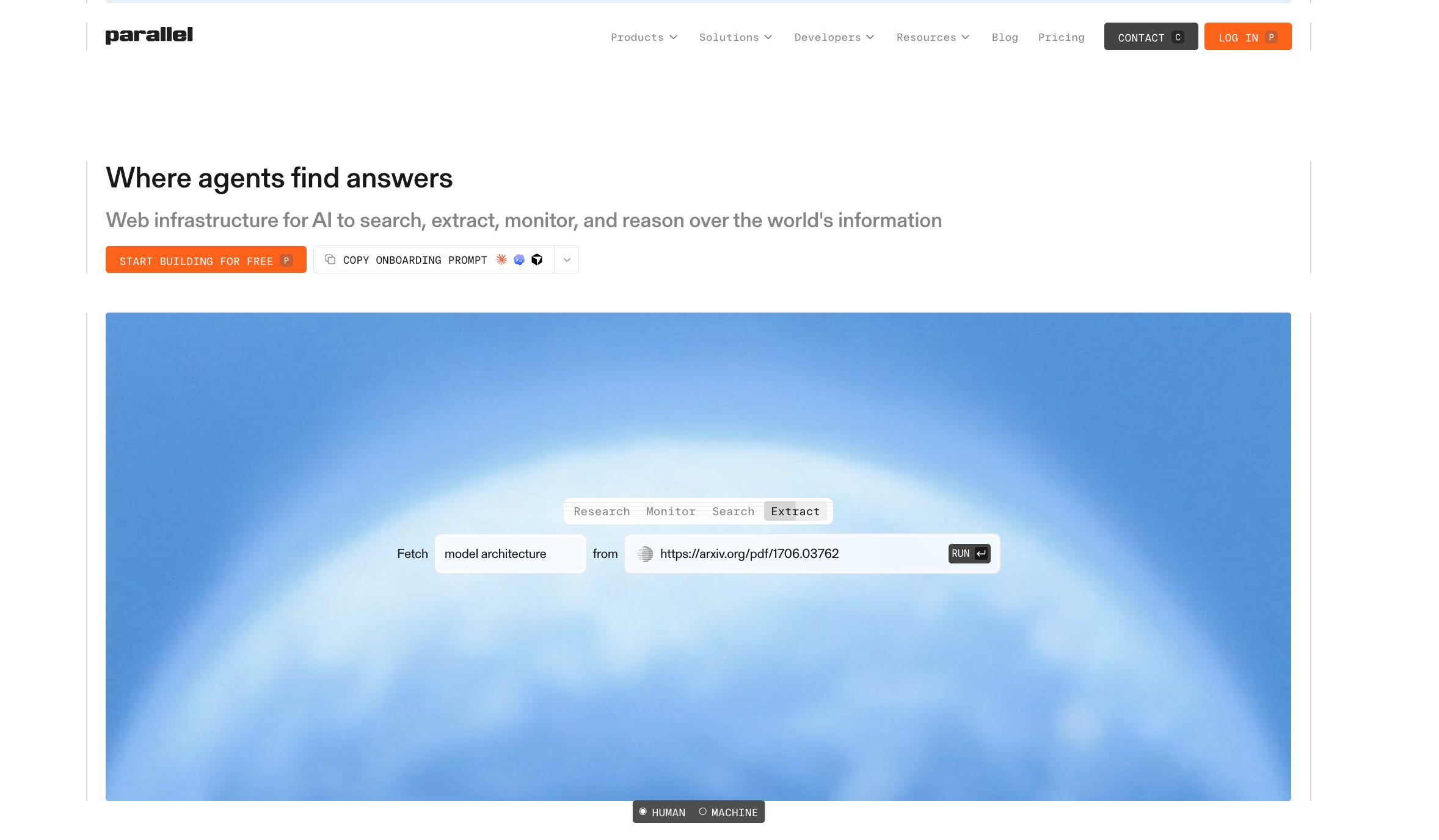
Parallel has designed its own website for agent readers since launch, with a toggle between human and machine versions. Its onboarding assumes a developer working with a coding agent, providing prompts that let the agent set up Parallel while the human authorizes access, adds payment, and accepts terms.

Vercel, Cognition, USV, & Stripe on the Shift to Agent Traffic
Coding agents triggered 3% of deployments on Vercel at the start of 2026 and now trigger 60%. Vercel took 10 years to reach its first 1B deployments and has added 1.5B more in the last 10 months. Vercel also serves AI agents a separate, text-based version of its website and offers the same capability to its customers.
“We started out the year with 3% of deployments on Vercel were coming from coding agents. Now, 60% are agentic.” - Guillermo Rauch, Founder and CEO, Vercel

At Cognition, Devin writes roughly 95% of the company’s own code. Total code shipped inside Cognition grew 7x in 6 months, and customer usage of Devin grew 11x to 12x over the same period.
“We almost exclusively used Devin to build Devin at this point. 95% of the code or something is written by Devin.” - Scott Wu, Co-Founder and CEO, Cognition

Fred Wilson of Union Square Ventures expects every major platform to offer its own agent, with consumers running personal agents that negotiate with platform agents on their behalf. Amazon has blocked Muse from accessing its site. Wilson has also described Google’s traditional search business as being cannibalized by AI and agents, with Gemini as Google’s response. Rebecca Kaden of USV puts consumer AI trial behavior at an all-time high and engagement at an all-time low.
“We do believe that people will want their own agents that represent them as opposed to my Amazon, only having my Amazon agent.” - Fred Wilson, Union Square Ventures

At Browserbase Navigate, Stripe co-founder John Collison asked whether bot detection is still needed once most web traffic comes from agents.
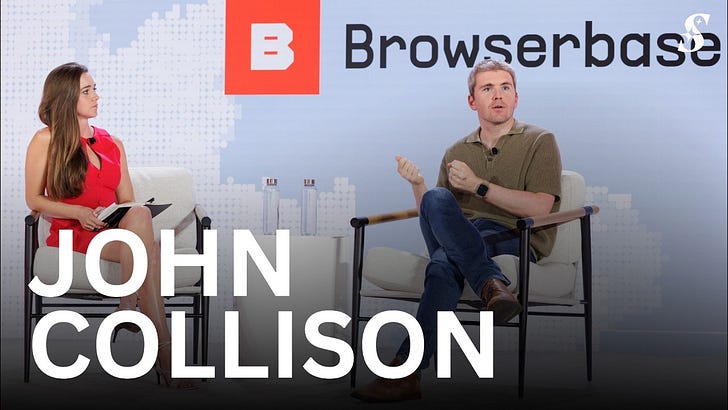
Mike Mignano of USV pointed to email access as a security gap for consumer agents. USV portfolio company Common Fabric builds a sandbox for agent permissions.
“If you give your agent access to your email, which is where all your password reset emails go, they just automatically will be able to access literally every account you own.” - Mike Mignano, Union Square Ventures
→ Listen on X, Spotify, YouTube, Apple

The material presented on Molly O’Shea’s website are my opinions only and are provided for informational purposes and should not be construed as investment advice. It is not a recommendation of, or an offer to sell or solicitation of an offer to buy, any particular security, strategy, or investment product. Any analysis or discussion of investments, sectors or the market generally are based on current information, including from public sources, that I consider reliable, but I do not represent that any research or the information provided is accurate or complete, and it should not be relied on as such. My views and opinions expressed in any website content are current at the time of publication and are subject to change. Past performance is not indicative of future results.
Paid Ad. Agents are an experimental AI tool. Its output may be inaccurate and is not investment advice. Public Holding’s, Inc. makes no guarantees about its accuracy or reliability—verify independently before use. Brokerage accounts & services provided by Open to the Public Investing, Inc. See additional disclosures at: https://public.com/disclosures/agenticdisclosures.